There are many different trees which are used as "Christmas trees" by our culture; everything from pines, to firs, to exotic Southern araucarias are used. But the most stereotypical of christmas trees, the one whose form rather defines what a christmas tree "ought" to look like, and is most aped by the plastic artificial trees many homeowners use, is the spruce genus, Picea. And so, this week, we will look at one of the most successful members of that genus, Picea abies, the Norway Spruce.
It seems fitting, to me, that Spruces should be used as the centerpoint of a celebration that takes place in the dead midnight of the year, when even the hardiest of deciduous trees give up their ghost and prepare for spring, and all but the sempiternal non-migratory birds have fled for warmer climes, taking hosts of retirees and vacationeers with them. For the spruce is a dark tree, and spruce forests always seem to me to have an alien and foreboding air about them. It is in such a place, one thinks, that one might encounter, not merely the ogres and ghosts that people's imaginations have traditionally populated all forests with, but rather with some eldritch Lovecraftian horror from beyond time.
Of course, all this is superstition, just as surely as Santa Claus (no, i do not mean it, my dark masters! i say such things only so that the unconverted may not know of our plans! Iä! Iä! Ph'nglui mglw'nafh Cthulhu R'lyeh wgah'nagl ph'tagn! Iä! Iä!), but I have always thought that Spruce trees had something foreboding and sinister about them. But this is most easily explainable by their shape, for Spruces, members of genus Picea, do have that classic, conical "Christmas Tree" shape. Which is all well and charming when the tree is young, but if, as the tree grows older, the lower branches do not fall off (or are not pruned off), what you will have is a monster, between whose dense boughs one is utterly unable to walk, and who casts a shadow so dense as to make the ground beneath even a fully-clothed maple tree seem bright and sunny. It is a dense mass of hard leaves, hard wood, and hard twigs, and it seems secretive and brooding, aloof and ancient beyond its years.
But moving on from these flights of poetry, how does one identify Picea abies, the Norway Spruce? For Spruces, as a group, are difficult to distinguish from certain relatives of theirs, such as the firs and Douglas-Firs, and so even once one has determined that a given tree is a Spruce, to then proceed to ascertain which kind of spruce it is takes a really keen botanical eye and memory. So, let's begin!
The first thing I always do when I suspect a tree of being a Spruce is examine its needles. Now, in spruces, the needles are attached to the branches by small, wooden pegs, called pulvini (singular pulvinus). Seeing as how an individual Spruce needle has a lifespan of only 4-10 years, then, the branches of a spruce are covered with these rough bumps, allowing one to easily place one's tree squarely within the genus Picea, without even the need to look closely at individual needles, asking "Hmm...is that a pulvinus, or just a lump?".
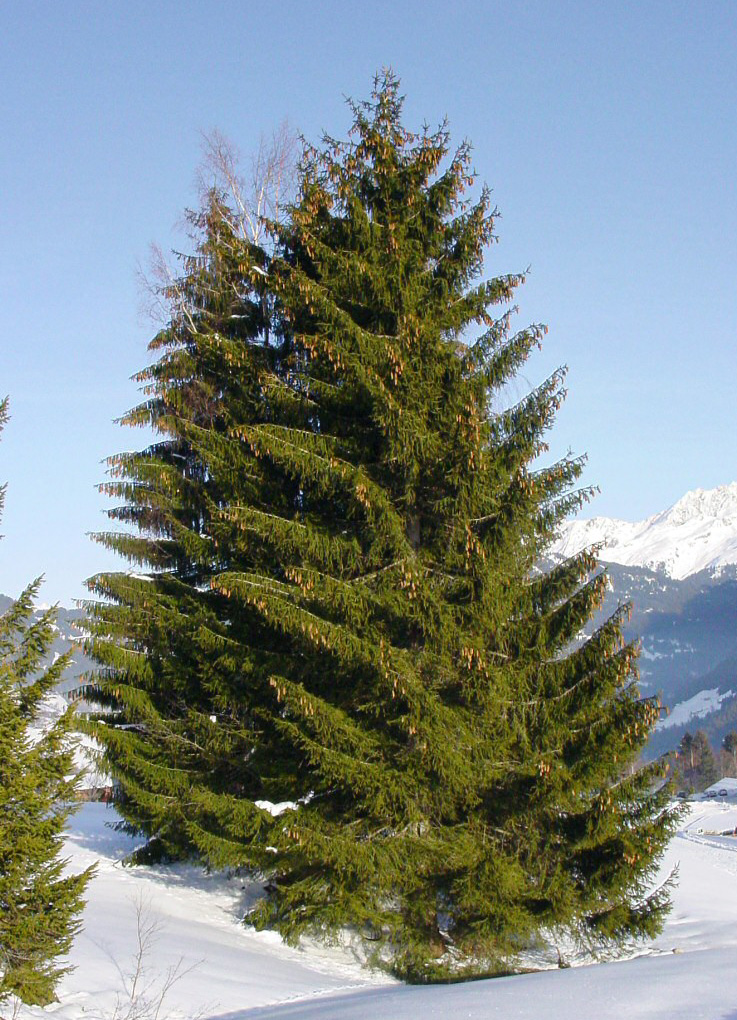
Within the genus, things get trickier, but by the following features can one distinguish one's Picea abies. The Norway Spruce is known for its drooping branches, which make it look as if the tree were but a dead skeleton, and had been draped in wreaths and garlands by mourners. But not all Norway Spruces have this feature; some - especially the trimmed and cropped ones found in well-maintained gardens - have the tighter growth habit that is more stereotypical of the genus.
Returning to the tree's needles, which spiral around their branch in mathematical whorls, they are four-sided and small, typically less than 4/5" in length. They most typically are dark green in color, but P. abies is a rather varied species in this regard, and they can sometimes be lighter.
Contrariwise from their small needles, Norway Spruces have very large cones, much larger than those of most other spruces. These light brown & hairless cones can grow up to 7 or 8 inches in length. Growing downward from the twig (unlike the cones of the true firs, which grow upwards from it), they have numerous diamond-shaped scales that are sharp and pointy, making them great for use as extra armament in a snowball fight.
And of the tree itself? Ignoring these piddling details of identification, what can we say of Picea abies on the whole? Well, as its common name suggests, it is indeed native to the Old World rather than to the New. There, it can be found throughout Eastern europe, from Norway to Poland and the Baltic States to the Balkan highlands to the dark forests of northwestern Russia. It grows in the Carpathian Mountains, in Transylvania, and it is sure that this dark, haunted tree broods around the castle of the infamous Vlad the Impaler, better known in the West as Count Dracula. It grows in those lands most favored by the Romani, and in the homelands of the Vikings. In these ancestral European haunts of P. abies, it is one of the tallest trees around, regularly peeking up to heights of 120 or 130 feet; and the tallest verified specimen, west of Moscow in the Russian Federation, is 160 feet tall. There are, however, unverified reports of giants growing up to 200 feet in height. The dendrological community awaits verification of these with bated breath.
But here in North America, home to so many other giant trees, P. abies does not grow so high, and it normally must be satisfied with a mere 60 or 70 feet. Still, this makes it a respectable forest tree, and there are plenty of individuals who grow taller, whose tops reach some 80 or 90 feet. I do not know why the Western Hemisphere has proven so much less to its liking then the Old Countries; I can think of all manner of superstitious notions to correspond with my fanciful ideas of the genus Picea's association with the Powers of Darkness; but as for reasonable, scientific ideas, I have none.
The Norway Spruce is widely planted here, though, both as an ornamental tree in cities and gardens, and as a harvested tree planted in managed forests. It is grown both for the annual Winter sacrificing of evergreens as "Christmas Trees", and for its wood. In its rôle as the former, it strikes a somewhat paradoxical pose. For, although it is perhaps the most popular Christmas Tree in the world, it is also rather singularly unfitted for that purpose, as it sheds its needles in droves as the tree dries out, making a mess all over one's living room carpet. In timber production this tree, like all spruces, is valued by papermakers, for its straight grains give no impedence to their pulping machines. But despite the numbers of Norway Spruces that have been planted on our continent, it has not become invasive. No, just as the American examples of P. abies are content to reach heights of merely 20 or 30 meters (whoa-pah! ninja units switch!), so are they content to brood in silence, lazily not venturing to conquer more ground than is bequeathed to them by the short-lived Humans who seem to love them so.
Content to brood in silence since 1986,
--mark

_forest_from_Vestfold_county_in_Norway.jpg)




No comments:
Post a Comment