Well, as promised, today I went, with my good friend Mr. Abram, to the Chicago Food Co., a Korean grocer's, at 3333 N. Kimball, and purchased some acorn jelly. The supermarket was a charming place, with all sorts of yummies on display - such as some seaweed, which, whenever I see some for sale, I am sorely tempted to buy, as seaweed is delicious! But, that was not my aim to-day, and so instead I purchased a package of dotorimuk, which Abram quickly found almost as soon as we entered the store.
When we returned to my apartment, we proceeded to look on the intarweb for any recipes we could find. In general, those we located consisted of cold salads, in which the acorn jelly was seasoned with sauces and garnished with lettuce, and requiring foodstuffs that Jane & I do not stock in our apartment. Deciding to taste the damn stuff before reaching any conclusions about what to do with it, we unwrapped it from its package and cut off a couple of slivers to eat. The jelly had a pleasant taste, very slightly salty, and with a mild, but quite distinct, nutty flavor. It reminded me, faintly, of walnuts. Being as gelatinous as it was, it would crumble and melt in one's mouth in a rather interesting way.
After thus having tried the stuff, we pondered in what manner we should use it, and rummaged through the contents of my 'fridge to see what was available. Eventually, what we decided to do (and, to give credit where credit's due, it was mostly Mr. Abram's plan) was to stir fry the dotorimuk in olive oil, with some garlic, ginger, and baby spinach leaves, adding some vinegar-based salad dressing and sugar for flavor afterwards.
I am pleased to report that this concoction tasted pretty damn good. Even though the dotorimuk's flavor isn't terribly strong, and it was surrounded by powerfully-flavored ingredients (like garlic), its nutty note was still unique enough to be detectable in the dish. Abram & I gobbled it down happily, and seeing as how there is plenty of dotorimuk left from the glop we bought, I'll probably be making it again in the future. So, there you go, kids: Acorns are nutritious, and delicious!
Being nutritious and delicious since 1986,
--mark
Sunday, November 18, 2007

Thursday, November 15, 2007
Tree of the Week for Nov. 11th-Nov 18th, 2007: Pyrus calleryana
Whelp, it looks like this week I'm actually posting before the last possible minute. Wünderbar, da?
Winter draweth nigh, my friends; November is halfway over with, and we are only a month away from the Solstice, from the Midnight of the year. Most of the deciduous trees have lost their leaves, and are standing barren and bald for their many months' coma. But, even aside from the evergreen trees, the Pines and Firs and Hollies, there are a few species of trees that, though deciduous, stubbornly hang onto their dangling organs even to this late of a date. Now, O Gentle Readers, you have probably already deduced that this week's Tree, Pyrus calleryana, the Callery Pear, is just such a tree, or else I wouldn't have brought up the subject. And you are quite correct. Indeed, I chose it for this week because, not only has the Callery Pear not lost its leaves yet, but many of the individuals of the species that I have seen around the Chicago Area have not even had their leaves change colors yet.
Those leaves are oval-shaped and have a somewhat glossy tinge. They are some two or three inches in length and are darker in color above than they are below. Long into November do they persist on their branches, slowly changing from their chlorophyll-laden green to their native color, a fiery and flamboyant red, often streaked with gold. But so long do they take to change colors that, should the cold hand of Jack Frost come even a little early, the leaves will die from frostburn before they can all manage to change. This has not happened this year, though, and right now many of the Callery Pears near my apartment are half summer-green and half autumn-red, disrobing themselves slowly over these last weeks of fall.
Pyrus calleryana is by no means a large tree; at the very outside it can grow to sixty feet. Nor is it very long-lived. A Callery Pear should consider itself very lucky indeed if it sees its third decade. It is in some ways because of this smallness of stature and briefness of life that it has gained such favor as an urban tree. In new-built suburban shopping districts and subdivisions, outside of office buildings and industrial parks, along the medians of busy commercial streets: in all of these places does P. calleryana find that a home has been prepared for it by landscape architects and arborists. In these locales, its small size and neat, rounded, symmetrical crown have made it a favorite, for it neither takes up too much space nor does it disrupt the geometrical lines and curves of the modern architect's designs. Furtermore, its short life can be awfully convenient, for should the shopping mall or office complex need to be knocked down to pave the way for new developments, well, what of it? It's not like the little pear tree was going to live much longer anyway.
The tree also has the attraction, for Urban planners, of the magnificent semiannual shows it puts on. For not only does the species burst into the kinds of colors that make transcendentalist poets go into ecstasies every fall, but also in spring does it burst into flower in a most spectacular fashion. These white, five-petaled beauties appear before the leaves have fully unfolded from their buds, giving the tree, for a few short weeks, a charming and fantastic appearence. P. calleryana can also boast of having a reasonable tolerance for poor urban soils, able to withstand both highly compacted and highly loose dirt profiles, surviving acidic earths, and not minding exceedingly dry and exceedingly waterlogged dirts both.
But all of these advantages are not enough, in the eyes of many, to make up for the plant's equally numerous sins. The same symmetry and regularity of form that make it so attractive to some landscapers invite a dismissive scowl from others, and there are many who think it to be horribly over-planted. Furthermore, the tree pays for this geometrical order with a weak structure. The "crotch" angles (look, I'm not making this term up, folks, so don't blame me!) between the branches of many of the most widely planted varieties - including the 'Bradford' Callery Pear, millions of which have been planted across the United States - are extremely narrow, making them highly susceptible to breakage. Skillful pruning can somewhat alleviate the problem, but when a heavy enough thunderstorm or snowstorm comes through town, those branches will break. Other cultivars such as P. calleryana 'Aristocrat' - look at them flowers! - are stronger than the Bradfords, but they can still have problems.
The very popularity of the tree has also put it on the hit list of many environmental groups. Every fall, you see, starting in September and October, P. calleryana produces its pears. These aren't the large, curvy treats we are all familiar with - those come from the related species P. communis - but are rather small, hard balls a centimeter or so in diameter. These fruits are bitter and, to humans, mildly toxic, and are so hard as to be initially inedible to most everything. But they remain attached to the tree through the winter, and the regular frosts of that season will soften them up. After this suitable softening, they become eaten by birds of all sorts, who gobble them up and spread the seeds contained within the fruit through their foeces. P. calleryana is therefore spreading throughout the forests of the Eastern states, as the vast urban stands fruit each fall and have their seeds sown by the ever-helpful beaks of the birds.
This phenomenon has raised many environmentalists' hackles because P. calleryana is not in the least bit native to the U.S. No, the plant is, like so many famous ornamental trees, native to the Far East, to China, Korea, Japan, and northern Vietnam. And so this escape into America's wilderness makes it, in the watchful eyes of the ecologists, a villain of the first rank. In the Southeast, especially, in Maryland, Virginia, Delaware, and the Carolinas, the tree is becoming a real problem, and the National Arbor Day Foundation is no longer offering any variety of P. calleryana for sale. Personally, I am fond of this species. It is a handsome little fellow, and its wide range of colors help to brighten up Urban and Suburband areas. Up close, the well-proportioned leaves and its tangled, intertwining networks of branches give it a pleasing countenance. This being said, there's no way in hell that I'd ever be caught planting one of these in any garden I had control over, unless, of course, that garden were somewhere in the distant Orient.
Taxonomically, P. calleryana is, like all of its fellow pears, in the Rosaceae, the Rose family. The Rosaceae is both one of the largest - with some 3 or 4,000 species world wide - and one of the most taxonomically convuluted families of flowering plants. Traditionally, the family has been subdivided into several sub-families on the basis of fruit structure, but it is currently unsure whether or not these groups are true evolutionary units, and not just mix-ups of similarly seeming but not closely related species. Nevertheless, until more research is done (mm! research!), the genus Pyrus is placed in the sub-family Maloideae, along with the apples and hawthorns.
The Rosaceae as a whole is the family of not only the apples, hawthorns, and pears, but also of the blackberries, strawberries, raspberries, prunes, plums, peaches, almonds, cherries, apricots, and, of course, the Rose itself, most praised of flowers. It is a library of good things, and I have heard the rather charming claim made, by a professor at UIC at that, that while the Poaceae and Fabaceae (the grass and bean families, respectively) make human life possible, it is the Rosaceae that makes life worth living.
Making life worth living since 1986,
--mark
Winter draweth nigh, my friends; November is halfway over with, and we are only a month away from the Solstice, from the Midnight of the year. Most of the deciduous trees have lost their leaves, and are standing barren and bald for their many months' coma. But, even aside from the evergreen trees, the Pines and Firs and Hollies, there are a few species of trees that, though deciduous, stubbornly hang onto their dangling organs even to this late of a date. Now, O Gentle Readers, you have probably already deduced that this week's Tree, Pyrus calleryana, the Callery Pear, is just such a tree, or else I wouldn't have brought up the subject. And you are quite correct. Indeed, I chose it for this week because, not only has the Callery Pear not lost its leaves yet, but many of the individuals of the species that I have seen around the Chicago Area have not even had their leaves change colors yet.
Those leaves are oval-shaped and have a somewhat glossy tinge. They are some two or three inches in length and are darker in color above than they are below. Long into November do they persist on their branches, slowly changing from their chlorophyll-laden green to their native color, a fiery and flamboyant red, often streaked with gold. But so long do they take to change colors that, should the cold hand of Jack Frost come even a little early, the leaves will die from frostburn before they can all manage to change. This has not happened this year, though, and right now many of the Callery Pears near my apartment are half summer-green and half autumn-red, disrobing themselves slowly over these last weeks of fall.


Pyrus calleryana is by no means a large tree; at the very outside it can grow to sixty feet. Nor is it very long-lived. A Callery Pear should consider itself very lucky indeed if it sees its third decade. It is in some ways because of this smallness of stature and briefness of life that it has gained such favor as an urban tree. In new-built suburban shopping districts and subdivisions, outside of office buildings and industrial parks, along the medians of busy commercial streets: in all of these places does P. calleryana find that a home has been prepared for it by landscape architects and arborists. In these locales, its small size and neat, rounded, symmetrical crown have made it a favorite, for it neither takes up too much space nor does it disrupt the geometrical lines and curves of the modern architect's designs. Furtermore, its short life can be awfully convenient, for should the shopping mall or office complex need to be knocked down to pave the way for new developments, well, what of it? It's not like the little pear tree was going to live much longer anyway.

The tree also has the attraction, for Urban planners, of the magnificent semiannual shows it puts on. For not only does the species burst into the kinds of colors that make transcendentalist poets go into ecstasies every fall, but also in spring does it burst into flower in a most spectacular fashion. These white, five-petaled beauties appear before the leaves have fully unfolded from their buds, giving the tree, for a few short weeks, a charming and fantastic appearence. P. calleryana can also boast of having a reasonable tolerance for poor urban soils, able to withstand both highly compacted and highly loose dirt profiles, surviving acidic earths, and not minding exceedingly dry and exceedingly waterlogged dirts both.


But all of these advantages are not enough, in the eyes of many, to make up for the plant's equally numerous sins. The same symmetry and regularity of form that make it so attractive to some landscapers invite a dismissive scowl from others, and there are many who think it to be horribly over-planted. Furthermore, the tree pays for this geometrical order with a weak structure. The "crotch" angles (look, I'm not making this term up, folks, so don't blame me!) between the branches of many of the most widely planted varieties - including the 'Bradford' Callery Pear, millions of which have been planted across the United States - are extremely narrow, making them highly susceptible to breakage. Skillful pruning can somewhat alleviate the problem, but when a heavy enough thunderstorm or snowstorm comes through town, those branches will break. Other cultivars such as P. calleryana 'Aristocrat' - look at them flowers! - are stronger than the Bradfords, but they can still have problems.


The very popularity of the tree has also put it on the hit list of many environmental groups. Every fall, you see, starting in September and October, P. calleryana produces its pears. These aren't the large, curvy treats we are all familiar with - those come from the related species P. communis - but are rather small, hard balls a centimeter or so in diameter. These fruits are bitter and, to humans, mildly toxic, and are so hard as to be initially inedible to most everything. But they remain attached to the tree through the winter, and the regular frosts of that season will soften them up. After this suitable softening, they become eaten by birds of all sorts, who gobble them up and spread the seeds contained within the fruit through their foeces. P. calleryana is therefore spreading throughout the forests of the Eastern states, as the vast urban stands fruit each fall and have their seeds sown by the ever-helpful beaks of the birds.


This phenomenon has raised many environmentalists' hackles because P. calleryana is not in the least bit native to the U.S. No, the plant is, like so many famous ornamental trees, native to the Far East, to China, Korea, Japan, and northern Vietnam. And so this escape into America's wilderness makes it, in the watchful eyes of the ecologists, a villain of the first rank. In the Southeast, especially, in Maryland, Virginia, Delaware, and the Carolinas, the tree is becoming a real problem, and the National Arbor Day Foundation is no longer offering any variety of P. calleryana for sale. Personally, I am fond of this species. It is a handsome little fellow, and its wide range of colors help to brighten up Urban and Suburband areas. Up close, the well-proportioned leaves and its tangled, intertwining networks of branches give it a pleasing countenance. This being said, there's no way in hell that I'd ever be caught planting one of these in any garden I had control over, unless, of course, that garden were somewhere in the distant Orient.
Taxonomically, P. calleryana is, like all of its fellow pears, in the Rosaceae, the Rose family. The Rosaceae is both one of the largest - with some 3 or 4,000 species world wide - and one of the most taxonomically convuluted families of flowering plants. Traditionally, the family has been subdivided into several sub-families on the basis of fruit structure, but it is currently unsure whether or not these groups are true evolutionary units, and not just mix-ups of similarly seeming but not closely related species. Nevertheless, until more research is done (mm! research!), the genus Pyrus is placed in the sub-family Maloideae, along with the apples and hawthorns.
The Rosaceae as a whole is the family of not only the apples, hawthorns, and pears, but also of the blackberries, strawberries, raspberries, prunes, plums, peaches, almonds, cherries, apricots, and, of course, the Rose itself, most praised of flowers. It is a library of good things, and I have heard the rather charming claim made, by a professor at UIC at that, that while the Poaceae and Fabaceae (the grass and bean families, respectively) make human life possible, it is the Rosaceae that makes life worth living.
Making life worth living since 1986,
--mark
Sunday, November 11, 2007
Tree of the Week for Nov. 4th-Nov. 11th, 2007: Quercus macrocarpa
I will be the first to admit that my entry for last week's Tree was poorly written and a little boring. But do not worry, Gentle Readers! This week I have prepared a rhetorical coup, to amaze and astound you all with my eloquent praise of what has to be one of the proudest members of North America's sylva...
It is a common cause for wonderment among the poets that an acorn - a granule whose tininess is proverbial - possesses the ability to, through some strange alchemy, transform itself into an Oak tree - a forest giant famed, contrariwise, for his bigness. This week you shall find yourself reading about this process, for our tree of the week is an oaktree, and I am finally prepared to undergo the strenuous task of discussing that mighty genus Quercus.
I say that talking about Oaks is a strenuous task not because of any personal dislike of oaks, for like all arborists of the Northern hemisphere I love them dearly, but rather because the genus Quercus is a horrible, chaotic taxonomic mess, and will doubtlessly remain that way for as long as there are any oaks at all. Not only does this genus contain more than 120 different species within itself, but also oaks are renowned for their ability to hybridize freely with each other. That is to say that a member of a given species of oak is able, sometimes, to fertilize an oak of a different species, to produce a "mule" whose genes (and therefore whose physical characteristics) are a cross between both parents. But, unlike actual mules (horse/donkey hybrids, as ye all should well know), these hybrid oaks are themselves able to produce progeny; perhaps they might fertilize (or be fertilized by) an oak from one of their parent species, in which case the resulting offspring would be very similar to that parent, but with a few new genomic tricks up its sleeve to enrich the gene pool of that species. Perhaps, though, the hybrid might mate with another similar hybrid, in which case the two tree's children would have the new set of hybridized characteristics; if they continue to breed true with one another, and are distinct enough from either set of parents, then we may here have witnessed the dawning of a new Oak species. But perhaps the hybrid managed to breed with another Oak who is a hybrid of two completely different species; in which case the final product will be an amalgamation of genes and characteristics from four entirely seperate oak species! It is this chaotic genetic mess that makes identifying Oaks so difficult in the wild, and makes Oak specialists as much lovers of genealogies as Englishmen and Hobbits are claimed to be. Sometimes, one can clearly distinguish between one's bur oaks and one's white oaks, or between one's pin oaks and one's scarlet oaks. But othertimes the experienced oak student will stop before a tree and begin to try and figure out from which species its forebears were - and sometimes the list may reach up to a half-dozen species!
Now, those of you with some foreknowledge of the Biological Sciences may be looking on that preceding paragraph with skepticism. For you may know that species are in fact defined as populations of beings who are incapable of mixing genes with (that is, successfully interbreeding with) various other populations of organisms. If this thought did come to your mind, O Gentle Reader, then I congratulate you on your fine scientific brain. But I am afraid that the picture is more complicated than you had been led to suppose. Although the above definition of species works reasonably well for animals, when it is applied to the various other Kingdoms and Domains of Life on Earth, problems occur. Despite their wide variety of odd practices, animals are in fact among the sexually tamest of all Earthlings. To give an example of some of the strange habits common in other organisms, we turn to the most perverted lot of them all: the Bacteria. While, strictly speaking, Bacteria are sexless, in practice they have invented a bewildering wide range of pseudo-sexual behaviors. And I don't merely mean various "positions", such as we canny Humans have invented. No, in their four billion years of existence, they have developed entirely novel sexual mechanisms. It is as if, in addition to the "normal" penile/vaginal sex we humans are capable of, we also could screw by, say, swapping blood, which would cause both partners to become pregnant; and it were also possible for one partner to, with the aid of a certain secretion, change the gender of their partner; and also, instead of simply getting pregnant, the two partners could, after the exchange of genetic information, incorporate the other's genes into their own genome, making each of them a whole new individual combining the physicochemical properties of both their old self and their partner's old self; and that we could have wholly effective sex with creatures as distantly related to us as horses and dandelions! Such is the world that those masters of kink, the Bacteria, regularly inhabit.
But we have strayed quite far from our ostensible topic - Quercus macrocarpa, the mighty Bur Oak of the Middle West - and so I will conclude this digression. Let it be said that the term "species" is not one which admits of a strict definition, nor is it one which can even really be universally applied to the natural world, a fact which has become increasingly apparent to Biologists over the 150 years since Darwin. It is a man-made construct, which is still used because of its practical usefulness. It is true that creatures arrange themselves into populations with various degrees of reproductive isolation from other populations; but the extent of this isolation varies widely across a continuum, and it becomes more difficult to talk about "species" in any really naturalistic and non-arbitrary way the further one moves along this continuum. At one end, there are Humans, Homo Sapiens, who cannot interbreed with even their closest relations, such as the Chimpanzees. And at the other end, there are the Bacteria. Somewhere in the middle of these two extremes lieth Quercus, whose oaken members are isolated from each other by reproductive walls which are, at least, extant, but very porous and of constantly changing positions.
I shall begin, like the poets, with the Bur Oak's acorn. This choice is made for more reasons than simple whimsy, however, for it is by their acorns that one variety of oak can most readily be distinguished from other varieties. This is certainly the case for Q. macrocarpa. Its acorn is very distinctive. It is much larger than the nuts of its fellow oaks - indeed, the tree's specific name, macrocarpa, roughly means "Big Nut" - being some 2-5 cm (1-2 inches) in length, and some 2-4 cm in breadth. Like all acorns, it has a woody cap covering its top. Unlike most acorns, though, the cap of the Bur Oak is more than a simple beret, it is a full-fledged ballroom gown, often ending in an array of frilly fringes.
The acorn is among the most nutritious of nuts, surpassed only by walnuts, about which more in a later entry. They are rich in fats, proteins (8.1% by weight when dried), carbohydrates, and a wide variety of essential vitamins and minerals. Furthermore, Oak trees produce them in huge quantities, ensuring large harvests for those interested. Is it any wonder, then, that they were a staple food for many non-agricultural societies of yore? The aboriginal inhabitants of California took this practice to its greatest limit, depending on a complex and intricate system of arboriculture to keep them fed from the many species of oaks that grow in that land. They were, like Tolkien's Ents, true treeherders. The recent spate of huge wildfires that have caused such tragedy in that country have been in part due to their conquerors' regression to what is, in many ways, a much more primitive level of arboricultural technology.
Modern societies are, of course, primarily dependent on grain and pulse crops for their nutrition. But in Korea, in that Eastern land, one can still find some foodstuffs made from acorn consumed by the populace at large. There, they make a vaguely tofu-like jelly called dotorimuk from the harvested acorns of Korea's many oaks. I plan on, sometime in the next week, going to a Korean grocer's - the internet tells me that there is a good one at 3333 N. Kimball - and there procuring some dotorimuk to sample. I shall, of course, post the results of my inquiry as to the taste of processed acorn flesh.
Before moving on, I must warn you of something, O my Readers. Acorns might be rich in nutrition, but they are also rich in tannins, the bitter compounds which give tea and red wine much of their flavor. And while, in the moderate amounts present in those wildly popular beverages, tannins are really very good for you, with a whole spectrum of health benefits, in larger doses they can be mildly toxic. O don't worry, it would take a large amount indeed before tannins really started to poison you, and the human body is fully capable of dealing with their effects. It's just that the way the human body deals with excesses of tannins is by vomiting, a fact I learned the hard way by drinking an excess of black tea one morning as a youth of some seven or eight years. So while eating acorns raw is possible - and certain species, including the Bur Oak, are less rich in tannins and therefore sweeter and more palatable than others - it is not something I would really advise you to do.
So now that you know all about acorns in general, and how to identify that of a Bur Oak in particular, shall we turn our attention to what happens when one is allowed to become an oak? The answer to this particular rhetorical question is, of course, "Yes". Fix in your mind the image of a Bur Oak acorn. It has been harvested from its parent by a squirrel, that greedy collector of nuts of all sorts. The squirrel, obeying the long custom of its race, buries our acorn into the soil. It does this both so that it might have a ready supply of food through the lean months of the winter, and also so that the groundwater might slowly leach the tannins out of the nut, rendering it tastier to the squirrel's discerning palate. But this squirrel's memory is not acute enough to remember the burial plots of all the hundreds of acorns it so stores away, and so our special acorn is left to its own devices over the winter. Almost immediately, it uses the massive amount of nutrients stored away in its fat body to fuel two growths of opposite directions: one straight up, and one straight down. Its tiny shoot will, come spring, appear above the dirt, announcing to the world the appearance of a new Bur Oak. But of infinitely more immediate importance to this infant tree are the new cells that push downward into the dirt. For they will grow into the mighty taproot which anchors, both literally and metaphorically, all of the rest of the plant.
It anchors the Oak literally in the obvious way, for the tree's native range is the great prairies of the Middle West - it is the State Tree of Iowa - where vast summer thunderstorms and tornadoes are a regular occurrence. And given that oaks are famous for their inflexible response to winds, "breaking but not bending", it is doubly important for one in such an environment to be attached firmly to the brown soil at its feet, lest it be wholly uprooted. This taproot grows very rapidly when the tree is young, sometimes getting the tree four feet closer to the center of the earth by the end of its first year of life. Since the acorn germinates so immediately upon burial in the soil, by the time spring comes around and the first leaves of the tree have unfolded, the root may already have plunged a full half of those four feet downards. According to experiments, even in dense, compacted, clay-heavy soils, the taproot can reach a depth of fifteen feet in just eight years of growth.
This taproot not only tethers the spreading tree to the solid sphere it stands on, it also serves as the "anchor" for an incredibly complex root system which feeds the Oak and which allows it to survive in even the most desperate of conditions, and through the harshest of droughts. Shooting out from this taproot are numerous secondary lateral roots, which themselves branch and network in a vastly intricate fractal pattern. These roots are tremendously strong for being so thin; in an open area, they may spread upwards of 200 feet from the tree's trunk. It is said that the only thing which can halt the outward spread of a Bur Oak's roots are the roots of another Bur Oak. It is for this reason that Q. macrocarpa is such a marvelous success in the open prairies of Illinois. One of the main causes for the worldwide success of grasses is their complicated, highly developed root system, which allows them to grow lush and tall even in comparatively dry soils. Q. macrocarpa is one of the few trees which can compete with grasses on their own turf (a-heh), and therefore has, during the past million years of sporadic glaciations, frequently been on the front lines of the continent-spanning battle between the forests and the prairies. When those everlasting ices of the north advance, both oaks and grasses are pushed so far to the south as to be forced into truce. But when they retreat, as they last did twelve millenia ago (and as they are retreating even further now), and new lands are opened for re-colonization by Flora's fair children, the grasses and forests engage in a mortal contest over ownership of the new lands. In general, in drier conditions, where few trees can find enough water, grasses will prevail, and in wetter conditions, the cool shade of the forest canopy will prevent the spread of grasslands. In this most recent interglacial period, the eastern portion of the continent has become wetter, and Q. macrocarpa has spearheaded the westward march of the great forests. It has been speculated that, had it not been for Humanity, Illinois, the "Prairie State", would now be covered with forests from Lake Michigan to the Mississippi. This is because, for many millenia, the region was inhabited by a people who loved and were dependent on the flora and fauna of the prairie lands, rather than that of the wooded country to the East. So they set regular brush fires, as part of their managerial policy on their vast holdings. Grasses are much abler than their arborial neighbors to re-grow and re-seed after one of these occurrences, and so were leant a helping hand in their ancient struggle.
An adult Bur Oak is more than capable of dealing with the intense heat of a prairie fire. Its ridge-encrusted bark is thick and corky, allowing it to survive through the burning. Furthermore, even if the fire is so strong as to utterly destroy the tree, so long as the root system survives, a Bur Oak is capable of re-sprouting from its base and growing again. But younger seedlings, though fire-resistant, are not as near-invulnerable as their elders, and can be killed by frequent enough fires, preventing the further spread of the species.
But let us assume that our acorn is lucky, and that during its first few decades of life it experiences no fire so utterly unbearable as to destroy it. Soon, then, it will grow into a handsome young tree. And it will be sooner rather than later because, while oaks as a group are very slow-growing trees, inching their way up from the dirt with all the self-assurance that their millenial lifespan entails, a young Bur Oak defies the customs of its tribe. In a good year, our seedling will grow some two or three feet up from the earth, its branches climbing heavenward just as quickly as its roots descend towards hell. These branches will, of course, feature along their length the stereotypical well-lobed oak leaves. These leaves provide good indications to the Tree Fancier that a given Oak is indeed a Bur'd one, for they have certain unique characteristics. Firstly, they are smoothly lobed, rather than sharply lobed. This is a characteristic shared by a wide variety of oaks, but there are equally many who do not share it, so it provides a hint. Furthermore, while they can vary widely in overall shape, normally along their base the leaves are deeply lobed and narrow, while towards their tip they fan out and grow more shallowly lobed, like so.
As the tree passes its second and third decade, enduring whatever hardships its homeland has in store for it, alternately being plunged into freezing darkness, cold, and ice during the winters and burning light, heat, and fire during the summers, its growth slows. Instead of the powerful upwards and downwards leaping of its infancy, it enters into a period of quieter, but surer, growth, as more of its energy begins to go into the production of new acorns, its children. For it takes Q. macrocarpa some several decades to reach sexual maturity, to begin producing flowers. Our little tree is fully hermaphroditic, or "monoecious" in the botanical terminology, and produces both male flowers (the long, green catkins seen in the previous picture), and female flowers, which are small, scaly cups at the base of the leaves. Both sexes of flowers appear in the early Spring, when the leaves are still small, and so, one fine day in Spring, when a young boy's fancy turns to thoughts of Love, our little acorn becomes a Man. And a Woman.
While the Bur Oak produces at least a few acorns every year, it is only once every three or five years that it produces a really large crop. But these crops are not just large, but absolutely enormous. A large example of the race can produce, in one of these years of plenty, up to five thousand acorns. The philosophy behind this massive glut of nuts is the same as that behind the 17-year cycle of the cicada, which we were so fortunate as to witness earlier this year, namely that by producing so many offspring its predators will be simply unable to eat all of them, leaving at least a few to survive and grow.
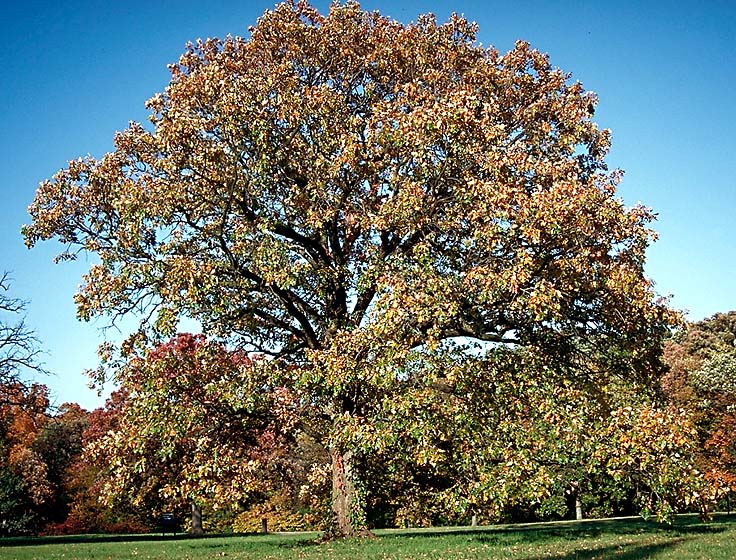
As our little Q. macrocarpa acorn passes into maturity, it may look forward to a long, long life. Bur Oaks are capable of surviving for centuries, and there is little that can kill them. Drought, as previously mentioned, leaves them completely unfazed, as do both heat and cold (indeed, Q. macrocarpa is the northernmost of the New World's oaks in range). Few are the diseases capable of really damaging a Bur Oak, and though it will have many, many encounters with pests and insects, equally few are the ones that pose any serious threat to its continued existence. Tornadoes can, of course, be problematic, as they can be for everything short of a steel-reinforced concrete bunker, but it will take a nearly direct hit to efface a big Oak from its environment. So it will continue its slow growth, sending out huge limbs as thick as many a lesser tree, and spreading its canopy far over the plain. If it is allowed the opportunity, it is capable of truly awe-inspiring proportions, as the National Champion Bur Oak, in Kentucky, shows, with its height of nearly 100 feet, its trunk diameter of 8 feet, and its crown spread of 110 feet. This giant was born sometime in the 16th century, some five hundred years ago, and has strewn its many children, and grandchildren, and great-grandchildren, and great-great-grandchildren, and...etc., all across the center of our continent, and though it is now scarred by lightnings, it yet endures, growing in its slow and steady way.
And so, right now, somewhere near Paris, Kentucky, there is an acorn, the son and daughter both of a Titan, that has just begun to germinate...
Being the son of a Titan since 1986,
--mark
It is a common cause for wonderment among the poets that an acorn - a granule whose tininess is proverbial - possesses the ability to, through some strange alchemy, transform itself into an Oak tree - a forest giant famed, contrariwise, for his bigness. This week you shall find yourself reading about this process, for our tree of the week is an oaktree, and I am finally prepared to undergo the strenuous task of discussing that mighty genus Quercus.
I say that talking about Oaks is a strenuous task not because of any personal dislike of oaks, for like all arborists of the Northern hemisphere I love them dearly, but rather because the genus Quercus is a horrible, chaotic taxonomic mess, and will doubtlessly remain that way for as long as there are any oaks at all. Not only does this genus contain more than 120 different species within itself, but also oaks are renowned for their ability to hybridize freely with each other. That is to say that a member of a given species of oak is able, sometimes, to fertilize an oak of a different species, to produce a "mule" whose genes (and therefore whose physical characteristics) are a cross between both parents. But, unlike actual mules (horse/donkey hybrids, as ye all should well know), these hybrid oaks are themselves able to produce progeny; perhaps they might fertilize (or be fertilized by) an oak from one of their parent species, in which case the resulting offspring would be very similar to that parent, but with a few new genomic tricks up its sleeve to enrich the gene pool of that species. Perhaps, though, the hybrid might mate with another similar hybrid, in which case the two tree's children would have the new set of hybridized characteristics; if they continue to breed true with one another, and are distinct enough from either set of parents, then we may here have witnessed the dawning of a new Oak species. But perhaps the hybrid managed to breed with another Oak who is a hybrid of two completely different species; in which case the final product will be an amalgamation of genes and characteristics from four entirely seperate oak species! It is this chaotic genetic mess that makes identifying Oaks so difficult in the wild, and makes Oak specialists as much lovers of genealogies as Englishmen and Hobbits are claimed to be. Sometimes, one can clearly distinguish between one's bur oaks and one's white oaks, or between one's pin oaks and one's scarlet oaks. But othertimes the experienced oak student will stop before a tree and begin to try and figure out from which species its forebears were - and sometimes the list may reach up to a half-dozen species!
Now, those of you with some foreknowledge of the Biological Sciences may be looking on that preceding paragraph with skepticism. For you may know that species are in fact defined as populations of beings who are incapable of mixing genes with (that is, successfully interbreeding with) various other populations of organisms. If this thought did come to your mind, O Gentle Reader, then I congratulate you on your fine scientific brain. But I am afraid that the picture is more complicated than you had been led to suppose. Although the above definition of species works reasonably well for animals, when it is applied to the various other Kingdoms and Domains of Life on Earth, problems occur. Despite their wide variety of odd practices, animals are in fact among the sexually tamest of all Earthlings. To give an example of some of the strange habits common in other organisms, we turn to the most perverted lot of them all: the Bacteria. While, strictly speaking, Bacteria are sexless, in practice they have invented a bewildering wide range of pseudo-sexual behaviors. And I don't merely mean various "positions", such as we canny Humans have invented. No, in their four billion years of existence, they have developed entirely novel sexual mechanisms. It is as if, in addition to the "normal" penile/vaginal sex we humans are capable of, we also could screw by, say, swapping blood, which would cause both partners to become pregnant; and it were also possible for one partner to, with the aid of a certain secretion, change the gender of their partner; and also, instead of simply getting pregnant, the two partners could, after the exchange of genetic information, incorporate the other's genes into their own genome, making each of them a whole new individual combining the physicochemical properties of both their old self and their partner's old self; and that we could have wholly effective sex with creatures as distantly related to us as horses and dandelions! Such is the world that those masters of kink, the Bacteria, regularly inhabit.
But we have strayed quite far from our ostensible topic - Quercus macrocarpa, the mighty Bur Oak of the Middle West - and so I will conclude this digression. Let it be said that the term "species" is not one which admits of a strict definition, nor is it one which can even really be universally applied to the natural world, a fact which has become increasingly apparent to Biologists over the 150 years since Darwin. It is a man-made construct, which is still used because of its practical usefulness. It is true that creatures arrange themselves into populations with various degrees of reproductive isolation from other populations; but the extent of this isolation varies widely across a continuum, and it becomes more difficult to talk about "species" in any really naturalistic and non-arbitrary way the further one moves along this continuum. At one end, there are Humans, Homo Sapiens, who cannot interbreed with even their closest relations, such as the Chimpanzees. And at the other end, there are the Bacteria. Somewhere in the middle of these two extremes lieth Quercus, whose oaken members are isolated from each other by reproductive walls which are, at least, extant, but very porous and of constantly changing positions.
I shall begin, like the poets, with the Bur Oak's acorn. This choice is made for more reasons than simple whimsy, however, for it is by their acorns that one variety of oak can most readily be distinguished from other varieties. This is certainly the case for Q. macrocarpa. Its acorn is very distinctive. It is much larger than the nuts of its fellow oaks - indeed, the tree's specific name, macrocarpa, roughly means "Big Nut" - being some 2-5 cm (1-2 inches) in length, and some 2-4 cm in breadth. Like all acorns, it has a woody cap covering its top. Unlike most acorns, though, the cap of the Bur Oak is more than a simple beret, it is a full-fledged ballroom gown, often ending in an array of frilly fringes.


The acorn is among the most nutritious of nuts, surpassed only by walnuts, about which more in a later entry. They are rich in fats, proteins (8.1% by weight when dried), carbohydrates, and a wide variety of essential vitamins and minerals. Furthermore, Oak trees produce them in huge quantities, ensuring large harvests for those interested. Is it any wonder, then, that they were a staple food for many non-agricultural societies of yore? The aboriginal inhabitants of California took this practice to its greatest limit, depending on a complex and intricate system of arboriculture to keep them fed from the many species of oaks that grow in that land. They were, like Tolkien's Ents, true treeherders. The recent spate of huge wildfires that have caused such tragedy in that country have been in part due to their conquerors' regression to what is, in many ways, a much more primitive level of arboricultural technology.
Modern societies are, of course, primarily dependent on grain and pulse crops for their nutrition. But in Korea, in that Eastern land, one can still find some foodstuffs made from acorn consumed by the populace at large. There, they make a vaguely tofu-like jelly called dotorimuk from the harvested acorns of Korea's many oaks. I plan on, sometime in the next week, going to a Korean grocer's - the internet tells me that there is a good one at 3333 N. Kimball - and there procuring some dotorimuk to sample. I shall, of course, post the results of my inquiry as to the taste of processed acorn flesh.
Before moving on, I must warn you of something, O my Readers. Acorns might be rich in nutrition, but they are also rich in tannins, the bitter compounds which give tea and red wine much of their flavor. And while, in the moderate amounts present in those wildly popular beverages, tannins are really very good for you, with a whole spectrum of health benefits, in larger doses they can be mildly toxic. O don't worry, it would take a large amount indeed before tannins really started to poison you, and the human body is fully capable of dealing with their effects. It's just that the way the human body deals with excesses of tannins is by vomiting, a fact I learned the hard way by drinking an excess of black tea one morning as a youth of some seven or eight years. So while eating acorns raw is possible - and certain species, including the Bur Oak, are less rich in tannins and therefore sweeter and more palatable than others - it is not something I would really advise you to do.
So now that you know all about acorns in general, and how to identify that of a Bur Oak in particular, shall we turn our attention to what happens when one is allowed to become an oak? The answer to this particular rhetorical question is, of course, "Yes". Fix in your mind the image of a Bur Oak acorn. It has been harvested from its parent by a squirrel, that greedy collector of nuts of all sorts. The squirrel, obeying the long custom of its race, buries our acorn into the soil. It does this both so that it might have a ready supply of food through the lean months of the winter, and also so that the groundwater might slowly leach the tannins out of the nut, rendering it tastier to the squirrel's discerning palate. But this squirrel's memory is not acute enough to remember the burial plots of all the hundreds of acorns it so stores away, and so our special acorn is left to its own devices over the winter. Almost immediately, it uses the massive amount of nutrients stored away in its fat body to fuel two growths of opposite directions: one straight up, and one straight down. Its tiny shoot will, come spring, appear above the dirt, announcing to the world the appearance of a new Bur Oak. But of infinitely more immediate importance to this infant tree are the new cells that push downward into the dirt. For they will grow into the mighty taproot which anchors, both literally and metaphorically, all of the rest of the plant.

It anchors the Oak literally in the obvious way, for the tree's native range is the great prairies of the Middle West - it is the State Tree of Iowa - where vast summer thunderstorms and tornadoes are a regular occurrence. And given that oaks are famous for their inflexible response to winds, "breaking but not bending", it is doubly important for one in such an environment to be attached firmly to the brown soil at its feet, lest it be wholly uprooted. This taproot grows very rapidly when the tree is young, sometimes getting the tree four feet closer to the center of the earth by the end of its first year of life. Since the acorn germinates so immediately upon burial in the soil, by the time spring comes around and the first leaves of the tree have unfolded, the root may already have plunged a full half of those four feet downards. According to experiments, even in dense, compacted, clay-heavy soils, the taproot can reach a depth of fifteen feet in just eight years of growth.

This taproot not only tethers the spreading tree to the solid sphere it stands on, it also serves as the "anchor" for an incredibly complex root system which feeds the Oak and which allows it to survive in even the most desperate of conditions, and through the harshest of droughts. Shooting out from this taproot are numerous secondary lateral roots, which themselves branch and network in a vastly intricate fractal pattern. These roots are tremendously strong for being so thin; in an open area, they may spread upwards of 200 feet from the tree's trunk. It is said that the only thing which can halt the outward spread of a Bur Oak's roots are the roots of another Bur Oak. It is for this reason that Q. macrocarpa is such a marvelous success in the open prairies of Illinois. One of the main causes for the worldwide success of grasses is their complicated, highly developed root system, which allows them to grow lush and tall even in comparatively dry soils. Q. macrocarpa is one of the few trees which can compete with grasses on their own turf (a-heh), and therefore has, during the past million years of sporadic glaciations, frequently been on the front lines of the continent-spanning battle between the forests and the prairies. When those everlasting ices of the north advance, both oaks and grasses are pushed so far to the south as to be forced into truce. But when they retreat, as they last did twelve millenia ago (and as they are retreating even further now), and new lands are opened for re-colonization by Flora's fair children, the grasses and forests engage in a mortal contest over ownership of the new lands. In general, in drier conditions, where few trees can find enough water, grasses will prevail, and in wetter conditions, the cool shade of the forest canopy will prevent the spread of grasslands. In this most recent interglacial period, the eastern portion of the continent has become wetter, and Q. macrocarpa has spearheaded the westward march of the great forests. It has been speculated that, had it not been for Humanity, Illinois, the "Prairie State", would now be covered with forests from Lake Michigan to the Mississippi. This is because, for many millenia, the region was inhabited by a people who loved and were dependent on the flora and fauna of the prairie lands, rather than that of the wooded country to the East. So they set regular brush fires, as part of their managerial policy on their vast holdings. Grasses are much abler than their arborial neighbors to re-grow and re-seed after one of these occurrences, and so were leant a helping hand in their ancient struggle.
An adult Bur Oak is more than capable of dealing with the intense heat of a prairie fire. Its ridge-encrusted bark is thick and corky, allowing it to survive through the burning. Furthermore, even if the fire is so strong as to utterly destroy the tree, so long as the root system survives, a Bur Oak is capable of re-sprouting from its base and growing again. But younger seedlings, though fire-resistant, are not as near-invulnerable as their elders, and can be killed by frequent enough fires, preventing the further spread of the species.

But let us assume that our acorn is lucky, and that during its first few decades of life it experiences no fire so utterly unbearable as to destroy it. Soon, then, it will grow into a handsome young tree. And it will be sooner rather than later because, while oaks as a group are very slow-growing trees, inching their way up from the dirt with all the self-assurance that their millenial lifespan entails, a young Bur Oak defies the customs of its tribe. In a good year, our seedling will grow some two or three feet up from the earth, its branches climbing heavenward just as quickly as its roots descend towards hell. These branches will, of course, feature along their length the stereotypical well-lobed oak leaves. These leaves provide good indications to the Tree Fancier that a given Oak is indeed a Bur'd one, for they have certain unique characteristics. Firstly, they are smoothly lobed, rather than sharply lobed. This is a characteristic shared by a wide variety of oaks, but there are equally many who do not share it, so it provides a hint. Furthermore, while they can vary widely in overall shape, normally along their base the leaves are deeply lobed and narrow, while towards their tip they fan out and grow more shallowly lobed, like so.


As the tree passes its second and third decade, enduring whatever hardships its homeland has in store for it, alternately being plunged into freezing darkness, cold, and ice during the winters and burning light, heat, and fire during the summers, its growth slows. Instead of the powerful upwards and downwards leaping of its infancy, it enters into a period of quieter, but surer, growth, as more of its energy begins to go into the production of new acorns, its children. For it takes Q. macrocarpa some several decades to reach sexual maturity, to begin producing flowers. Our little tree is fully hermaphroditic, or "monoecious" in the botanical terminology, and produces both male flowers (the long, green catkins seen in the previous picture), and female flowers, which are small, scaly cups at the base of the leaves. Both sexes of flowers appear in the early Spring, when the leaves are still small, and so, one fine day in Spring, when a young boy's fancy turns to thoughts of Love, our little acorn becomes a Man. And a Woman.

While the Bur Oak produces at least a few acorns every year, it is only once every three or five years that it produces a really large crop. But these crops are not just large, but absolutely enormous. A large example of the race can produce, in one of these years of plenty, up to five thousand acorns. The philosophy behind this massive glut of nuts is the same as that behind the 17-year cycle of the cicada, which we were so fortunate as to witness earlier this year, namely that by producing so many offspring its predators will be simply unable to eat all of them, leaving at least a few to survive and grow.
As our little Q. macrocarpa acorn passes into maturity, it may look forward to a long, long life. Bur Oaks are capable of surviving for centuries, and there is little that can kill them. Drought, as previously mentioned, leaves them completely unfazed, as do both heat and cold (indeed, Q. macrocarpa is the northernmost of the New World's oaks in range). Few are the diseases capable of really damaging a Bur Oak, and though it will have many, many encounters with pests and insects, equally few are the ones that pose any serious threat to its continued existence. Tornadoes can, of course, be problematic, as they can be for everything short of a steel-reinforced concrete bunker, but it will take a nearly direct hit to efface a big Oak from its environment. So it will continue its slow growth, sending out huge limbs as thick as many a lesser tree, and spreading its canopy far over the plain. If it is allowed the opportunity, it is capable of truly awe-inspiring proportions, as the National Champion Bur Oak, in Kentucky, shows, with its height of nearly 100 feet, its trunk diameter of 8 feet, and its crown spread of 110 feet. This giant was born sometime in the 16th century, some five hundred years ago, and has strewn its many children, and grandchildren, and great-grandchildren, and great-great-grandchildren, and...etc., all across the center of our continent, and though it is now scarred by lightnings, it yet endures, growing in its slow and steady way.


And so, right now, somewhere near Paris, Kentucky, there is an acorn, the son and daughter both of a Titan, that has just begun to germinate...
Being the son of a Titan since 1986,
--mark
Subscribe to:
Posts (Atom)