Friday, December 21, 2007

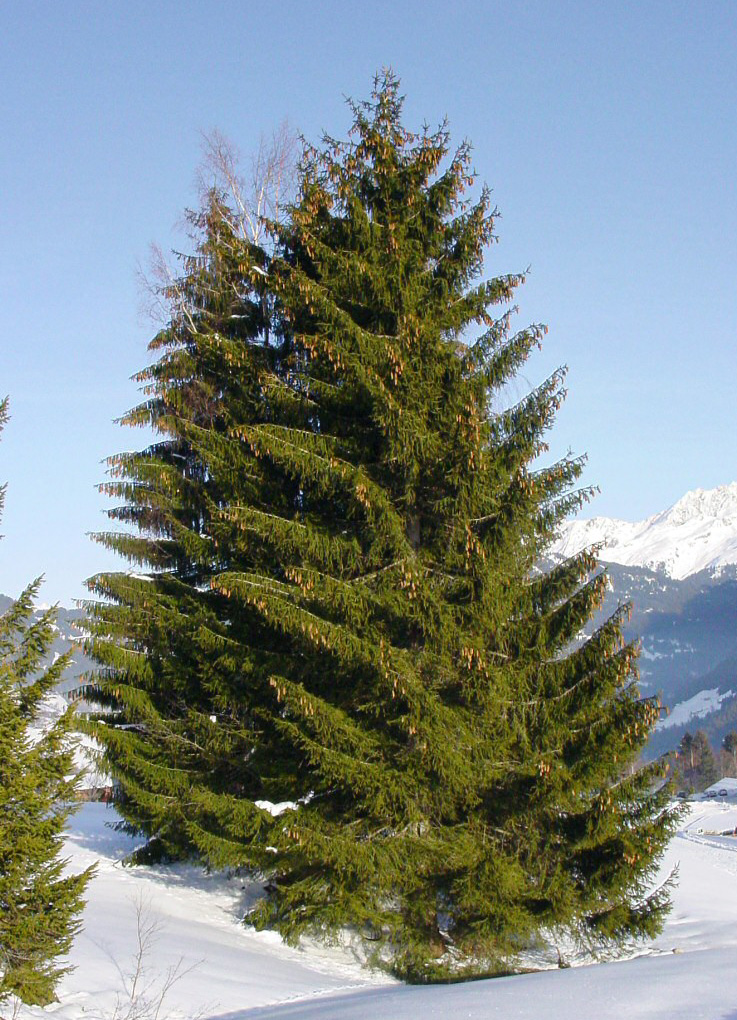
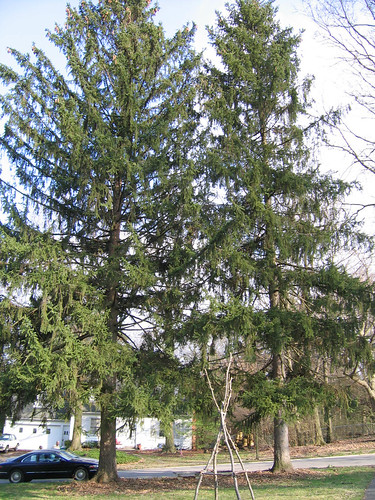
Tree of the Week for Dec. 16th-Dec. 23rd, Picea abies

Well, today is the Midnight of the year, the Winter Solstice. We have not only entered into the night, we are at its middle. The days of light and joy are long behind us, and not even a memory remains. And though light, and spring, and flowers will come again, it shall be many moons before that happens. So come, let us huddle together by our radiators, for warmth, and tell stories of the great northern tree which is held sacred by our society as the ultimate "Christmas Tree".


There are many different trees which are used as "Christmas trees" by our culture; everything from pines, to firs, to exotic Southern araucarias are used. But the most stereotypical of christmas trees, the one whose form rather defines what a christmas tree "ought" to look like, and is most aped by the plastic artificial trees many homeowners use, is the spruce genus, Picea. And so, this week, we will look at one of the most successful members of that genus, Picea abies, the Norway Spruce.

It seems fitting, to me, that Spruces should be used as the centerpoint of a celebration that takes place in the dead midnight of the year, when even the hardiest of deciduous trees give up their ghost and prepare for spring, and all but the sempiternal non-migratory birds have fled for warmer climes, taking hosts of retirees and vacationeers with them. For the spruce is a dark tree, and spruce forests always seem to me to have an alien and foreboding air about them. It is in such a place, one thinks, that one might encounter, not merely the ogres and ghosts that people's imaginations have traditionally populated all forests with, but rather with some eldritch Lovecraftian horror from beyond time.

Of course, all this is superstition, just as surely as Santa Claus (no, i do not mean it, my dark masters! i say such things only so that the unconverted may not know of our plans! Iä! Iä! Ph'nglui mglw'nafh Cthulhu R'lyeh wgah'nagl ph'tagn! Iä! Iä!), but I have always thought that Spruce trees had something foreboding and sinister about them. But this is most easily explainable by their shape, for Spruces, members of genus Picea, do have that classic, conical "Christmas Tree" shape. Which is all well and charming when the tree is young, but if, as the tree grows older, the lower branches do not fall off (or are not pruned off), what you will have is a monster, between whose dense boughs one is utterly unable to walk, and who casts a shadow so dense as to make the ground beneath even a fully-clothed maple tree seem bright and sunny. It is a dense mass of hard leaves, hard wood, and hard twigs, and it seems secretive and brooding, aloof and ancient beyond its years.

But moving on from these flights of poetry, how does one identify Picea abies, the Norway Spruce? For Spruces, as a group, are difficult to distinguish from certain relatives of theirs, such as the firs and Douglas-Firs, and so even once one has determined that a given tree is a Spruce, to then proceed to ascertain which kind of spruce it is takes a really keen botanical eye and memory. So, let's begin!

The first thing I always do when I suspect a tree of being a Spruce is examine its needles. Now, in spruces, the needles are attached to the branches by small, wooden pegs, called pulvini (singular pulvinus). Seeing as how an individual Spruce needle has a lifespan of only 4-10 years, then, the branches of a spruce are covered with these rough bumps, allowing one to easily place one's tree squarely within the genus Picea, without even the need to look closely at individual needles, asking "Hmm...is that a pulvinus, or just a lump?".

Within the genus, things get trickier, but by the following features can one distinguish one's Picea abies. The Norway Spruce is known for its drooping branches, which make it look as if the tree were but a dead skeleton, and had been draped in wreaths and garlands by mourners. But not all Norway Spruces have this feature; some - especially the trimmed and cropped ones found in well-maintained gardens - have the tighter growth habit that is more stereotypical of the genus.

Returning to the tree's needles, which spiral around their branch in mathematical whorls, they are four-sided and small, typically less than 4/5" in length. They most typically are dark green in color, but P. abies is a rather varied species in this regard, and they can sometimes be lighter.

Contrariwise from their small needles, Norway Spruces have very large cones, much larger than those of most other spruces. These light brown & hairless cones can grow up to 7 or 8 inches in length. Growing downward from the twig (unlike the cones of the true firs, which grow upwards from it), they have numerous diamond-shaped scales that are sharp and pointy, making them great for use as extra armament in a snowball fight.

And of the tree itself? Ignoring these piddling details of identification, what can we say of Picea abies on the whole? Well, as its common name suggests, it is indeed native to the Old World rather than to the New. There, it can be found throughout Eastern europe, from Norway to Poland and the Baltic States to the Balkan highlands to the dark forests of northwestern Russia. It grows in the Carpathian Mountains, in Transylvania, and it is sure that this dark, haunted tree broods around the castle of the infamous Vlad the Impaler, better known in the West as Count Dracula. It grows in those lands most favored by the Romani, and in the homelands of the Vikings. In these ancestral European haunts of P. abies, it is one of the tallest trees around, regularly peeking up to heights of 120 or 130 feet; and the tallest verified specimen, west of Moscow in the Russian Federation, is 160 feet tall. There are, however, unverified reports of giants growing up to 200 feet in height. The dendrological community awaits verification of these with bated breath.

But here in North America, home to so many other giant trees, P. abies does not grow so high, and it normally must be satisfied with a mere 60 or 70 feet. Still, this makes it a respectable forest tree, and there are plenty of individuals who grow taller, whose tops reach some 80 or 90 feet. I do not know why the Western Hemisphere has proven so much less to its liking then the Old Countries; I can think of all manner of superstitious notions to correspond with my fanciful ideas of the genus Picea's association with the Powers of Darkness; but as for reasonable, scientific ideas, I have none.

The Norway Spruce is widely planted here, though, both as an ornamental tree in cities and gardens, and as a harvested tree planted in managed forests. It is grown both for the annual Winter sacrificing of evergreens as "Christmas Trees", and for its wood. In its rôle as the former, it strikes a somewhat paradoxical pose. For, although it is perhaps the most popular Christmas Tree in the world, it is also rather singularly unfitted for that purpose, as it sheds its needles in droves as the tree dries out, making a mess all over one's living room carpet. In timber production this tree, like all spruces, is valued by papermakers, for its straight grains give no impedence to their pulping machines. But despite the numbers of Norway Spruces that have been planted on our continent, it has not become invasive. No, just as the American examples of P. abies are content to reach heights of merely 20 or 30 meters (whoa-pah! ninja units switch!), so are they content to brood in silence, lazily not venturing to conquer more ground than is bequeathed to them by the short-lived Humans who seem to love them so.


Content to brood in silence since 1986,
--mark

Wednesday, December 12, 2007

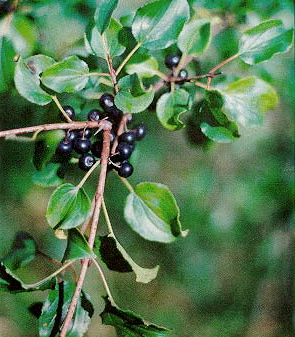
Tree of the Week for Dec. 9th-Dec. 16th, 2007: Rhamnus cathartica

There are weeks when the claim that Chicago lies in a "Temperate" climate zone seems like a bitter joke; this is one of them. But by the hells is all that snow purty! Anyway, I apologize for the extreme lateness of this entry; it was supposed to be for last week, not this one.


Support our Troops, Ladies 'n Gentleman! They are in the midst of terrible battles, fighting an enemy that seems to sprout up irrepressibly no matter how often he is beaten down. It requires the every effort of our noble fighting men and women merely to prevent this enemy from overrunning our entire nation, in the process destroying the beauty of this great Union. The enemy I am referring to is, of course, the European Buckthorn, Rhamnus cathartica, and the soldiers I am speaking of have no connection to the United States Millitary, but rather are the serried ranks of the nation's arborists, horticulturalists, foresters, gardeners, and park rangers, who are, even as I speak, taking advantage of the roominess which the winter season imparts to deciduous forests to hunt down and destroy as many instances of this tree that they can find.

Why this extreme prejudice against this plant? Are we not taught, as followers in Darwin's footsteps, that no organism is intrinsically wicked, but all are merely doing what they can to survive? Aye, we are, and indeed this is one of the dictums to which I have pledged my life. But if we wish to act in the world, and ourselves engage in the battle for survival, rather than merely become spectators doomed to eventual extinction, than we must make value judgements of some sort; we must say that we prefer some eventualities to others, and then act to ensure that the eventualities we prefer come to fruition, whereas those that we dislike remain the province of 'alternate historians' and others in love with the question "What If?" And despite what many with strong opinions, especially in politics and religion, seem to think, it is possible to make such value judgements without condemning those eventualities, or individuals, that we wish to avoid as 'Evil'.

So it is with R. cathartica. There is nothing wrong with the species; indeed, there is much to admire about it, as you will see as this entry progresses, and in its native Eurasia and Africa, it is a valuable part of the ecological community. But here in America, it is an invader, taking over spaces once inhabited by valuable, rare, and beautiful natives, and marginalizing them, putting them at great risk. Therefore, conservationists in this country are quite right to seek it out with chainsaws and axes, slaying it wherever found. For its spread poses a grave threat to the biodiversity of our country and continent.

In appearance, a single buckthorn seems a rather unassuming plant. It is oftentimes more shrubby than tree-like, growing up from several thin, closely clustered "trunks", and seldom growing any taller than twenty feet, though very, very occasionally it will reach thirty feet. Its leaves are similarly plain; they are simple, coming in little pointed ellipses between 1.5 and 3 inches in length. These leaves are finely serrated, and have a simplistic and very regular pattern of leaf veins that is characteristic, and is one of the chief ways that I identify the plant. These leaves have a dark, faded green color, a color which seems almost designed not to attract attention amidst the various other hues, both the brighter and more somber ones, of the forest. But, despite this plainness, there is a certain classical symmetry to the buckthorn's leaves that make them appeal to my aesthetic sense in much the same way as do particularly well-designed pieces of modernist architecture. These leaves persist much longer into autumn and winter than do those of many other deciduous plants, one of the reasons why arborists frequently wait until November or December to hunt them down; for in the midst of the barren woods, a still-clothed buckthorn will stand out in a way that it completely fails to do the rest of the year.

And does it ever produce a lot of those leaves! Buckthorns might not be tall trees, but they can grow very densely, both as single, intricately-twisting shrubs, and as thickets, either of single, spindly plants, or even denser stands of bushy buckthorns. Equally as prodigious as their leaf output is their production of berries. The black, centimeter-wide fruit, poisonous to humans, of R. cathartica cluster thickly on its branches, and remains there long into, or sometimes even all the way through, the winter; another reason why it is more easily identifiable, and therefore easier to engage in "Seek-and-Destroy" missions, during the winter.

Its flowers, appearing greenish-yellow and four-petalled late in the spring, in May and June, are small and unobtrusive, though somewhat pretty in clusters, and give little hint of the plague that they prepare. R. cathartica is dioecious, meaning that male and female flowers appear on seperate plants, though they are indistinguishable to all but the acutest of botanical eyes.

Visually, by far the most interesting part of the European Buckthorn is its bark. Scaly and peeling, it has a rather baroque appearance. I have seen a lone buckthorn, straighter in habit than most of its race, standing all alone like a waymarker near the entrance of a forest preserve, and with its flaky bark it presented a most charming appearance. But rare is the chance one has of catching such an isolated buckthorn, and when they grow in thickets it is rare to catch such a glimpse of this pretty bark amidst the dense growths of branch and leaves! This bark is made even gorgeouser when the tree is wounded, for the tissue underneath can take on a bright orange color, looking like the warning colors of some poisonous insects. Ah! How often is this the case in life, that the gravest dangers come in secret, sneaking up on us all unawares, and giving no hint of the deadly peril they bring! Or some shit like that.

If one is curious as to which properties of the buckthorn's make it such a successful invader, one will find almost all of them listed, incognito, in the general description above. The thickets that it forms create shade so dense that almost nothing can grow beneath them, and these fast-spreading thickets not only stop native plants from appearing underneath, but also slowly edge out those that used to grow around them. And these thickets are, indeed, truly dense. Neighboring shrubs will not stop the spread of their branches until those branches actually come in contact with those of a neighboring plant. This creates an almost completely closed canopy, underneath which, even at noontime on a summer's day, all seems dim and twilit; not optimal growing conditions for any plant.

What allows a thicket of buckthorns to spread even more quickly are their berries, which it produces such a prodigial amount of. Wildlife seems to gobble these things down, thereby effecting their spread, but even those left on the tree will eventually fall to earth, and are likely to germinate thatwise. Fortunately, R. cathartica is unable to spread asexually, by suckers, like dandelions and sumacs can, so we are at least spared that horror, but the rapid growth of individual young buckthorns, when combined with their vast numbers, is damaging enough. And to many arborists, it surely seems as if the buckthorn can spread asexually, for they are tenaciously vital, and able to grow back from trunks cut nearly to the ground.

R. cathartica is also capable of growing on a huge variety of different soil types, further enhancing its ability to spread and conquer. Clay, sand, or chalk; well or poorly-drained; the only thing that the European Buckthorn demands of its soil is that it be none too acidic. And although it grows most vigorously under only light shade, it can withstand much denser shade, allowing it to come to dominate a forest's understory. The long wait which its leaves endure before finally falling, and their early return in the spring, gives the plant a chance to do some light-harvesting at times of year when its neighbors produce only very small amounts of shade.

So why should we care if this species is invading? Is this not the way of evolution, that the "more fit" replace the "less fit"? Bah, I say, bah! As all good evolutionary biologists know, to say that an organism is "fit" does not mean that it is particularly strong, or well-engineered; it just means that it's survived. Take, for example, Canis lupus familiaris, the domesticated dog. Now, I have been assured that, under wild conditions, this sub-species of the wolf would soon become extinct. It is not particularly "fit" in the way most people assume the phrase "Survival of the Fittest" means. And yet, evolutionists would consider it a remarkably "fit" organism. Spread widely across not only the six habitable continents, it is also one of the few species that has occasionally endured on that frozen desert which is our earth's seventh continent. And it has done so by forming a tight, symbiotic relationship with another extremely successful organism, Homo sapiens. The evolutionary features that allow that symbiosis are precisely those which would, in the wild, make the dog horribly "unfit". Like Buddhist sages and Jedi Masters, the dog gains strength through its very weakness.

Having thus dispelled any notion that the European Buckthorn's admittedly wide variety of talents makes it somehow 'moral' or 'right' for it to conquer our continent, let us examine the ecological and, indeed, economic damage that it causes. First, and obviously, it supresses the growth of native understory species in forests via its dense shade and rapid spread. But that shade also kills the saplings of taller trees, preventing regeneration of the forest as a whole; including any valuable timber trees that are present. Also, dead buckthorn leaves decay quickly, and have been showed by scientists to encourage the rapid decay of the rest of the forest litter. It turns out that this actually changes the whole composition of the forest's soil, changing slowly the ecology of the forest in a more subtle, but perhaps more important, way than its shade does - for the chemical changes in the soil have been shown to last for some time even after the removal of the Buckthorn. This rapid decay of forest litter also helps to supress forest fires, and so in forests whose health is dependent on regular forest fires it causes this further damage. R. catharticaalso plays host to several diseases and insects which, though not fatal to it, can cause damage to valuable crops like wheat and soybeans.

And so the nation's forestry professionals take their chainsaws to this Buckthorn species, hoping that they can chop down the thickets faster than they can regrow. But the problem is huge. It has spread all across the nation. On a personal level, I have seen, in the Lyman Woods near where my parents live, huge thickets of R. cathartica strangling the bases of the mighty cottonwoods that stand alone over the marshy areas of the forest, while even vaster monospecific strands lurk underneath the elms and silver maples of the forest proper. So oftentimes they resort to fire, that great purgative. This is, in truth, wise, for the European buckthorn is not a very fire resistant plant, and will succumb utterly to regular enough forest fires. But this strategy is unfeasable in some locations, whether because of nearness to human habitation, or because the forest in question is one composed of trees who are themselves vulnerable to fire. And, of course, "elimination" of buckthorns will always be temporary, because they can always return to locations from which they have been removed in the same way they got there in the first place: via their seeds. But forest management is not a societal function which has any foreseeable end; as long as there are forests, and humans who care about and depend upon them, it will be necessary for humans to coöperate with and put work into those forests. For, despite the prattlings of the Jurassic Park character Ian Malcolm, too much chaos in an ecosystem leads, not to adaptation, but to mass extinction.

Back in its native Old World haunts, R. cathartica is an important enough player in the ecosystem that Linnaeus named its family, the Rhamnaceae, after its genus, Rhamnus. This family, which flourishes primarily in subtropical regions, is not well-known in the Temperate regions whence our American civilization has its chiefest roots. But it does contain some seven or eight hundred known species, mostly shrubs and small trees.


Mostly shrubs and small trees since 1986,
--mark

Saturday, December 1, 2007

Late again, is Mark. He attributes this to the two following unfortunate facts: first, that he's been having a rough couple of weeks; and secondly, that the people whose interne Jane & I have been "borrowing" at our apartment has been either on the fritz, or has been told not to let us "borrow" it anymore. But, anyway, we're in double digits now! Cool, n'est-ce-pas?

Our tree this week is not a plant one oftentimes thinks of as a "tree". Although it is common enough in Urban landscapes, and is indeed a great favorite of the horticultural profession, when we city-slickers see it, it is as likely as not in the form of a mere shrub, forming an elegant hedge wall or framing the walk of some stately home or office-bearing massif.

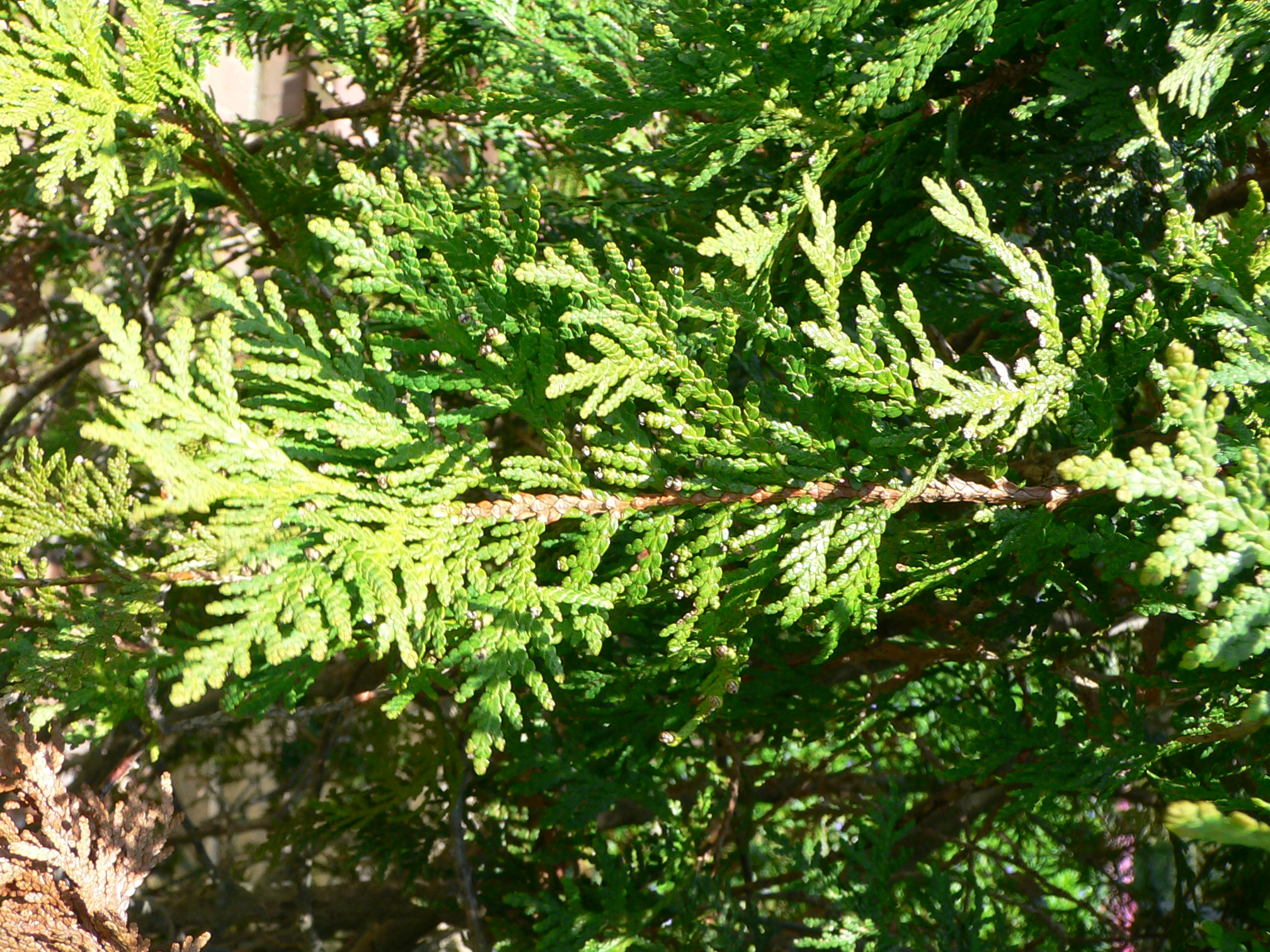
But it in the wilderness, Thuja occidentalis (Thuja is pronounced "Thew-ya", NOT "Thew-ja"), the Eastern Arborvitae, can reach sizes that are more than respectable. The tallest currently known specimen, growing on South Manitou Island in the middle of Lake Michigan, is some 115 feet in height and nearly six feet in diameter. I should add here, for the sake of my own rememberance if nothing else, that next summer, when I take my epic month-long bikeride 'round that great Lake, I am going to have to take the ferry over to South Manitou Island for a "day-trip" to visit the ancient Arborvitae grove where that tree lies.

And when I say "ancient", I do mean it. The oldest living Arborvitae has seen some thousand cyclings of the earth 'round the sun, and stumps of dead arborvitaes have been found that dendochronoligists have calculated as being a millenium and a half in age at their death. I would like to regale you with stories of all the seemingly long lives of Men that can pass in that time, all the epic deeds and great sea-changes of fortune and destiny that humans can witness in such vast stretch of History; but instead of such an anthropocentric fancy, let us instead take a more dendrocentric approach. Consider, not what human deeds can pass in 1500 years, but rather the epic struggles that that tree has had to endure. Imagine the thousands of lightning storms its endured, with those bolts of Zeus far hotter than the surface of the Sun arcing down from the sky towards this tree. Imagine those fifteen hundred winters it saw, enduring cold, bitter cold, without the aid of either shelter or fire, and with neither warm blood in its veins to keep its innrt flame going, nor the blissful hibernation of toads and deciduous trees which bringeth nepenthe and rest. Imagine the numberless droughts it endured, lasting far longer without any water to soothe its thirst than any fragile human could hope to! Imagine its timeless battles with its pestilent predators, the millions of birds, insects, and tearing, biting deer who have feasted on its green succulence for those ages of its life, but all of whom it has out-lived, and laughed at, though it is but an immobile plant and cannot evade their hunger. And imagine its constant exertion, its constant upward and downward growth, building a spire in defiance of all gravity and wind, and cracking the solid, immemorial rocks themselves with its roots as they twine deeper and deeper in their quest food. What could have killed such a thing? Was it humans, whose axes and saws fell it and then mutilated its corpse to serve as the roofing for their dwellings? Was it some lightning bolt which the tree could not evade or survive? Or was it simply old age, simply the slow decay of vitality and life which could now no longer be avoided?

I have no idea, I'm afraid, and, what's more, I fear I am getting quite ahead of myself. I've allowed myself to tell a tale of high drama and storybook legend without first giving any hint of the main character's personality! And though I flatter myself that my friends are intelligent people, capable of deducing much from minimal information, still it would take someone with powers greater than those of Mr. Holmes or M. Dupin to extract much information about Thuja occidentalis from the above rhapsodies.

Worldwide, there are five species within the genus Thuja. There is, of course, T. occidentalis, the species under question, which is native to the Northeastern region of our continent. There is another species, T. plicata, native to the West coast. The other three species are found in the far Orient, in China, Korea, and Japan. As a group, these trees are remarkably easy to distinguish from all other trees. Principally, this is because of their branches, which look as if they've been pressed flat by an iron. These branches are enveloped by the small, scale-like leaves that stick out of them. Arborvitae scales are soft, too, quite unlike the jagged needles produced by various junipers. All that being said, distinguishing between one species of Thuja and another can be a real bitch, as can be distinguishing between Thuja species and those of the related genera Platycladus and Thujopsis, also commonly known as "arborvitaes". Now, in general, in urban areas, the arborvitaes you will be seeing are either going to be Thuja occidentalis, or Platycladus orientalis (formerly known as T. orientalis, but now transferred over to the other genus), one of the Chinese species of arborvitaes. You can tell the difference by a close inspection of the leaves. The scales on T. occidentalis are darker and more tightly attached to their branch than those of P. orientalis, whose leaves are a lighter color and have a greater tendency to 'flare' off from their branches. Furthermore, the leaves of true members of the genus Thuja, unlike those of the related Platycladus, will emit a pleasing odor if crushed. Also, if you will look closely at the pictures I linked to above, you will notice that, on the scales of T. occidentalis, you will note that they have on them a tiny "dot". This dot is a gland of some sort (I confess that I know not what its function is) and is unique to T. occidentalis, allowing it to be distinguished from all other arborvitaes.

Being a coniferous plant, the eastern arborvitae reproduces via its cones, slender, elliptical things just a centimeter or two in length. At this time of year, they are brown, ripe, and mature; earlier in the season, before their final ripening, they wore a bright yellow hue. Though the species be long-lived, they are also precocious, and begin producing sexually mature cones at the age of six years or so. But it is not until they enter their adolescence, at their 75th-odd birthday, that they really start to crank out the seeds.

Now, I know that in my lengthy introduction I may have stated that T. occidentalis can be a mighty tree, streaking up over a hundred feet into the air. Technically, this is true. There do exist such mighty specimens of the species. But that tree is an extreme outlier. In general, this arborvitae is a much more humble plant, growing to maybe forty feet in height. It is a slow-growing tree, as well, oftentimes adding significantly less than a foot to its height over the course of an entire year. It is reasonably shade tolerant, and so can often function as an understory tree; but its slow growth and small height makes it rather thoroughly unable to actually compete in the forest canopy. So, instead of trying to compete against foes it knows it can't beat, T. occidentalis opts instead to play a different game. The arborvitae can be found in all sorts of extreme environments where more traditional trees find themselves completely at a loss. On the edges of swamps and bogs, where the soil oxygen content is low, and water regularly washes away both nutrients and the stabilizing soil, the eastern arborvitae will, if not quite thrive, then certainly at the least survive. And many of the very oldest individuals can be found on the sides of cliffs, as simultaneously tiny, stunted, and ancient as Yoda himself. There, they thrust their roots into rocks, cracking the solid mineral apart in their quest for whatever little food they can find in this demanding habitat. Whipped by fierce, biting winds for which they have no protection, they are lucky to hit the two meter mark. But, though stunted, they endure, and without any competition, and isolated from the depradations of their mortal nemesis, the white-tailed deer, Odocoileus virginianus, they have little to fear from Father Time, and can count themselves un-lucky if they do not live to celebrate their 500th birthday. Making it even more difficult to kill, To. occidentalis can grow back from a stump, and can even send out shoots that grow into new trees, allowing it to reproduce asexually; rare feats for a conifer.

Still, despite its ability to survive in such harsh climes, the favored place of growth of the Eastern Arborvitae is in the rich, cool, and moist but well-drained soils at the southern edge of the great Boreal forests of the North. In that habitat, though, it suffers dearly from its inability to compete with the taller, faster-growing firs, spruces, birches, and maples, and also from its vulnerability to the many ravenous stomachs of the white-tailed deer. During the winter, when the broadleaves have lost their foliage, the soft, feathery fronds (which are great for tickling people with, by the way) of T. occidentalis become immensely appealing to these deer, who strip them from the tree with gusto. Given the skyrocketing deer populations that our nation's often misguided wilderness management policies have fostered, in many areas our Eastern Arborvitae is becoming rarer. Not that it is endangered; as a species, it still does flourish and is at no more risk of becoming extinct than Humanity itself. But just as certain populations of humans may come to risk by the local disasters such as floods, droughts, wars, plague, and famine, so are these Arborvitae clans having to face the Plague of Deer, which is for them a disaster most terrible.

Speaking of Humanity, our two species, Homo sapiens and Thuja occidentalis, have a long history of interaction. When the first explorers ventured onto this continent from their native Kamchatka some 12,000 years ago, they discovered that this plant had a bevy of uses. Its leaves had certain medicinal properties that proved efficacious against some ailments, and its bark and wood, though in many respects weak and flimsy, was found to be easy to work with, lightweight, resistant to rot, and very "tough", and so they used it for structural components in their well crafted birchbark canoes. When the next great wave of colonists came to our shores in the 1500 and 1600s, and brought with them that greatest of all human inventions, Literacy, they recorded their encounters with the tree. It was during the voyages of Jacques Cartier that news of the tree first entered into History. For during the winter of 1835-36, M. Cartier and men of his fellow adventurers grew ill with the Scurvy. They were bleeding from their pores; their gums were sloughing off; they were covered in sores; wounds and fractures they had once thought long-healed would re-open. They were miserable. But, being made of that sturdy stuff which anyone, from any age, who decides to become an Adventurer must be made of, if he wants not to die, they kept on. One of their guides, a man named Domagaya, the son of a chief whose people had lived in that area since time immemorial (immemorial to them, perhaps, although doubtlessly the Arborvitae elders would have a different story to tell) had gotten so sick with the scurvy that they had to leave him behind. They couldn't afford to take him with them any further. Continuing on, they were surprised when, in a few days, they encountered their friend Domagaya, looking as hale and hearty as a Grecian athlete! After first ascertaining that he was, indeed, alive, and not some shade from beyond the grave, they asked him how he came to be healed of his scurvy. He told them that he simply made a tea from the leaves of a certain tree, which his people called "annedda", and drank some of it every day, and the officinal virtue contained therein healed his malady. M. Cartier and his comrades, of course, begged Domagaya to show them this wonderous plant, that they too might be relieved of their agonies through its aid. Domagaya then nonchalantly took them to a stand of Thuja occidentalis, and told them that 'twas from this tree that he obtained the leaves. And by following his advice were Jacques Cartier and his band of Frenchmen healed; for the leaves of this arborvitae are rich in Vitamin C, and therefore are indeed capable of curing the scurvy. It was in honor of this life-saving power that the tree was given the name of 'Arborvitae', meaning "Tree of Life", by European horticulturalists. Should any of my readers decide to try to make their own arborvitae tea, in lieu, perhaps, of a glass of OJ in the morning. I would caution you, though it should be obvious, not to brew it from any arborvitae you find growing in a city, for it doubtlessly has, by accident, incorporated into its vital matter some of the toxins that are commonly found in the urban air and earth.

The story of the intermingling of our two species continues, for the Eastern Arborvitae was among the very first trees from the Westlands that European explorers brought back to their home countries for cultivation. It is known for a fact that the gardens of the burgeoning civilizations of that continent were graced by T. occidentalis' prescence as early as the 1560s. The tree is still loved by gardeners, for its unique lacy foliage, its handsome reddish bark and its neat, slender conical form. Its long life and durability help make it popular, too, for if one plant in a gardener's demesne is easy to take care of, then the gardener will have more time to look after his or her more fragile plants. That same slenderness of form and longevity have also made it perfect for the formation of tall hedges, living screens and walls, and other such formal features which many gardeners (for reasons unbeknownst to this one) so enjoy to play with.

Now that you've been formally introduced to T. occidentalis, you can perhaps better appreciate my earlier anecdotes. And, being well-bred individuals all, you probably are now wondering about the lineage from which T. occidentalis has sprung. Allow me to assure you that it comes from a truly noble family; indeed, there are many who would rank its family as the noblest in all the Plant kingdom. That family is the Cupressaceae, the Cypress family. While I said several weeks ago, in my report on Pseudotsuga menziesii, the Douglas-Fir, that the Pinaceae is the coniferous family which has best survived during the past 90 million years of flowering plants, the Cupressaceae must be a close second. And indeed, though the Pinaceae might contain more species, it is purely Northern in its habitat, whereas the Cupressaceae, as befitting such a distinguished lineage, is more cosmopolitan, and can be found growing natively on all continents, save Antarctica. It can count among its members not only the arborvitae, but also such plants as the Junipers, the Cypresses, the Japanese Sugi tree, the massive (and long-living!) Fitzroya of South America, and the strangely beautiful Chamaecyparis.

But, though these are all excellent trees, it is not they who confer on the Cupressaceae their high status. Indeed, it was not until recent times, and the advent of molecular and genetic taxonomy, that it was understood just how exalted a group the Cupressaceae was. For those studies proved that the Taxodiaceae, the Bald-Cypress family, could not be considered as a true monophyletic group, seperate from the Cupressaceae; and that any reasonable evolutionary definition of the Cupressaceae would have to include the Taxodiaceae, as this handy diagram from Wikipedia clearly shows. And the Taxodiaceae, in addition to the magnificent Bald-Cypress, also includes such blue-blooded royals as Sequoia sempervirens, the Coastal Redwood, and Sequoiadendron giganteum, the Giant Sequoia. Now folded in to the new Cupressaceae, they add into an already aristocratic family the blood...er, the sap, anyway...of Emperors.

Containing the sap of emperors since 1986,
--mark

Sunday, November 18, 2007

Dotorimuk!

Well, as promised, today I went, with my good friend Mr. Abram, to the Chicago Food Co., a Korean grocer's, at 3333 N. Kimball, and purchased some acorn jelly. The supermarket was a charming place, with all sorts of yummies on display - such as some seaweed, which, whenever I see some for sale, I am sorely tempted to buy, as seaweed is delicious! But, that was not my aim to-day, and so instead I purchased a package of dotorimuk, which Abram quickly found almost as soon as we entered the store.

When we returned to my apartment, we proceeded to look on the intarweb for any recipes we could find. In general, those we located consisted of cold salads, in which the acorn jelly was seasoned with sauces and garnished with lettuce, and requiring foodstuffs that Jane & I do not stock in our apartment. Deciding to taste the damn stuff before reaching any conclusions about what to do with it, we unwrapped it from its package and cut off a couple of slivers to eat. The jelly had a pleasant taste, very slightly salty, and with a mild, but quite distinct, nutty flavor. It reminded me, faintly, of walnuts. Being as gelatinous as it was, it would crumble and melt in one's mouth in a rather interesting way.

After thus having tried the stuff, we pondered in what manner we should use it, and rummaged through the contents of my 'fridge to see what was available. Eventually, what we decided to do (and, to give credit where credit's due, it was mostly Mr. Abram's plan) was to stir fry the dotorimuk in olive oil, with some garlic, ginger, and baby spinach leaves, adding some vinegar-based salad dressing and sugar for flavor afterwards.

I am pleased to report that this concoction tasted pretty damn good. Even though the dotorimuk's flavor isn't terribly strong, and it was surrounded by powerfully-flavored ingredients (like garlic), its nutty note was still unique enough to be detectable in the dish. Abram & I gobbled it down happily, and seeing as how there is plenty of dotorimuk left from the glop we bought, I'll probably be making it again in the future. So, there you go, kids: Acorns are nutritious, and delicious!

Being nutritious and delicious since 1986,
--mark

Thursday, November 15, 2007

Tree of the Week for Nov. 11th-Nov 18th, 2007: Pyrus calleryana

Whelp, it looks like this week I'm actually posting before the last possible minute. Wünderbar, da?


Winter draweth nigh, my friends; November is halfway over with, and we are only a month away from the Solstice, from the Midnight of the year. Most of the deciduous trees have lost their leaves, and are standing barren and bald for their many months' coma. But, even aside from the evergreen trees, the Pines and Firs and Hollies, there are a few species of trees that, though deciduous, stubbornly hang onto their dangling organs even to this late of a date. Now, O Gentle Readers, you have probably already deduced that this week's Tree, Pyrus calleryana, the Callery Pear, is just such a tree, or else I wouldn't have brought up the subject. And you are quite correct. Indeed, I chose it for this week because, not only has the Callery Pear not lost its leaves yet, but many of the individuals of the species that I have seen around the Chicago Area have not even had their leaves change colors yet.

Those leaves are oval-shaped and have a somewhat glossy tinge. They are some two or three inches in length and are darker in color above than they are below. Long into November do they persist on their branches, slowly changing from their chlorophyll-laden green to their native color, a fiery and flamboyant red, often streaked with gold. But so long do they take to change colors that, should the cold hand of Jack Frost come even a little early, the leaves will die from frostburn before they can all manage to change. This has not happened this year, though, and right now many of the Callery Pears near my apartment are half summer-green and half autumn-red, disrobing themselves slowly over these last weeks of fall.

Pyrus calleryana is by no means a large tree; at the very outside it can grow to sixty feet. Nor is it very long-lived. A Callery Pear should consider itself very lucky indeed if it sees its third decade. It is in some ways because of this smallness of stature and briefness of life that it has gained such favor as an urban tree. In new-built suburban shopping districts and subdivisions, outside of office buildings and industrial parks, along the medians of busy commercial streets: in all of these places does P. calleryana find that a home has been prepared for it by landscape architects and arborists. In these locales, its small size and neat, rounded, symmetrical crown have made it a favorite, for it neither takes up too much space nor does it disrupt the geometrical lines and curves of the modern architect's designs. Furtermore, its short life can be awfully convenient, for should the shopping mall or office complex need to be knocked down to pave the way for new developments, well, what of it? It's not like the little pear tree was going to live much longer anyway.

The tree also has the attraction, for Urban planners, of the magnificent semiannual shows it puts on. For not only does the species burst into the kinds of colors that make transcendentalist poets go into ecstasies every fall, but also in spring does it burst into flower in a most spectacular fashion. These white, five-petaled beauties appear before the leaves have fully unfolded from their buds, giving the tree, for a few short weeks, a charming and fantastic appearence. P. calleryana can also boast of having a reasonable tolerance for poor urban soils, able to withstand both highly compacted and highly loose dirt profiles, surviving acidic earths, and not minding exceedingly dry and exceedingly waterlogged dirts both.

But all of these advantages are not enough, in the eyes of many, to make up for the plant's equally numerous sins. The same symmetry and regularity of form that make it so attractive to some landscapers invite a dismissive scowl from others, and there are many who think it to be horribly over-planted. Furthermore, the tree pays for this geometrical order with a weak structure. The "crotch" angles (look, I'm not making this term up, folks, so don't blame me!) between the branches of many of the most widely planted varieties - including the 'Bradford' Callery Pear, millions of which have been planted across the United States - are extremely narrow, making them highly susceptible to breakage. Skillful pruning can somewhat alleviate the problem, but when a heavy enough thunderstorm or snowstorm comes through town, those branches will break. Other cultivars such as P. calleryana 'Aristocrat' - look at them flowers! - are stronger than the Bradfords, but they can still have problems.

The very popularity of the tree has also put it on the hit list of many environmental groups. Every fall, you see, starting in September and October, P. calleryana produces its pears. These aren't the large, curvy treats we are all familiar with - those come from the related species P. communis - but are rather small, hard balls a centimeter or so in diameter. These fruits are bitter and, to humans, mildly toxic, and are so hard as to be initially inedible to most everything. But they remain attached to the tree through the winter, and the regular frosts of that season will soften them up. After this suitable softening, they become eaten by birds of all sorts, who gobble them up and spread the seeds contained within the fruit through their foeces. P. calleryana is therefore spreading throughout the forests of the Eastern states, as the vast urban stands fruit each fall and have their seeds sown by the ever-helpful beaks of the birds.

This phenomenon has raised many environmentalists' hackles because P. calleryana is not in the least bit native to the U.S. No, the plant is, like so many famous ornamental trees, native to the Far East, to China, Korea, Japan, and northern Vietnam. And so this escape into America's wilderness makes it, in the watchful eyes of the ecologists, a villain of the first rank. In the Southeast, especially, in Maryland, Virginia, Delaware, and the Carolinas, the tree is becoming a real problem, and the National Arbor Day Foundation is no longer offering any variety of P. calleryana for sale. Personally, I am fond of this species. It is a handsome little fellow, and its wide range of colors help to brighten up Urban and Suburband areas. Up close, the well-proportioned leaves and its tangled, intertwining networks of branches give it a pleasing countenance. This being said, there's no way in hell that I'd ever be caught planting one of these in any garden I had control over, unless, of course, that garden were somewhere in the distant Orient.

Taxonomically, P. calleryana is, like all of its fellow pears, in the Rosaceae, the Rose family. The Rosaceae is both one of the largest - with some 3 or 4,000 species world wide - and one of the most taxonomically convuluted families of flowering plants. Traditionally, the family has been subdivided into several sub-families on the basis of fruit structure, but it is currently unsure whether or not these groups are true evolutionary units, and not just mix-ups of similarly seeming but not closely related species. Nevertheless, until more research is done (mm! research!), the genus Pyrus is placed in the sub-family Maloideae, along with the apples and hawthorns.

The Rosaceae as a whole is the family of not only the apples, hawthorns, and pears, but also of the blackberries, strawberries, raspberries, prunes, plums, peaches, almonds, cherries, apricots, and, of course, the Rose itself, most praised of flowers. It is a library of good things, and I have heard the rather charming claim made, by a professor at UIC at that, that while the Poaceae and Fabaceae (the grass and bean families, respectively) make human life possible, it is the Rosaceae that makes life worth living.

Making life worth living since 1986,
--mark

Sunday, November 11, 2007

Tree of the Week for Nov. 4th-Nov. 11th, 2007: Quercus macrocarpa

I will be the first to admit that my entry for last week's Tree was poorly written and a little boring. But do not worry, Gentle Readers! This week I have prepared a rhetorical coup, to amaze and astound you all with my eloquent praise of what has to be one of the proudest members of North America's sylva...

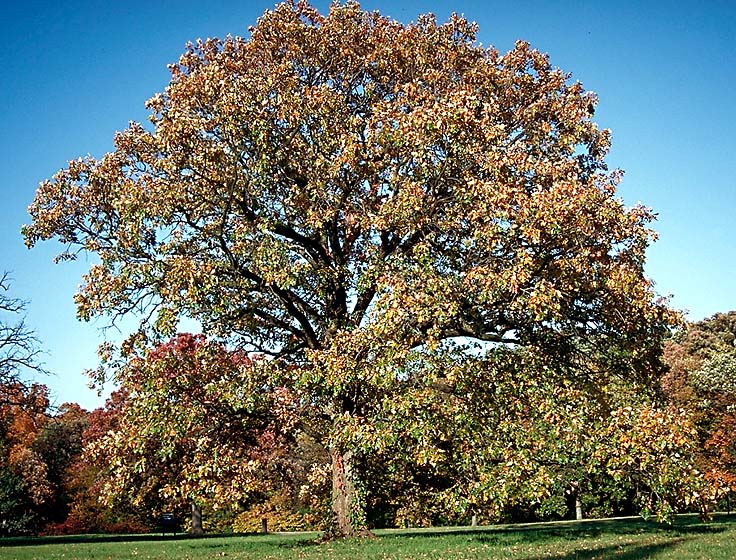
It is a common cause for wonderment among the poets that an acorn - a granule whose tininess is proverbial - possesses the ability to, through some strange alchemy, transform itself into an Oak tree - a forest giant famed, contrariwise, for his bigness. This week you shall find yourself reading about this process, for our tree of the week is an oaktree, and I am finally prepared to undergo the strenuous task of discussing that mighty genus Quercus.

I say that talking about Oaks is a strenuous task not because of any personal dislike of oaks, for like all arborists of the Northern hemisphere I love them dearly, but rather because the genus Quercus is a horrible, chaotic taxonomic mess, and will doubtlessly remain that way for as long as there are any oaks at all. Not only does this genus contain more than 120 different species within itself, but also oaks are renowned for their ability to hybridize freely with each other. That is to say that a member of a given species of oak is able, sometimes, to fertilize an oak of a different species, to produce a "mule" whose genes (and therefore whose physical characteristics) are a cross between both parents. But, unlike actual mules (horse/donkey hybrids, as ye all should well know), these hybrid oaks are themselves able to produce progeny; perhaps they might fertilize (or be fertilized by) an oak from one of their parent species, in which case the resulting offspring would be very similar to that parent, but with a few new genomic tricks up its sleeve to enrich the gene pool of that species. Perhaps, though, the hybrid might mate with another similar hybrid, in which case the two tree's children would have the new set of hybridized characteristics; if they continue to breed true with one another, and are distinct enough from either set of parents, then we may here have witnessed the dawning of a new Oak species. But perhaps the hybrid managed to breed with another Oak who is a hybrid of two completely different species; in which case the final product will be an amalgamation of genes and characteristics from four entirely seperate oak species! It is this chaotic genetic mess that makes identifying Oaks so difficult in the wild, and makes Oak specialists as much lovers of genealogies as Englishmen and Hobbits are claimed to be. Sometimes, one can clearly distinguish between one's bur oaks and one's white oaks, or between one's pin oaks and one's scarlet oaks. But othertimes the experienced oak student will stop before a tree and begin to try and figure out from which species its forebears were - and sometimes the list may reach up to a half-dozen species!

Now, those of you with some foreknowledge of the Biological Sciences may be looking on that preceding paragraph with skepticism. For you may know that species are in fact defined as populations of beings who are incapable of mixing genes with (that is, successfully interbreeding with) various other populations of organisms. If this thought did come to your mind, O Gentle Reader, then I congratulate you on your fine scientific brain. But I am afraid that the picture is more complicated than you had been led to suppose. Although the above definition of species works reasonably well for animals, when it is applied to the various other Kingdoms and Domains of Life on Earth, problems occur. Despite their wide variety of odd practices, animals are in fact among the sexually tamest of all Earthlings. To give an example of some of the strange habits common in other organisms, we turn to the most perverted lot of them all: the Bacteria. While, strictly speaking, Bacteria are sexless, in practice they have invented a bewildering wide range of pseudo-sexual behaviors. And I don't merely mean various "positions", such as we canny Humans have invented. No, in their four billion years of existence, they have developed entirely novel sexual mechanisms. It is as if, in addition to the "normal" penile/vaginal sex we humans are capable of, we also could screw by, say, swapping blood, which would cause both partners to become pregnant; and it were also possible for one partner to, with the aid of a certain secretion, change the gender of their partner; and also, instead of simply getting pregnant, the two partners could, after the exchange of genetic information, incorporate the other's genes into their own genome, making each of them a whole new individual combining the physicochemical properties of both their old self and their partner's old self; and that we could have wholly effective sex with creatures as distantly related to us as horses and dandelions! Such is the world that those masters of kink, the Bacteria, regularly inhabit.

But we have strayed quite far from our ostensible topic - Quercus macrocarpa, the mighty Bur Oak of the Middle West - and so I will conclude this digression. Let it be said that the term "species" is not one which admits of a strict definition, nor is it one which can even really be universally applied to the natural world, a fact which has become increasingly apparent to Biologists over the 150 years since Darwin. It is a man-made construct, which is still used because of its practical usefulness. It is true that creatures arrange themselves into populations with various degrees of reproductive isolation from other populations; but the extent of this isolation varies widely across a continuum, and it becomes more difficult to talk about "species" in any really naturalistic and non-arbitrary way the further one moves along this continuum. At one end, there are Humans, Homo Sapiens, who cannot interbreed with even their closest relations, such as the Chimpanzees. And at the other end, there are the Bacteria. Somewhere in the middle of these two extremes lieth Quercus, whose oaken members are isolated from each other by reproductive walls which are, at least, extant, but very porous and of constantly changing positions.

I shall begin, like the poets, with the Bur Oak's acorn. This choice is made for more reasons than simple whimsy, however, for it is by their acorns that one variety of oak can most readily be distinguished from other varieties. This is certainly the case for Q. macrocarpa. Its acorn is very distinctive. It is much larger than the nuts of its fellow oaks - indeed, the tree's specific name, macrocarpa, roughly means "Big Nut" - being some 2-5 cm (1-2 inches) in length, and some 2-4 cm in breadth. Like all acorns, it has a woody cap covering its top. Unlike most acorns, though, the cap of the Bur Oak is more than a simple beret, it is a full-fledged ballroom gown, often ending in an array of frilly fringes.

The acorn is among the most nutritious of nuts, surpassed only by walnuts, about which more in a later entry. They are rich in fats, proteins (8.1% by weight when dried), carbohydrates, and a wide variety of essential vitamins and minerals. Furthermore, Oak trees produce them in huge quantities, ensuring large harvests for those interested. Is it any wonder, then, that they were a staple food for many non-agricultural societies of yore? The aboriginal inhabitants of California took this practice to its greatest limit, depending on a complex and intricate system of arboriculture to keep them fed from the many species of oaks that grow in that land. They were, like Tolkien's Ents, true treeherders. The recent spate of huge wildfires that have caused such tragedy in that country have been in part due to their conquerors' regression to what is, in many ways, a much more primitive level of arboricultural technology.

Modern societies are, of course, primarily dependent on grain and pulse crops for their nutrition. But in Korea, in that Eastern land, one can still find some foodstuffs made from acorn consumed by the populace at large. There, they make a vaguely tofu-like jelly called dotorimuk from the harvested acorns of Korea's many oaks. I plan on, sometime in the next week, going to a Korean grocer's - the internet tells me that there is a good one at 3333 N. Kimball - and there procuring some dotorimuk to sample. I shall, of course, post the results of my inquiry as to the taste of processed acorn flesh.

Before moving on, I must warn you of something, O my Readers. Acorns might be rich in nutrition, but they are also rich in tannins, the bitter compounds which give tea and red wine much of their flavor. And while, in the moderate amounts present in those wildly popular beverages, tannins are really very good for you, with a whole spectrum of health benefits, in larger doses they can be mildly toxic. O don't worry, it would take a large amount indeed before tannins really started to poison you, and the human body is fully capable of dealing with their effects. It's just that the way the human body deals with excesses of tannins is by vomiting, a fact I learned the hard way by drinking an excess of black tea one morning as a youth of some seven or eight years. So while eating acorns raw is possible - and certain species, including the Bur Oak, are less rich in tannins and therefore sweeter and more palatable than others - it is not something I would really advise you to do.

So now that you know all about acorns in general, and how to identify that of a Bur Oak in particular, shall we turn our attention to what happens when one is allowed to become an oak? The answer to this particular rhetorical question is, of course, "Yes". Fix in your mind the image of a Bur Oak acorn. It has been harvested from its parent by a squirrel, that greedy collector of nuts of all sorts. The squirrel, obeying the long custom of its race, buries our acorn into the soil. It does this both so that it might have a ready supply of food through the lean months of the winter, and also so that the groundwater might slowly leach the tannins out of the nut, rendering it tastier to the squirrel's discerning palate. But this squirrel's memory is not acute enough to remember the burial plots of all the hundreds of acorns it so stores away, and so our special acorn is left to its own devices over the winter. Almost immediately, it uses the massive amount of nutrients stored away in its fat body to fuel two growths of opposite directions: one straight up, and one straight down. Its tiny shoot will, come spring, appear above the dirt, announcing to the world the appearance of a new Bur Oak. But of infinitely more immediate importance to this infant tree are the new cells that push downward into the dirt. For they will grow into the mighty taproot which anchors, both literally and metaphorically, all of the rest of the plant.

It anchors the Oak literally in the obvious way, for the tree's native range is the great prairies of the Middle West - it is the State Tree of Iowa - where vast summer thunderstorms and tornadoes are a regular occurrence. And given that oaks are famous for their inflexible response to winds, "breaking but not bending", it is doubly important for one in such an environment to be attached firmly to the brown soil at its feet, lest it be wholly uprooted. This taproot grows very rapidly when the tree is young, sometimes getting the tree four feet closer to the center of the earth by the end of its first year of life. Since the acorn germinates so immediately upon burial in the soil, by the time spring comes around and the first leaves of the tree have unfolded, the root may already have plunged a full half of those four feet downards. According to experiments, even in dense, compacted, clay-heavy soils, the taproot can reach a depth of fifteen feet in just eight years of growth.

This taproot not only tethers the spreading tree to the solid sphere it stands on, it also serves as the "anchor" for an incredibly complex root system which feeds the Oak and which allows it to survive in even the most desperate of conditions, and through the harshest of droughts. Shooting out from this taproot are numerous secondary lateral roots, which themselves branch and network in a vastly intricate fractal pattern. These roots are tremendously strong for being so thin; in an open area, they may spread upwards of 200 feet from the tree's trunk. It is said that the only thing which can halt the outward spread of a Bur Oak's roots are the roots of another Bur Oak. It is for this reason that Q. macrocarpa is such a marvelous success in the open prairies of Illinois. One of the main causes for the worldwide success of grasses is their complicated, highly developed root system, which allows them to grow lush and tall even in comparatively dry soils. Q. macrocarpa is one of the few trees which can compete with grasses on their own turf (a-heh), and therefore has, during the past million years of sporadic glaciations, frequently been on the front lines of the continent-spanning battle between the forests and the prairies. When those everlasting ices of the north advance, both oaks and grasses are pushed so far to the south as to be forced into truce. But when they retreat, as they last did twelve millenia ago (and as they are retreating even further now), and new lands are opened for re-colonization by Flora's fair children, the grasses and forests engage in a mortal contest over ownership of the new lands. In general, in drier conditions, where few trees can find enough water, grasses will prevail, and in wetter conditions, the cool shade of the forest canopy will prevent the spread of grasslands. In this most recent interglacial period, the eastern portion of the continent has become wetter, and Q. macrocarpa has spearheaded the westward march of the great forests. It has been speculated that, had it not been for Humanity, Illinois, the "Prairie State", would now be covered with forests from Lake Michigan to the Mississippi. This is because, for many millenia, the region was inhabited by a people who loved and were dependent on the flora and fauna of the prairie lands, rather than that of the wooded country to the East. So they set regular brush fires, as part of their managerial policy on their vast holdings. Grasses are much abler than their arborial neighbors to re-grow and re-seed after one of these occurrences, and so were leant a helping hand in their ancient struggle.

An adult Bur Oak is more than capable of dealing with the intense heat of a prairie fire. Its ridge-encrusted bark is thick and corky, allowing it to survive through the burning. Furthermore, even if the fire is so strong as to utterly destroy the tree, so long as the root system survives, a Bur Oak is capable of re-sprouting from its base and growing again. But younger seedlings, though fire-resistant, are not as near-invulnerable as their elders, and can be killed by frequent enough fires, preventing the further spread of the species.

But let us assume that our acorn is lucky, and that during its first few decades of life it experiences no fire so utterly unbearable as to destroy it. Soon, then, it will grow into a handsome young tree. And it will be sooner rather than later because, while oaks as a group are very slow-growing trees, inching their way up from the dirt with all the self-assurance that their millenial lifespan entails, a young Bur Oak defies the customs of its tribe. In a good year, our seedling will grow some two or three feet up from the earth, its branches climbing heavenward just as quickly as its roots descend towards hell. These branches will, of course, feature along their length the stereotypical well-lobed oak leaves. These leaves provide good indications to the Tree Fancier that a given Oak is indeed a Bur'd one, for they have certain unique characteristics. Firstly, they are smoothly lobed, rather than sharply lobed. This is a characteristic shared by a wide variety of oaks, but there are equally many who do not share it, so it provides a hint. Furthermore, while they can vary widely in overall shape, normally along their base the leaves are deeply lobed and narrow, while towards their tip they fan out and grow more shallowly lobed, like so.

As the tree passes its second and third decade, enduring whatever hardships its homeland has in store for it, alternately being plunged into freezing darkness, cold, and ice during the winters and burning light, heat, and fire during the summers, its growth slows. Instead of the powerful upwards and downwards leaping of its infancy, it enters into a period of quieter, but surer, growth, as more of its energy begins to go into the production of new acorns, its children. For it takes Q. macrocarpa some several decades to reach sexual maturity, to begin producing flowers. Our little tree is fully hermaphroditic, or "monoecious" in the botanical terminology, and produces both male flowers (the long, green catkins seen in the previous picture), and female flowers, which are small, scaly cups at the base of the leaves. Both sexes of flowers appear in the early Spring, when the leaves are still small, and so, one fine day in Spring, when a young boy's fancy turns to thoughts of Love, our little acorn becomes a Man. And a Woman.

While the Bur Oak produces at least a few acorns every year, it is only once every three or five years that it produces a really large crop. But these crops are not just large, but absolutely enormous. A large example of the race can produce, in one of these years of plenty, up to five thousand acorns. The philosophy behind this massive glut of nuts is the same as that behind the 17-year cycle of the cicada, which we were so fortunate as to witness earlier this year, namely that by producing so many offspring its predators will be simply unable to eat all of them, leaving at least a few to survive and grow.

As our little Q. macrocarpa acorn passes into maturity, it may look forward to a long, long life. Bur Oaks are capable of surviving for centuries, and there is little that can kill them. Drought, as previously mentioned, leaves them completely unfazed, as do both heat and cold (indeed, Q. macrocarpa is the northernmost of the New World's oaks in range). Few are the diseases capable of really damaging a Bur Oak, and though it will have many, many encounters with pests and insects, equally few are the ones that pose any serious threat to its continued existence. Tornadoes can, of course, be problematic, as they can be for everything short of a steel-reinforced concrete bunker, but it will take a nearly direct hit to efface a big Oak from its environment. So it will continue its slow growth, sending out huge limbs as thick as many a lesser tree, and spreading its canopy far over the plain. If it is allowed the opportunity, it is capable of truly awe-inspiring proportions, as the National Champion Bur Oak, in Kentucky, shows, with its height of nearly 100 feet, its trunk diameter of 8 feet, and its crown spread of 110 feet. This giant was born sometime in the 16th century, some five hundred years ago, and has strewn its many children, and grandchildren, and great-grandchildren, and great-great-grandchildren, and...etc., all across the center of our continent, and though it is now scarred by lightnings, it yet endures, growing in its slow and steady way.

And so, right now, somewhere near Paris, Kentucky, there is an acorn, the son and daughter both of a Titan, that has just begun to germinate...

Being the son of a Titan since 1986,
--mark

Tuesday, October 30, 2007

Tree of the Week for Oct. 28th-Nov. 4th 2007: Taxodium distichum

I'm even later than usual with my Tree of the Week this time around, for I was supposed to post this entry sometime last week. Since I know that all my pleas of occupying business will avail me not, I shan't give them, and instead shall promise you a Very Special tree of the week this week. Hallowe'en is tomorrow, and therefore here at Harvester of Eyes Enterprises, we've decided to feature one of the creepiest members of North America's sylva. So, if ye have the stomach for it, keep on reading..

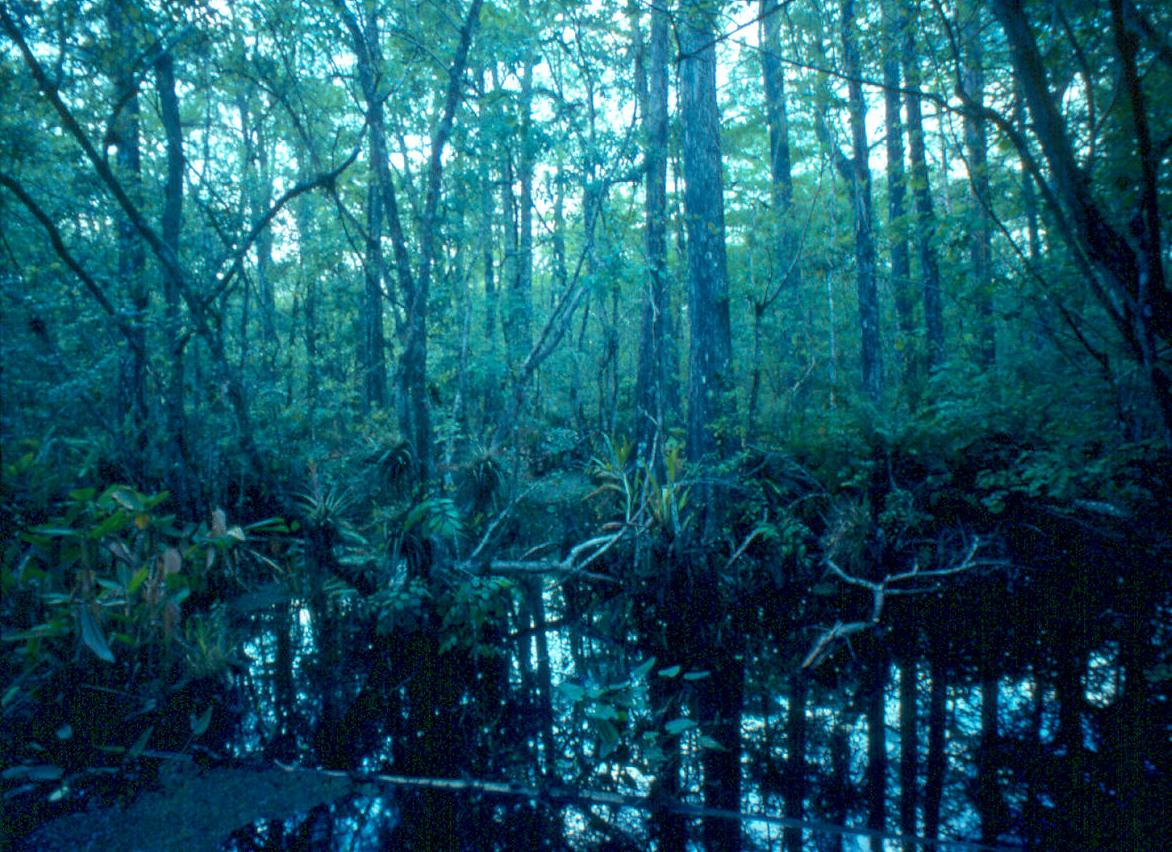
No truly epic horror movie is complete without a journey into some forbidden swamp or other, where alligators languidly lie in wait, old crones mumble mystic incantations over black pots of foul-smelling stew, rustics sit on the front porch of their stilt-footed shanty, shotgun in hands, and Spanish Moss droops like garlands from the ancient boughs of this week's tree, Taxodium distichum, the Bald Cypress.

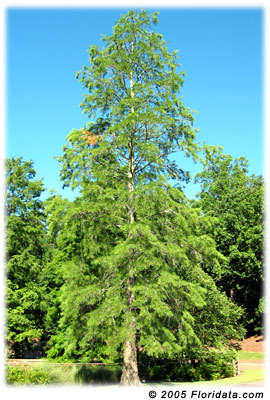
But, despite this tree's legendary and well-deserved association with the eeriest of the Southland's swamps and bogs, you don't have to go down to Louisiana or Florida to see this grand conifer. For the Bald Cypress fares surprisingly well (at least, I was shocked to learn this fact) in cultivation, and has been successfully planted as a street tree as far north as motherfuckin' Minneapolis, Minnesota. Indeed, the Society of Municipal Arborists declared T. distichum 2007's Urban Tree of the Year, based on the results of an online poll held by that organization. The tree deals very well with the wretched soil conditions of big cities, not caring one whit how compacted and nutrient-poor the dirt it sinks its feet into may be. It positively loves acid, able to flourish in soils whose pH is as low as 4.0. To give a comparison which my various readers, almost all of whom are enrolled in some institution of tertiary education, may be immediately familiar with, beer has a pH of around 4.5. And not only will it grow and survive under such conditions but, unlike many coniferous plants, T. distichum will grow quickly, sometimes achieving a rate of two feet a year in its unstoppable heavenward rise. This rise is rather perfectly straight, too, and the tree almost without exception has that vertical, columnar habit so beloved by many landscape architects.

City life isn't all fun and games for the Bald Cypress, though, for despite its vigor and unquenchable inner strength, it can be very picky about certain aspects of its environment. As befits a swamp plant, it needs all the water it can find, and requires a minimum of four feet of precipitation a year. To give an example of exactly how much that is, Chicago, which once was a swamp itself, annually gets a mere three feet of water. So Cypresses grown in climates that are less than saturated with water do require some regular watering. Furthermore, although it loves acidic soil, it cannot tolerate any alkalinity in its environment, and won't grow in areas with a pH greater than 7.5. It also requires a great deal of sunlight to power the chemical fires that fuel its growth. I know this seems odd, that a plant of the deepest swamplands would require the full light of the sun to grow well, but remember that T. distichum is, in general, the tallest plant in those wetlands, and therefore up in the canopy where its photosynthetic organs are placed, there is nothing to block the sun's rays. Of course, this means that life is difficult for Bald Cypress seedlings underneath their parent's spreading branches, but given how little competition they face in the standing water environments they favor, and given how ancient a Bald Cypress can become (there are known examples who have survived for well over a millenia), a Bald Cypress forest is difficult to oust by non-human means.

Speaking of its seedlings, they represent another difficulty that T. distichum faces in adapting to urban environments. For although an adult Cypress can easily withstand the cold spells of Minneapolis and Buffalo, Cypress youths are infinitely more fragile creatures and can be killed by even the briefest frost. It is this culling of the young that has prevented this hardy tree from spreading too far north by its own power. Outside of regions where our civilization has planted it, T. distichum goes no farther north than the southern reaches of Illinois, Indiana, and Ohio. But we Americans are a crafty people, and our arboriculturists are capable of growing young treelings indoors, and then transporting them to their out-of-doors destinations when they've grown large enough to withstand the ice and snow that they may there be subject to.

Of course, although seeing a Bald Cypress in the middle of a Chicago winter, needle-bare and covered with snow, may be an esthetically rewarding experience, it cannot compare to seeing them in their native homeland, the swamps of the Gulf coast and the lower Mississippi. This is not an experience I can claim to have had myself, but it is certainly one which I look forward to. In that wet vale, T. distichum is one of the largest trees around, not only growing up to 40 m (130 ft.) in height, but also having enormous girths. The by-volume largest individual Bald Cypress in these fifty United States of ours, nicknamed "The Senator" and found in Longwood, Florida, has a diameter at breast height of some dozen feet, and contains over 3500 cubic feet of wood. It is also in these riparian environments that T. distichum shows its most characteristic and famous feature, the woody "knees" that it projects out of the water around its base. These knees are extensions of the plant's root system. Their precise function is still unknown to science. For many decades it was assumed that they were used to provide oxygen to the roots of the tree, which are trapped 'neath both ground and water in a very deoxygenated environment. This is a trick which mangrove trees are known to pull, and so it seemed natural to conclude that T. distichum was doing the same thing. But recent research suggests that these knees do not, in fact, have any measurable effect on the amount of oxygen contained in the cells in the tree's roots, and so some other hypothesis had to be devised.

It is therefore currently believed that these projections serve primarily to stabilize the great tree. It is already a very sturdy tree, for a Baldcypress' trunk is heavily flanged and buttressed at the base. When this is combined with its extensive root system, and these great projections anchoring it in place, you have a tree that can withstand hurricanes. I mean that quite literally, by the by, for in the course of researching this tree, I have read reports of Bald Cypresses standing quite unmolested through the worst winds a full-force hurricane can muster - winds that will tear even modern, well-built homes and office buildings utterly to pieces.

Given that one of my aims in writing these essays is to encourage my readership to take notice of the trees around them, I would be remiss if I did not here mention a certain place where many of my readers can make a pilgrimage to in order to see T. distichum in its full glory. Jess, you, of course, won't have to do such a thing; Tenessee and Alabama are both near enough to this Cypress' greatest strongholds that a daytrip will allow you to kneel in awe before some of the mightiest individuals this species has ever produced. But for us damned Yankees, who can see this tree only when it's planted abnaturally in parks and along streets, a minor pilgrimage to the Chicago Botanical Garden is in order. For at that location, there are planted some rather gorgeous Baldcypresses right along the banks of the large pond that the Botanic Garden lies among. This pilgrimage is in order not only because these are unusually pretty examples of the species for these northern climes, but also because, in the partially submerged environment where they grow, they have had the opportunity and the inclination to develop those famous knees of theirs.

Now, the attentive among my readership may have noticed that a few paragraphs ago, I mentioned Baldcypresses standing bare of needles in winter. This was not a typo; the Baldcypress derives its common name from the fact that it is among that small group of coniferous trees who are deciduous, not evergreen. So every fall, its needles turn a coppery red or golden brown before falling from their twigs.

These needles are also rather distinctive, and bear a good looking at while still on the tree. soft and feathery in appearence, their light blue-green or yellow-green tinge can produce a variety of esthetic effects. In an urban environment, it lends a certain tropical vitality to a scene, whereas in their native swampland it allows for the eerie atmospherics that make it such a staple of horror flicks. The needles march out along the branch in just two rows, not in the whorling pattern of more familiar conifers like the spruce.

It would seem, by all these features - its columnar growth habit, red-brown bark, thick and buttressed trunk, knee-producing roots, and feathery foliage - that T. distichum should be an easy enough tree to identify. But you must be careful, my readership, for there are several species that are closely related to it and which might easily be mistaken for it by a not sufficiently attentive observer. The first of these is the Dawn Redwood, Metasequoia glyptostroboides, a strange native of China which is in many respects almost identical to T. distichum. But a close examination of the twigs will show that, on the Bald Cypress, the needles are arranged alternately and have pointed tips, whereas the Metasequoia's needles are rounded at the tip and are arranged directly opposite each other. Also, Metasequoia is as kneeless as a multiple amputee; instead, it features its own distinctive pseudo-anatomical marker. These are the so-called "Armpits" which grow beneath its limbs.

There is also another member of the genus Taxodium, namely the Montezuma baldcypress (or "ahuehuete" in Nahuatl), T. mucronatum. Though this primarily tropical & subtropical genus, native to México, will probably not be encountered any time soon by most of my readership, should one find oneself in south Texas, where the ranges of T. mucronatum and T. distichum intermingle, it will be good to know the differences. In general, these two species are so similar as to be indistinguishable to all but the trained botanical eye, but there are several prominent differences which, though they shan't universally allow one to differentiate between the two species, can oftentimes allow one to make one's ID. Namely, T. mucronatum never produces any knees, and although it does shed its leaves, it does so on a different schedule than T. distichum. The latter sheds them in the fall or winter, whereas the Ahuehuete rids itself of 'em when the dry season comes along. These two seasons sometimes correspond, and sometimes do not, making using this feature for accurate IDing very difficult. The two species are so similar that some authorities suggest combining them.

These authorities are also the ones who insist that the Pond Cypress is merely a variety of Baldcypress. There has been much debate over whether this is a seperate species or not, but the most reliable information that I have seen classes it as a subvariety of T. distichum, namely T. distichum var. imbricatum. It is a slightly smaller tree than the main variety, but it is still quite grand, growing 90 ft. in height or more. Unlike the main variety (T. distichum var. distichum), the Pondcypress prefers brackish and still waters to flowing ones. Also, its needles are not arranged in two rows, but rather in slender, upwards-pointing whorls.

Because I am unbelievably tired, I am going to restrain myself from talking at all about the taxonomic relationships of T. distichum - about which I assure you you'll hear of at a future date - and instead wish a Happy Hallowe'en to all, and to all a good night!

Wishing everyone a Happy Hallowe'en since 1986,
--mark

Tuesday, October 16, 2007

Tree of the Week for Oct. 21st-Oct 28th 2007: Pseudotsuga menziesii

Ah-harr, me hearties! Well, I've got a long one for ya this week, so I hope you have the stamina to take it all in. Enjoy!

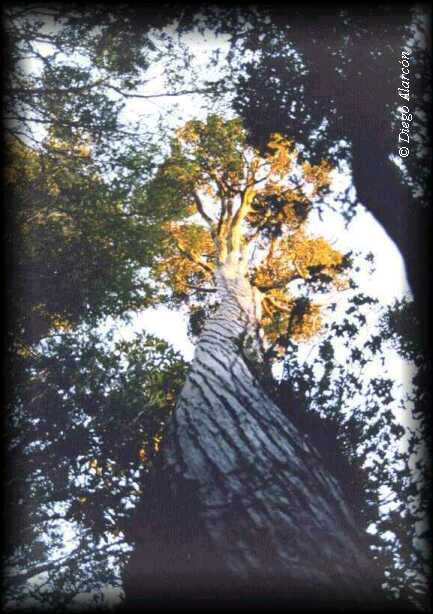
Whelp, seeing as how this week a full two members of my audience - including the one person whom I know actually reads all the way through these miraculous Adventures each week - are out in Portland right now, it seemed fitting to me that I should focus my attentions on the tree most eblematic of the great, rugged temperate rainforests of the Pacific Northwest: Pseudostuga menziesii, the Douglas-Fir.

When I merely mention that name, by the way, you, my readers, in your rôle as Botanical Boyscouts, should feel stir within your bones a sense of awe, of humility in the face of the unendurable majesty of one of the mightiest and noblest organisms on the face of this round earth. In those great Northwestern forests, P. menziesii can reach heights well over 300 feet, and live to ages in excess of a millenium; the tallest living specimen, the Brummit fir (also known as the "Doerner Fir") measures some 329 feet (about 100 meters even) from its intersection with the ground to its highest peak, and has a diameter of 11 1/2 feet. This monster, this prodigy of nature, can be found outside the town of Roseburg, in southern Oregon just off of U.S. Route 5 (hint, hint, guys).

But though it may be found so near to Roseburg, the mighty Douglas-Fir is no rose! No, nor is it any sort of flowering plant. For the Douglas-Fir belongs to a lineage more ancient by far than the late-blooming (hah!) Angiosperms. The flowering plants first unfolded their buds to the sun in the Cretaceous period, some ninety million years ago; but at that time the Conifers (the Pinophyta or Coniferae, as they are variously known in the scientific world) had already been possesed of a history stretching back some 200 million years, to the end of the Carboniferous Period. And this Division of life's grand family has never produced any ignoble weedy herb, for all of its members are woody plants, trees or shrubs which build for themselves strong, sempiternal bones of minutely organized plastic.

I can hear you now, my readers, as you scream in incredulity when I claim that wood is made of plastic. After all, in common parlance the two are held almost as antonyms. But my statement is in fact true - though, admittedly, for a rather loosey-goosey definition of plastic. Plastic is, you see, a polymer of some given organic molecule, repeated over and over again in vast chains. Now wood, wood is similarly composed primarily of cellulose (which is organic, natch) molecules repeated over and over again in vast chains. Certainly, there are many differences between wood and synthetic plastics - not least of which being the radically different manufacturing process - but surely you, my Coniferous Cadets, can recognize the distinct similarities between the two substances revealed in the above all-too brief comparison.

Returning to my previous theme, though, the Conifers have, almost alone among the non-flowering trees, managed to not merely survive but even to flourish in these latter days of Oaks and Wheatgrass. The Cycads, Ginkgos, and Tree-Ferns are now reduced to miniscule remnants of their once awesome biodiversity; the Lycopods and the giant Horsetails are utterly extinct, and have been for many millions of years, for aeons upon aeons. But the Conifers adapt and endure, thriving in some of the globe's harshest climates. And though the Coniferous order contains within itself many clans, it is primarily due to a single family that the Conifers are such a common and well-known group in the Northern world. This family, this diverse family of unbelievable resourcefulness, is the Pinaceae, the Pine Clan. Under its needle-wreathed boughs, it encompasses all the world's pines, firs, spruce trees, true cedars, hemlocks, and larches. And, of course, the awesome Douglas-fir.

Though there has been little doubt that the Douglas-fir belongs among the Pine family (save for some early botanists who wanted to place it in the genus Sequoia, along with the mighty redwood, which lies in the Cupressaceae) its precise location within that family, and its precise relation to other members of that family, was for many years in much doubt. It had been variably grouped in the same genus as the firs, the spruces, the pines (tho' why the pines, I know not), and the hemlocks before finally, in 1867, being given its own elite genus Pseudotsuga (meaning "fake hemlock") by the french botanist Élie-Abel Carrière. But even this did not end the debate, for the genus is a complicated one, with divisions between species resting sometimes on the minutest of criteria. Indeed, the precise number of species within this genus is even still open to much doubt; while the generally accepted number is five, there are those who would place it as high as thirteen. We will stick with the generally accepted five, for the sake of both brevity and agreement with the widest scope of the scientific literature possible.

Of these five, there is only one species that we are considering today, and it is the prince of not only its genus, but also of its family, and perhaps (if certain legends of old are to be believed) of all the trees that grow on this green earth. This species is, as I'm sure I've mentioned once already, Pseudotsuga menziesii, pronounced roughly "sue-doe-t'sue-guh men-zee-see-aye". If you will bear with me for a few more sentences, I would like to round out this lengthy discussion of the plant's genealogy with the important fact that there are two seperate subspecies of P. menziesii, which are sometimes considered quite distinct species - and understandably enough, for they do each have a noticeably different character about them. These two species are the Coast Douglas-Fir, P. menziesii menziesii, and the Rocky Mountain Douglas-Fir, P. menziesii glauca. For the rest of this essay, we will be concentrating on the Coast Douglas-Fir, but we will not ignore the inland race, and give it its due.

Members of the genus Pseudotsuga can be most easily distinguished from all other coniferous trees by virtue of a certain unique characteristic of their cones, namely the long, three-pointed bracts that stick out from beneath its scales. Note that what I am referring to here, following the common usage among non-Botanists, as the "cone" of the tree is in reality merely the female cone, which is handsome, medium-sized, and not-too showy at its two to four inches in length.. The male cones of the tree - which produce the pollen grains that, after being set adrift into the air, relentlessly fuck the countless thousands of ovules of their female siblings - are smallish things, an inch in length at the very outside. Every spring, towards the end of March, they spew out their flying jizz ("Flying Jizz" - what a great name for a band!) which is borne by the treacherous skies to the sticky embrace of the female cones - sticky, for in the Spring, the young, virgin female cones are indeed coated in a resinous material which entraps the manly pollen. I shall note, to conclude this racy tale, that since Douglas-Firs are all hermaphroditic, it sometimes is the case that a male's pollen will end up locked in the womb of the lady cone on the branch right next to it! Once this voluptuous ritual has been accomplished, the seeds will mature underneath the female cone's scaly bosom until they are ripe a half-year later, in the Autumn. At this time, the entire cone drops to the ground, breaking open and scattering its contents.

Now, you two readers of mine fortunate enough to be spending this week in the state of Oregon may be wondering how you are to ascertain whether or not a given tree is a Douglas-Fir if it has already shed all its cones. Worry not, though, friends! The tree has other characteristics that may speak to you and tell you its name, if you will but pause to listen. Its needles, for example, are about an inch or so in length, and are soft to the touch, not pricking the grasping finger. They are typically a bright, light green color, though they can also be a darker green, or else actively yellow-green (which is more common among the Coastal subspecies) or bluish green (which is more common among the Inland subspecies). These needles have, upon their underside, two narrow whitish strands. These needles are arranged in spirals about the twigs of the tree, and at their base they narrow and twist a bit in a way that is rather characteristic. This narrowing and twisting gives their needles a little bit of an herbaceous stem, a phenomenon rare among the Pinaceae, and a good clew if ye need one. This is as opposed to, say, spruce needles, which are attached to the twig by a woody 'peg', or those of the True Firs (genus Abies), which bud straight out from the twig without any appreciable stem. Finally, if all this avails you not, you can look at the leaf scar of the needles, for it is raised slightly above the twig - though this raising should not be confused with the small woody cushions of the hemlock.

I am sorry if all of those very similar looking needles caused you any confusion, O reader. I, too, have oftentimes found the various abstruse differences between the needles of the diverse conifers rather confusing. But I found that experience proved as educational as it is oftentimes claimed to be, and I would suggest that you follow my advice. Go and find some trees whose identity (due to their clearly present cones, for example) is not at all in question, and study their needles for some time, keeping your mind on just those points listed above. You will develop in your brain a "search image", a model, which can be used to mark those items about the needle that are most important, most distinguishable, for comparison to future specimens. It will be, I assure you, time well spent, for it will allow you to hear the Douglas-Fir proclaim its name into the Western sky.

And, once again, what a name it is! What awe and majesty it possesses! I hinted, above, of certain old legends which, if true, would make the Douglas-Fir the Prince of Sylva. The story is this: Several times, during the end of the 19th and dawn of the 20th centuries, there were reports, from lumbermen, of the felling of Douglas-Firs of truly prodigious proportions. The tallest of these was, it was claimed, some 415 feet in height. Not only is this some ninety feet taller than the tallest Douglas-Fir now alive, it is even 35 feet taller than the tallest tree currently living on the entire globe, the Redwood of northern California known as Hyperion, who is 379 feet in height. Now, it is true that lumbermen are as full of tall tales as all adventurers, and love to exagerrate their successes, and so none of these reports are given full credence by the scientific community. But there is such a number of them, and they are so far above even the grandest claims made by redwood lumbermen (no lumberjack had ever claimed to have felled a redwood of more than 380 feet, the approximate height of the current champion) that it seems plausible that mayhap, in the days when the saw had not dug its teeth into the wood of this species, there were indeed giants more than 400 feet tall.

If this is in fact the case, then within the lifetime of our children there may well again be such titans, assuming always that the last remaining old-growth forests of Douglas-Fir are not clear-cut by the shortsighted. P. menziesii is not a fast growing tree by any standard, but neither is it some creeping, cautious thing that inches its way towards heaven. It grows at the perfectly respectable rate of a foot or so a year. That being said, at a foot a year, it still will take the Doerner tree 70 years to break 400 feet.

But, although the ancientest and hugest Douglas-Firs have doubtlessly been felled, the species as a whole is in no danger. Indeed, the massive logging operations undertaken in the pacific Northwest are precisely what has allowed the Douglas-Fir to conquer vast new lands for its empire. Despite its awesome grandeur, which would make one think that it prefers to grow in the oldest of old forests, P. menziesii is, like the White Ash discussed several weeks ago, a successor species. It loathes shade and darkness, and will fare poorly if not exposed to the full light of the sun. So in an older forest, where the forest floor is constantly in the shadow of the huge conifers that dominate the landscape, Douglas-Fir seedlings are seldom seen, and no new crop of this species will be had.

But once the ancient trees of an area are removed - either by fire, by windstorm, or by the hands of Man - P. menziesii's advantages come to the fore. Its thick bark makes it terribly resistant to fire, and it is also famed for its ability to withstand droughts. And though such disasters may have been rare in past centuries, the millenial lifespan of a Douglas-Fir means that an elder is able to wait patiently for such an event to occur. Once the disaster's over, the Douglas-Fir is more likely to be left standing than its less fire-resistant neighbors, and its children are able to sprout up into the sweet sunshine unrivalled by any other trees - and, given their hardiness, each of these seedlings are reasonably likely to survive and flourish, ensuring that this disturbed region of the forest will remain dominated by Pseudotsuga for many centuries to come.

Which means, if you can dig it, that the massive lumber-harvesting enterprises undertaken in the area over the past several hundred years have been something of a boon for the Douglas-Fir, at least in areas that have been left alone to heal since they first felt the blade of man. In the areas where less enlightened policies have held sway, and the old forests have not been allowed to regrow at all, obviously the Douglas-Fir, like all trees, is injured horribly by humanity's shortsightedness. But, in those areas given time to heal, P. menziesii has staged a comeback, and now dominates much greater sections of these forests than it did of old.

Furthermore, because of the excellence of its wood, it has been planted by long-sighted human foresters all over the globe. Hard, stiff, and durable, this wood finds one of its chiefest uses in construction, where its strength under all kinds of pressure is appreciated. It is turned into wharves, bridges, trestles, etc. Not one of those sissy trees used for mere decorative purposes, the brawny Douglas-fir even in death brags of its ability to support crushing loads without flinching. And it has, of course, escaped from its plantations in these far-off lands, and has conquered some colonies in lands as distant from its native home as New Zealand, Germany, England, and South Africa. In some of these places, the tree's hardiness has even made it a 'problem', as it does what it is programmed to do: grow in disturbed areas. Poorly managed native forests that have been clear-cut by loggers sometimes find themselves suddenly awash in a sea of strange foreign invaders, all too often including the mighty Douglas-Fir.

There is infinitely more that I could say about the Douglas-Fir, about its relations with animals, with the soil, with other plants, and with humans, but I shall restrain myself, so that I may at least claim not to be too exceedingly boring. Once again, I must apologize for the obscene length of my entry, but in my defense may I claim that I am merely luxuriating in a discussion of my absolute favorite tree. For of all the trees I have ever met, P. menziesii is the one I love best. It is a noble, majestic, and grandiose tree, that flourishes in the exotic coniferous and temperate rainforests of Columbia. And yet, far from being some vulnerable relic of ancient days, infinitely sensitive to the New World Order established by mankind, P. menziesii is a rugged survivor, not only capable of lasting for centuries but also opportunistically conquering new land wherever new land presents itself to be conquered. So, my Western friends who luxuriantly repose in the Conifer Kingdom, go out there and sing the praises of the Prince of the Forest, Pseudotsuga menziesii, the Douglas-fir!

Singing the praises of the Prince of the Forest since 1986,
--mark