I'm even later than usual with my Tree of the Week this time around, for I was supposed to post this entry sometime last week. Since I know that all my pleas of occupying business will avail me not, I shan't give them, and instead shall promise you a Very Special tree of the week this week. Hallowe'en is tomorrow, and therefore here at Harvester of Eyes Enterprises, we've decided to feature one of the creepiest members of North America's sylva. So, if ye have the stomach for it, keep on reading..
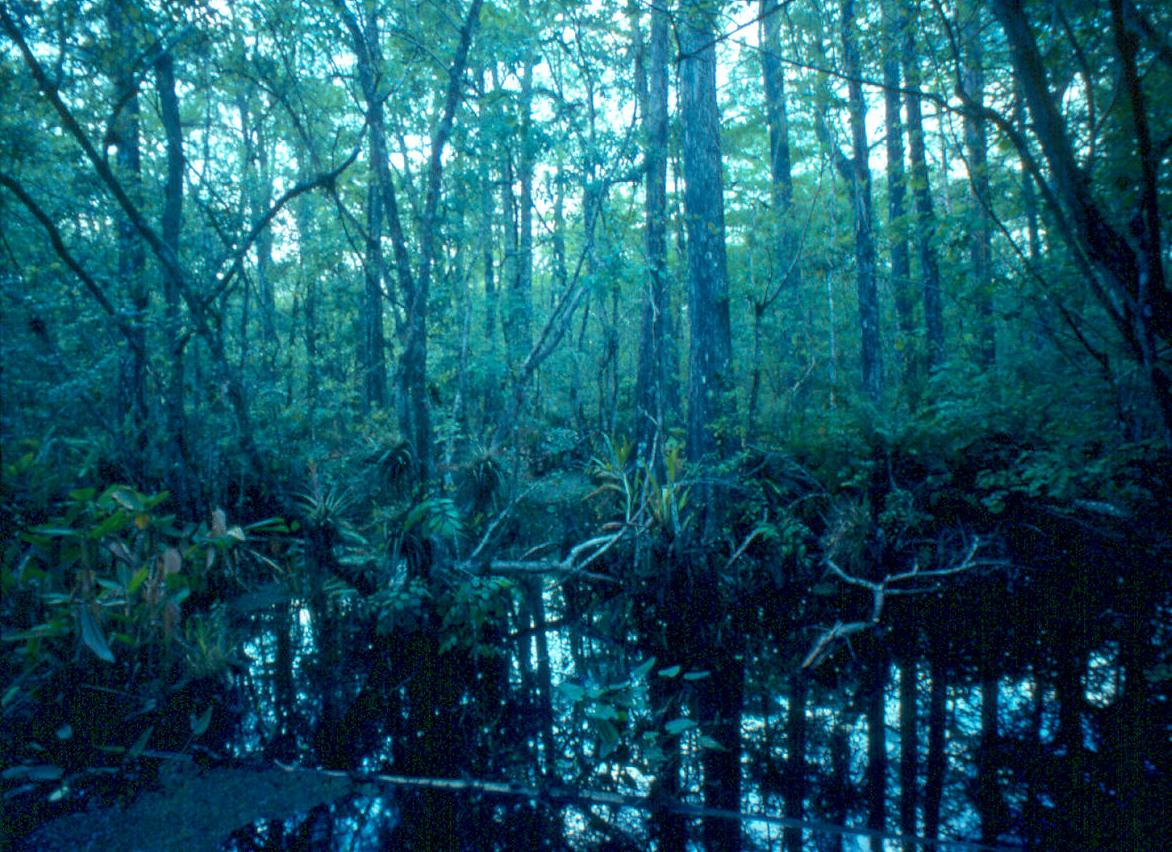
No truly epic horror movie is complete without a journey into some forbidden swamp or other, where alligators languidly lie in wait, old crones mumble mystic incantations over black pots of foul-smelling stew, rustics sit on the front porch of their stilt-footed shanty, shotgun in hands, and Spanish Moss droops like garlands from the ancient boughs of this week's tree, Taxodium distichum, the Bald Cypress.
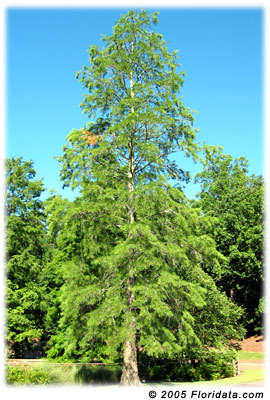
But, despite this tree's legendary and well-deserved association with the eeriest of the Southland's swamps and bogs, you don't have to go down to Louisiana or Florida to see this grand conifer. For the Bald Cypress fares surprisingly well (at least, I was shocked to learn this fact) in cultivation, and has been successfully planted as a street tree as far north as motherfuckin' Minneapolis, Minnesota. Indeed, the Society of Municipal Arborists declared T. distichum 2007's Urban Tree of the Year, based on the results of an online poll held by that organization. The tree deals very well with the wretched soil conditions of big cities, not caring one whit how compacted and nutrient-poor the dirt it sinks its feet into may be. It positively loves acid, able to flourish in soils whose pH is as low as 4.0. To give a comparison which my various readers, almost all of whom are enrolled in some institution of tertiary education, may be immediately familiar with, beer has a pH of around 4.5. And not only will it grow and survive under such conditions but, unlike many coniferous plants, T. distichum will grow quickly, sometimes achieving a rate of two feet a year in its unstoppable heavenward rise. This rise is rather perfectly straight, too, and the tree almost without exception has that vertical, columnar habit so beloved by many landscape architects.
City life isn't all fun and games for the Bald Cypress, though, for despite its vigor and unquenchable inner strength, it can be very picky about certain aspects of its environment. As befits a swamp plant, it needs all the water it can find, and requires a minimum of four feet of precipitation a year. To give an example of exactly how much that is, Chicago, which once was a swamp itself, annually gets a mere three feet of water. So Cypresses grown in climates that are less than saturated with water do require some regular watering. Furthermore, although it loves acidic soil, it cannot tolerate any alkalinity in its environment, and won't grow in areas with a pH greater than 7.5. It also requires a great deal of sunlight to power the chemical fires that fuel its growth. I know this seems odd, that a plant of the deepest swamplands would require the full light of the sun to grow well, but remember that T. distichum is, in general, the tallest plant in those wetlands, and therefore up in the canopy where its photosynthetic organs are placed, there is nothing to block the sun's rays. Of course, this means that life is difficult for Bald Cypress seedlings underneath their parent's spreading branches, but given how little competition they face in the standing water environments they favor, and given how ancient a Bald Cypress can become (there are known examples who have survived for well over a millenia), a Bald Cypress forest is difficult to oust by non-human means.
Speaking of its seedlings, they represent another difficulty that T. distichum faces in adapting to urban environments. For although an adult Cypress can easily withstand the cold spells of Minneapolis and Buffalo, Cypress youths are infinitely more fragile creatures and can be killed by even the briefest frost. It is this culling of the young that has prevented this hardy tree from spreading too far north by its own power. Outside of regions where our civilization has planted it, T. distichum goes no farther north than the southern reaches of Illinois, Indiana, and Ohio. But we Americans are a crafty people, and our arboriculturists are capable of growing young treelings indoors, and then transporting them to their out-of-doors destinations when they've grown large enough to withstand the ice and snow that they may there be subject to.
Of course, although seeing a Bald Cypress in the middle of a Chicago winter, needle-bare and covered with snow, may be an esthetically rewarding experience, it cannot compare to seeing them in their native homeland, the swamps of the Gulf coast and the lower Mississippi. This is not an experience I can claim to have had myself, but it is certainly one which I look forward to. In that wet vale, T. distichum is one of the largest trees around, not only growing up to 40 m (130 ft.) in height, but also having enormous girths. The by-volume largest individual Bald Cypress in these fifty United States of ours, nicknamed "The Senator" and found in Longwood, Florida, has a diameter at breast height of some dozen feet, and contains over 3500 cubic feet of wood. It is also in these riparian environments that T. distichum shows its most characteristic and famous feature, the woody "knees" that it projects out of the water around its base. These knees are extensions of the plant's root system. Their precise function is still unknown to science. For many decades it was assumed that they were used to provide oxygen to the roots of the tree, which are trapped 'neath both ground and water in a very deoxygenated environment. This is a trick which mangrove trees are known to pull, and so it seemed natural to conclude that T. distichum was doing the same thing. But recent research suggests that these knees do not, in fact, have any measurable effect on the amount of oxygen contained in the cells in the tree's roots, and so some other hypothesis had to be devised.
It is therefore currently believed that these projections serve primarily to stabilize the great tree. It is already a very sturdy tree, for a Baldcypress' trunk is heavily flanged and buttressed at the base. When this is combined with its extensive root system, and these great projections anchoring it in place, you have a tree that can withstand hurricanes. I mean that quite literally, by the by, for in the course of researching this tree, I have read reports of Bald Cypresses standing quite unmolested through the worst winds a full-force hurricane can muster - winds that will tear even modern, well-built homes and office buildings utterly to pieces.
Given that one of my aims in writing these essays is to encourage my readership to take notice of the trees around them, I would be remiss if I did not here mention a certain place where many of my readers can make a pilgrimage to in order to see T. distichum in its full glory. Jess, you, of course, won't have to do such a thing; Tenessee and Alabama are both near enough to this Cypress' greatest strongholds that a daytrip will allow you to kneel in awe before some of the mightiest individuals this species has ever produced. But for us damned Yankees, who can see this tree only when it's planted abnaturally in parks and along streets, a minor pilgrimage to the Chicago Botanical Garden is in order. For at that location, there are planted some rather gorgeous Baldcypresses right along the banks of the large pond that the Botanic Garden lies among. This pilgrimage is in order not only because these are unusually pretty examples of the species for these northern climes, but also because, in the partially submerged environment where they grow, they have had the opportunity and the inclination to develop those famous knees of theirs.
Now, the attentive among my readership may have noticed that a few paragraphs ago, I mentioned Baldcypresses standing bare of needles in winter. This was not a typo; the Baldcypress derives its common name from the fact that it is among that small group of coniferous trees who are deciduous, not evergreen. So every fall, its needles turn a coppery red or golden brown before falling from their twigs.
These needles are also rather distinctive, and bear a good looking at while still on the tree. soft and feathery in appearence, their light blue-green or yellow-green tinge can produce a variety of esthetic effects. In an urban environment, it lends a certain tropical vitality to a scene, whereas in their native swampland it allows for the eerie atmospherics that make it such a staple of horror flicks. The needles march out along the branch in just two rows, not in the whorling pattern of more familiar conifers like the spruce.
It would seem, by all these features - its columnar growth habit, red-brown bark, thick and buttressed trunk, knee-producing roots, and feathery foliage - that T. distichum should be an easy enough tree to identify. But you must be careful, my readership, for there are several species that are closely related to it and which might easily be mistaken for it by a not sufficiently attentive observer. The first of these is the Dawn Redwood, Metasequoia glyptostroboides, a strange native of China which is in many respects almost identical to T. distichum. But a close examination of the twigs will show that, on the Bald Cypress, the needles are arranged alternately and have pointed tips, whereas the Metasequoia's needles are rounded at the tip and are arranged directly opposite each other. Also, Metasequoia is as kneeless as a multiple amputee; instead, it features its own distinctive pseudo-anatomical marker. These are the so-called "Armpits" which grow beneath its limbs.
There is also another member of the genus Taxodium, namely the Montezuma baldcypress (or "ahuehuete" in Nahuatl), T. mucronatum. Though this primarily tropical & subtropical genus, native to México, will probably not be encountered any time soon by most of my readership, should one find oneself in south Texas, where the ranges of T. mucronatum and T. distichum intermingle, it will be good to know the differences. In general, these two species are so similar as to be indistinguishable to all but the trained botanical eye, but there are several prominent differences which, though they shan't universally allow one to differentiate between the two species, can oftentimes allow one to make one's ID. Namely, T. mucronatum never produces any knees, and although it does shed its leaves, it does so on a different schedule than T. distichum. The latter sheds them in the fall or winter, whereas the Ahuehuete rids itself of 'em when the dry season comes along. These two seasons sometimes correspond, and sometimes do not, making using this feature for accurate IDing very difficult. The two species are so similar that some authorities suggest combining them.
These authorities are also the ones who insist that the Pond Cypress is merely a variety of Baldcypress. There has been much debate over whether this is a seperate species or not, but the most reliable information that I have seen classes it as a subvariety of T. distichum, namely T. distichum var. imbricatum. It is a slightly smaller tree than the main variety, but it is still quite grand, growing 90 ft. in height or more. Unlike the main variety (T. distichum var. distichum), the Pondcypress prefers brackish and still waters to flowing ones. Also, its needles are not arranged in two rows, but rather in slender, upwards-pointing whorls.
Because I am unbelievably tired, I am going to restrain myself from talking at all about the taxonomic relationships of T. distichum - about which I assure you you'll hear of at a future date - and instead wish a Happy Hallowe'en to all, and to all a good night!
Wishing everyone a Happy Hallowe'en since 1986,
--mark






Subscribe to:
Post Comments (Atom)
No comments:
Post a Comment