Whelp, despite my perfectly legitimate excuse for not having posted a Tree-of-the-Week so far this week, it's now time to get down to business and start typing up this week's most wonderous Tree. So, without any further ado, let's kick out the jams, motherfuckers!
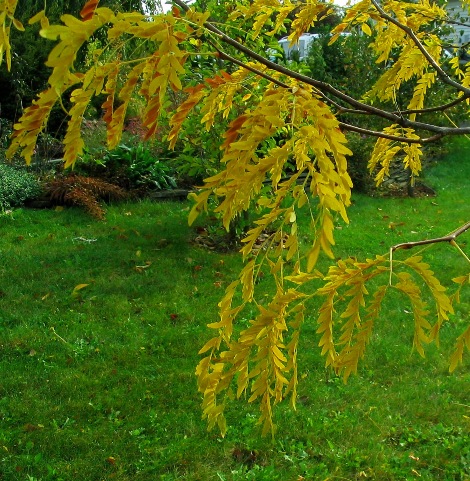
These late September days we are currently travelling through are, surprisingly enough, a wonderful time to be a tree-fancier in a big city like Chicago, and that fact is largely the work of this week's tree, Gleditsia triacanthos, the Honey Locust. I have heard this tree's aesthetic called an 'Impressionistic' one, and I cannot deny that this is a perceptive opinion. The Locust's long, feathery leaves, its flattened, squarish, acacia-like crown, and the dappled, shifting light that it lets through to the ground all combine to give one the feeling that one is observing something which better belongs in a painting by, say, Cezanne. But at this time of year, the effect is heightened, for in these early days of Autumn the tree's leaves slowly begins to change from its customary light green into an equally light and airy gold. Passing by them on the street, one falls under the impression that the tree is constantly being struck in suitably dramatic fashion by isolated shimmering sunbeams streaming down from between dense, gray clouds. But no - the Honey Locust requires no star to highlight its beauty, but rather does so by means of its own ingenious internal chemical factories.
Now, those of you who know me well have already heard a great deal about this tree, for it is both one of the trees that I most heartily love and one of the members of our North American sylva which is the most eminently visible to a grime encrusted city-slicker. This second fact is due to its immense popularity as a street tree throughout all of our great nation's major metropolitan areas. In Chicago, it is the single most frequently planted tree along streets both residential and commercial, and I do believe that it can lay claim to that same accomplishment in both New York and Los Angeles. "If you can make it here," they say about New York, "you can make it anywhere." And so G. triacanthos has, not only thriving in the harshest of urban environments, but also being planted in such divers locales as Europe and Australia - in both of which places it has been so successful as to become a major invasive 'weed' species. In Australia, in fact, it has been given the deliriously exciting common name of "McConnel's Curse". Or, at least, so claims Wikipedia.
Why is this tree so incredibly successful as a street tree? Why has it been planted so ubiquitously throughout our nation's major cities? The answer lies in a host of adaptations that the tree has which make it a near-perfect urban survivor. From the perspective of a human forester, one of the tree's chiefest advantages is its rapid growth rate. It might not grow as fast as a cottonwood, but during the first ten years of its life it can spring up at the more than respectable rate of two feet a year, meaning that one can have grown a truly respectable shade tree from a seed in well under two decades - meaning that one does not have to look into the vastly far future when planning neighborhoods around this tree. Furthermore, it is among the most salt-tolerant of trees. In the middle of winter, when tons of salt are poured out on the streets of our cities to prevent the excssive formation of ice slicks, the ability to survive the leaching of all this salt into the soil without being poisoned or losing literally tons of water is very important to a tree, and G. triacanthos can survive even on the edges of freeways which are even more salt-encrusted than a city's residential streets. I should note, though, for the sake of intellectual integrity, that while almost all the sources I have looked at agree on this property of the Honey Locust's, the USDA does not, and I normally treat the Department of Agriculture as among my more unimpeachable of sources. Due, however, to the unanimity, and even enthusiasm, with which my other sources treat this fact (and I include such reliable people as the National Arbor Day Foundation among these sources), I have decided to, for once, disbelieve the USDA. Especially since G. triacanthos so patently does flourish alongside the busiest of downtown streets, and this is a property one would expect of such a tree.
But wait - there's more! The Honey Locust is also tolerant of a wide range of soil pHs. It might not be as acid-loving as, say, rhododendrons or pines, but it is still tolerant of rather acidic soils, and can also survive well in soils that are rather more alkaline than many plants would prefer. Given the odd fluctuations in general soil chemistry likely to be found in an urban area, with all the pollution of a million car exhausts, a thousand factories, and an infinity of sewage pipes settling into the ground, such an insouciant ability to withstand these constantly changing, and generally unpleasant, conditions gives the tree another advantage. Furthermore, G. triacanthos is also able to survive a wide range of temperatures, minding neither the swelteringest hundred-degree days of summer nor the bitterest minus-twenties of the coldest winter. Those of you who, like me, live in Chicago can easily appreciate how essential both of these capabilities are, but you may not fully understand that trees are, like their animal counterparts, very susceptible to their environment's ambient temperature. Birches, for example, will wither and die if exposed for too long to the direct rays of the summer sun, whereas a live oak will quickly give up the ghost if a frost lasts for more than just a few days. But the Honey Locust shrugs off both of these extremes with equal ease. Also shrugged off with ease by this hardy tree are all but the most terrible droughts. Though it prefers a nice, deep, moist soil, and is, in nature, most frequently found in moist but well-drained river valleys, it seems to be unfazed by extended dry spells.
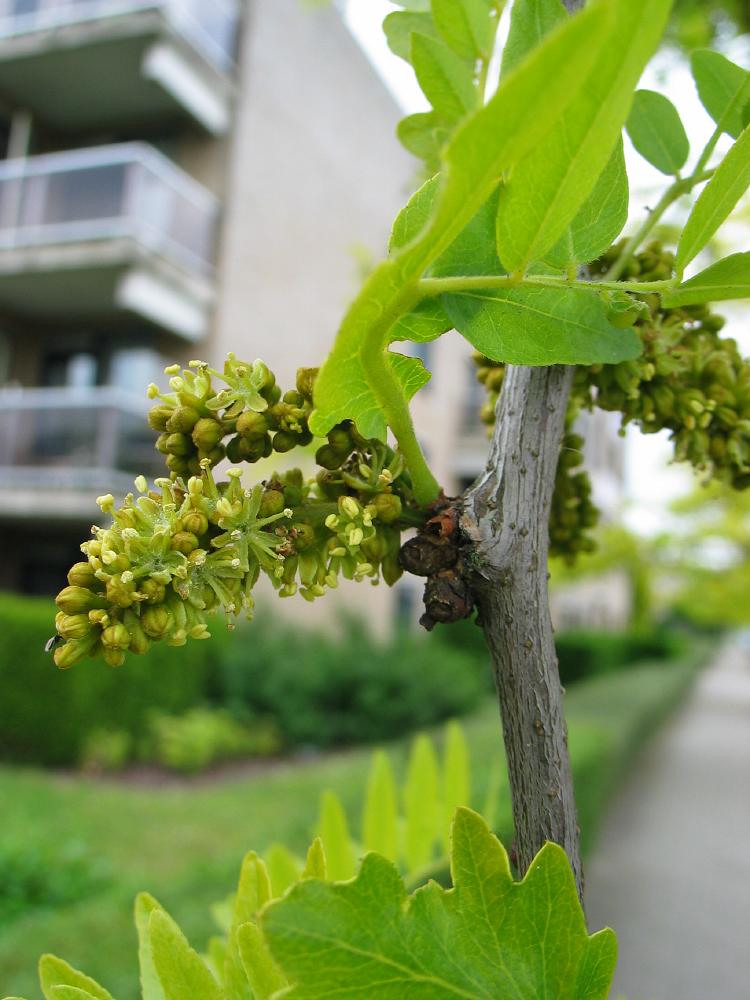
Gleditsia triacanthos is among the easiest of trees to identify, loudly proclaiming itself as 'unique' compared to all other common American trees in a variety of ways. I have already mentioned its fern-like leaves, either singly or else doubly pinnately compound, each seven or eight inches in length, and whose small, oval, spoon-shaped leaflets are all about a half-inch in length. This last fact provides a convenient way of distinguishing between it and the similar leaves of the Water Locust (Gleditsia aquatica) and the Black Locust (Robinia pseudoacacia), both of whose leaflets are much larger, a full inch or two in length. Also very characteristic is the tree's bark, which has a wonderful iron-gray color, and forms large plates along the trunk that are distinctive. The Honey Locust has a spidery growth habit, too, that allows one to identify it even at a distance. The tree rarely grows straight, producing a solid vertical trunk reaching high up into the air, but instead wriggles and twists as it grows, forming a main trunk that seems rather crooked and which soons sprouts out into many large diverging and forking branches. I am told that, in the rich lowland soils which it most delights in, the Honey Locust can reach heights of well over a hundred feet, but I am somewhat skeptical of this claim. Certainly, though, G. triacanthos is a goodly-sized tree, able to grow a solid seventy or so feet without even breaking a sweat. It also can produce a very wide-spreading crown, whose diameter at maturity can be just as great as the tree's height - a full 70'. Its flowers, which are rather small and inconspicuous, are nevertheless a pleasing creamy white or green in color, and appear in late spring, in May and June, and apparently have a reasonably strong and agreeable odor. I confess that I do not recall having ever gone up to smell a Honey Locust's flowers, and so cannot report back to you if this tale is correct, but next spring I will most certainly do so, and would also encourage all of you out there in TV-Land to do the same. Supposedly bees like this flower's scent as well as people, and seek it out, though it is not known as a great honey-producer or flavorer.
The two most distinctive traits of this tree, though, are its fruit and its thorns. Its fruit is a bean - and it is a true bean, for G. triacanthos is a member of the Fabaceae, the bean family which is so mighty and predominates in all of this world's terrestrial ecosystems - that is usually about 8" in length, though they sometimes reach to almost two feet long. These fruits - some of the largest in the entire spectrum of North American trees - begin appearing in early September, and slowly twist themselves into a corkscrew shape before dropping off over the course of the winter, which means that a Honey Locust can, even after all its leaves have dropped, still be covered with twisting red-brown bean pods, each containing some dozen seeds a centimeter or so in length. These seeds are surrounded by a sweet-tasting edible pulp, from which the tree gets the "honey" in its common name. This pulp is well-loved by deer, cattle, and other large herbivores, and is, I am assured, completely edible to people, and was indeed used as food by this continent's autochthonic inhabitants, who also fermented it to make a beer. I have never tried to eat Honey Locust pulp, but I certainly do plan on it. I feel somewhat suspicious of the fruit on city-grown trees, for the Lord alone knows what sprays they've used on it and how much of the city's pollution has been absorbed by the tree and passed on to the fruit, but there are several large, handsome Honey Locusts in the yard of my parents' house out in Suburbanland, so the next time I'm there, by God! I'll try me some Locust flesh. As for the thorns, they are truly impressive. Each one can be up to five inches long, and they frequently come in dense clusters along the trunk. These thorns grow straight out of the woody trunk of the tree, making breaking them off a Herculean task. But not all Honey Locusts have thorns, and those that do have them in very different quantities. Some trees are covered with them, whereas others have but a few. The ones most commonly planted in urban areas are from thornless varieties and cultivars (i.e. G. triacanthos inermis, G. triacanthos 'Sunburst', etc.) but it is nevertheless not uncommon to find one with a full set of thorns popping out of its trunk to menace passers-by.
The Honey Locust is a storied tree, with a dramatic history stretching back into the distant past, into the long-vanished era before the everlasting ice of the North rolled over this continent and changed its face forever, before any human eye ever saw any of the continents of this hemisphere. Since those two most characteristic features of the tree - its fruits and its thorns - play a key rôle in this story, it seems fitting to tell that tale at this precise point in my exposition of G. triacanthos' virtues & vices. In that distant pre-glacial epoch, North America was still home to giant animals the likes of which are not to be seen to-day: Saber-toothed cats, mammoths & mastodons, giant beavers(!), cameloids & llamas, dire wolves, cat-faced bears, and, of course, Megatherium, the giant ground sloth, a huge, possibly omnivorous animal that stood twenty feet tall when standing on its hind legs and had claws as long as a human forearm on both its fore and hind limbs. Evolution being the most opportunistic of masters, it is not to be supposed that there were no trees whose phenotypes were adapted specifically to take advantage of these ancient 'Giants in the Earth', and it is now hypothesized by many scientists (excellently summarized by biologist/science popularizer Connie Barlow in her book The Ghosts of Evolution) that the Honey Locust was just such a tree. Consider, for example, its thorns. In these latter days, what purpose could they serve? Do they defend against deer? No, of course not; a deer's head is certainly nimble enough to avoid the dense clusters of thorns on the side of a tree; they are no deterrent against those ruminants. Furthermore, although a young G. triacanthos might have something to fear from deer browsing their leaves, an older example of the species, with most of its limbs well out of reach of the mouth of any cervid, scoffs at the notion of deer posing a threat to its livelihood - and yet will still produce those intimidating thorns. And in the fall, when buck deer so vigorously rub their antlers against tree bark to scrape off dead skin, in the process often mortally wounding the tree that they do this against, the Honey Locust is not at all the sort of plant that they take delight in. They prefer trees whose bark is slippery, like the Willow, not one whose bark is as steadfastly attached to the wood 'neath it as is that of the Locust. So what purpose have these brutal thorns? Obviously, to defend against those extinct titans, the mastodons and Megatheriums who must once have loved the taste of Locust leaves.
Its fruit is also curiously anachronistic in the modern world. It is clear that it co-evolved with some sort of animal to serve as its dispersion mechanism, for Evolution does not go to the trouble of sweetening a tree's fruit with sugary pulp unless that plant has something to gain by it. Furthermore, the seeds that lie waiting within these pods have a coat that is thick enough that the embryo within cannot get access to precious air and water unless the coat is first damaged in some way - say, by being eaten away by the powerful acids inside an animal's stomach. Indeed, it is by being submerged in sulfuric acid for ~1 hr. that G. triacanthos seeds are scarified for commercial propagation today. It is reasonably certain, too, that it must have been larger animals that the Locusts took particular advantage of, for to-day, although squirrels and deer will certainly take advantage of Honey Locust "honey", they do a poor job of seed dispersal, typically either avoiding or eating entirely the seeds contained within the pods. It is, in fact, the farmer's cow who does the best job of dispersing the Honey Locust's seeds, eating the pod whole for its sweet filling, and allowing the seeds to pass straight through its multiple stomachs, its powerful acids properly scarifying the seedcoat before it finally emerges from the cow in the middle of a nice pile of beautiful fertilizer.
So, we have an image of a Pleistocene North America where the Honey Locust co-existed with its predators, the giant herbivorous animals of the time, feeding them with one hand whilst keeping them at bay with the other. Given how successful it is in nature even in these latter days when it is bereft of any reliable dispersal mechanism, it must have been even more widespread in those ancient times. But, when the glaciers finally retreated, and the combined effects of climate change, diseases imported from the East, and the devastating efficiency of a new predator, Homo sapiens, combined to reduce our continent's megafauna to a fraction of what it once was, the Honey Locust must have retreated in its range, and rapidly. For G. triacanthos is not a long-lived tree, paying for its early vigor by expiring after little more than a century of life. So it must have retreated to areas where the deer and squirrels would still offer it their feeble services, though they be but pitiful handmaidens compared to its dashing servants of old, and to where fast rivers would carry away its pods and smash its seeds fearfully enough to break their pods before depositing them in rich loamy soil. But with the spread of sophisticated agriculture to the regions north of the Rio Grande, and the arrival of large Eurasian domestic herbivores (i.e. horses & cattle), the Honey Locust sprang back from its slow slide into oblivion. Spread first by those food and companions of Humanity, the Honey Locust has, in the past half-century, attracted the attentions of mankind itself, and its advantages have (as revealed above) allowed it to co-operate with humanity for the mutual benefit of both species, as G. triacanthos has now been reintroduced into vast regions where once it floundered, and spread to whole new areas where it was previously completely unknown.
Now, as might easily be imagined by the length of this essay, I am getting very tired of typing, and impatient for it to be finished. So I will gloss over the taxonomical relationships of this tree. But do not worry for your lack of information, for this tree is part of a truly mighty clan, the Fabaceae, and I will reveal to you more data about that impressive kingroup in many a later essay about its other arborescent North American scions. Let it suffice to say for now, that G. triacanthos is undoubtedly part of this family, second only to the daisies and orchids in terms of numbers of species, and that it is a member of the Caesalpinieae sub-family (which molecular studies have re-shuffled the membership of significantly, but which clearly includes both Gleditsia genus and the Gymnocladus genus, another prominent member of the North America's sylva). Let it further be said that, like most members of the bean family (for the Fabaceae is indeed the family that includes everything from lentils to peas to lima beans), G. triacanthos is an expert at obtaining nitrogen from its environment, both entering into even more complex relationships with mycorrhizas (root fungi) than do most trees, and also providing, amongst its roots, tiny nodules in which form a home for certain soil bacteria that exchange nitrogen that they 'fix' from atmospheric sources for sugar that the tree feeds them. This capability of beans makes them important players in ecological cycles worldwide, and G. triacanthos is thus, even back in the days of its decline, no shirker from the global limelight.
Finally, before I conclude, I would like to mention one last thing about the tree: its wood is not terribly useful, because of its twisting and spidery habit, but it is a very hard and dense wood, and therefore serves excellently as a firewood, producing more BTUs per cord of wood than do the vast majority of other trees, though it is still not quite at the level of the hickories, who are veritable satanic lords of flames.
In conclusion, let me reiterate that G. triacanthos is one of the trees I love best, so mayhap I may be excused my excessively long essay about it. I love its combination of dogged stoicism, eccentricity, and ubiquity. I love the fact that it has become so well-beloved by urban foresters, even though it meets none of the socially acceptable ideas of what a "pretty tree" ought to look like - and this in a field where visual acceptability all too often trumps all other concerns. It is one of the great trees of our continent, and should ye see it (which ye all doubtlessly will, and frequently too!) ye should give it a salute for its conquests and its tenacity!
Saluting conquests and tenacity since 1986,
--mark
Friday, September 28, 2007






Wednesday, September 26, 2007
Trauma for breakfast!
Well, folks, ladies & gentlemen, boys & girls, children of alllll ages...as you may well have noticed, I am once again late in updating my 'Tree of the Week' entries. Unlike last week, tho', this time 'round I have the best of reasons for my tardiness. Specifically, this delay is due to the fact that on Saturday the 22nd of September I, while climbing some dozen feet off the ground in a Cucumbertree (Magnolia acuminata) at the Morton Arboretum in the company of my family & room-mate, broke my long-standing tradition of extreme caution while engaged in such arborial pursuits and pulled a stupid-ass stunt, which resulted in my tumbling precipitously to the ground and fracturing two vertebrae in my neck. After spending the rest of that day, the following day, and most of Monday at the Good Samaritan Hospital in Downers Grove, Il, I was released to freedom on the condition that I spend some month or two with a brace constantly about my neck to ensure that these bones heal themselves properly.
All of which, as ye may well guess, is a 'major bummer', as the kids would have it, but like all clouds, this one is not without a silver lining of its own. Specifically, I now have megabytes and megabytes of X-rays, MR images, and CT scans of my precious little body, which form the source of the User Image seen accompanying this post. Furthermore, I now know that, in addition to my sadly long-lost third thumb, I was in fact born with another wonderfully freakish congenital birth 'defect', which had gone un-noticed by the medical community until this accident: my sixth and seventh neck vertebrae (the ones injured by my fall) are partially fused in a way that is distinctly un-natural for a mammal of any sort. The doctors hypothesized that this fusion may have given them the added support which saved my neck and spinal column from worse injury than it, in fact, experienced. Also, I am now able to tell, to anyone willing to listen, a new anecdote which provides further evidence (as if any were required!) of my being one hardcore motherfucker; namely that I was able to, after the fall put me into a state of physiological shock and cracked two of my vertebrae and tore more muscles than I realized my torso had, lift myself off the ground and walk a good thirty feet to the road, and that I refused any ambulance ride to the hospital.
But, despite these distinct advantages (made all the more advantageous when one is a shameless braggart like me), the situation is still, as a whole, a 'major bummer'. It ruins my hopes and plans for obtaining that job at the Chicago Botanical Garden, leaves me with a long stretch of time wherein I can undertake no exercise more strenuous than a simple walk, and problematizes all my efforts to find me some good down-home lovin' - not to mention its deleteriously stressful effects on my friends and family, who all have enough worries and cares to deal with already without the added problem of my own basic physical survival, and who had already seen me go into one (admittedly much different) hospital during the summer, and therefore do not deserve to have to see me go into another. But, I am resolved to make the best of a bad situation, and shall do so! After all, is that not what all of life is: making the best of a bad situation? And so are not we humans already, merely by virtue of our existence, endowed by nature with a variety of faculties that allow us to do just that? Aye, aye, we are, and so I doubtlessly shall succeed, and gild these clouds with no mere silver lining, but rather with a bedding of the purest platinum metal!
Making the best of a bad situation since 1986,
--mark
All of which, as ye may well guess, is a 'major bummer', as the kids would have it, but like all clouds, this one is not without a silver lining of its own. Specifically, I now have megabytes and megabytes of X-rays, MR images, and CT scans of my precious little body, which form the source of the User Image seen accompanying this post. Furthermore, I now know that, in addition to my sadly long-lost third thumb, I was in fact born with another wonderfully freakish congenital birth 'defect', which had gone un-noticed by the medical community until this accident: my sixth and seventh neck vertebrae (the ones injured by my fall) are partially fused in a way that is distinctly un-natural for a mammal of any sort. The doctors hypothesized that this fusion may have given them the added support which saved my neck and spinal column from worse injury than it, in fact, experienced. Also, I am now able to tell, to anyone willing to listen, a new anecdote which provides further evidence (as if any were required!) of my being one hardcore motherfucker; namely that I was able to, after the fall put me into a state of physiological shock and cracked two of my vertebrae and tore more muscles than I realized my torso had, lift myself off the ground and walk a good thirty feet to the road, and that I refused any ambulance ride to the hospital.
But, despite these distinct advantages (made all the more advantageous when one is a shameless braggart like me), the situation is still, as a whole, a 'major bummer'. It ruins my hopes and plans for obtaining that job at the Chicago Botanical Garden, leaves me with a long stretch of time wherein I can undertake no exercise more strenuous than a simple walk, and problematizes all my efforts to find me some good down-home lovin' - not to mention its deleteriously stressful effects on my friends and family, who all have enough worries and cares to deal with already without the added problem of my own basic physical survival, and who had already seen me go into one (admittedly much different) hospital during the summer, and therefore do not deserve to have to see me go into another. But, I am resolved to make the best of a bad situation, and shall do so! After all, is that not what all of life is: making the best of a bad situation? And so are not we humans already, merely by virtue of our existence, endowed by nature with a variety of faculties that allow us to do just that? Aye, aye, we are, and so I doubtlessly shall succeed, and gild these clouds with no mere silver lining, but rather with a bedding of the purest platinum metal!
Making the best of a bad situation since 1986,
--mark
Thursday, September 20, 2007
Tree of the Week for Sept. 16th-Sept. 23rd: Aesculus glabra
For too long already have I dilly-dallied and procrastinated in posting this entry, but no more! Friends, though you may or may not actually care about the contents of these Tree-of-the-Week entries, you ought to love them for the beneficent effects that they have on me, Mark, your host, and so ought to be glad that I am at last getting down to work and posting one of them. Of course, you ought to be glad for their existence simply for their own sake, as well, for Flora provides to the watchful eye (yum-yum!) and mind delights aplenty, and I would cast a disapproving eye (yum-yum!) on any who would refuse to accept Her gifts.
Here in Chicagoland (and, I strongly suspect, in those other climes that other readers of mine inhabit), fall is fast approaching, and so I must be in something of a phrenzied rush to tell you all of those various deciduous species which shall soon loose their foliage and become horrifyingly difficult to identify, let alone to truly appreciate. So, in that spirit, I have this week chosen a plant whose leaves are among the first to change colors and fall from their boughs. Indeed, as long as a month ago, in the middle of August, when the sun beat down at is fiercest and all thoughts of January's snows seemed as distant as Epsilon Eridani, many individuals of this species were already begunning to turn themselves from green to orange, as I saw with my own eyes while making the rounds through the Northern Illinois collection at the Arboretum. The species is, as you already know from this entry's title, Aesculus glabra, commonly known as the Ohio Buckeye.
Members of the genus Aesculus are easily distinguished from other trees by virtue of a number of eccentricities they possess. They have large palmately compound leaves that (in the case of A. glabra) have 5-7 leaflets attached. Furthermore, they have similarly large capsular nuts, and extremely showy flowers.
Distinguishing between the various seperate species of the genus is more difficult, but A. glabra can be rather readily distinguished by several features:
1. It is a tree. This is as opposed to, say, the bottlebrush buckeye (A. parviflora) which is a shrub, though a rather showy and attractive one.
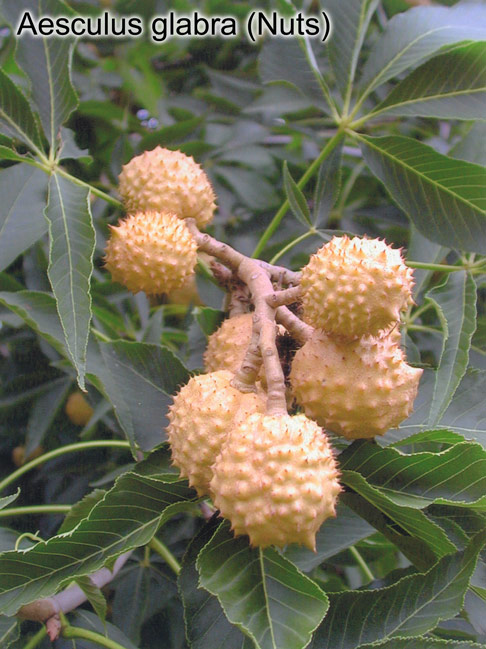
2. Its fruits, as shown in the earlier picture, have a prickly husk surrounding them, unlike certain other members of the genus whose fruits have smoother husks. Though be warned - A. glabra is not the only member of the genus whose fruit has a prickly husk, so that feature is only a clew, and not a clear diagnostic.
3. It typically has many more leaves with five leaflets than it does leaves with seven leaflets, a feature useful in distinguishing between it and the European Horse-Chestnut, A. hippocastanum, which even in these United States of ours so far from its native lands (Greece, in this case) is frequently planted as an ornamental, and whose leaves are far more typically equipped with seven leaflets than with five.
4. Most uniquely distinctive, the leaves of the Ohio Buckeye will, when crushed, release a foetid odor, as will the twigs when scratched. I am afraid that I have never actually tried this experiment myself, but all of the sources that I have consulted in doing my research for this post agree about it, and I plan to check for myself on the next Buckeye I find. I'll post the results later.
It is from this last fact that the tree derives one of its older common names, the Stinking Buckeye. So remember that next time you are in Ohio, and be forewarned by it! For any state which chooses as its mascot so unneighborly a plant is, in all likelihood, not to be trusted.
In fact, its foetid sap is not the only thing unneighborly about the Ohio Buckeye. Like many plants, it is unwilling to share the results of its hard work, the fruits of its labor if you will (ha-ha-ha!), with wandering animal passers-by, and it has gone so far as to protect its nuts with a bitter toxin which is poisonous to most animals, including humans, although there are some species of squirrel that are immune to the venom and so eagerly gobble up the hefty seeds. Whatever toxin it is that its large nuts contain (and I'm afraid that I know not the specific chemical responsible), it acts on the gastrointestinal system and, according to the Canadian government, is actively capable of murdering a human in its self-defense. It is from this poisonousness of all members of the genus that they get their oldest English name, that of "Horse-Chestnut", for their nuts are vaguely reminiscent of chestnuts (tho' in truth the two species be not nearly related), at least in size, and they are as puissant as a horse.
Which provides me with a convenient excuse to launch into a diatribe on taxonomy, for the family of these trees is given the name of the Hippocastanaceae, which is a literal translation of "horse (Hippo-) chestnut (-castanum)" into the Latin. It is a small clan, containing only the genuses Aesculus, Billia, and Handeliodendron, which probably originated (and let me mention that the following is merely an inference of this author's and not necessarily a full initiate of the Dogma of Forestry) in relatively recent geological eras in either North America or China, where there are by far the greatest numbers of species from this family. The rest of the world is graced with but few members of the clan, and in fact to the best of my knowledge the Balkan A. hippocastanum is the only species naturally present outside of those two regions. This family is believed to be a good one, a true clade all of whose members are more closely related to each other than to any other species on the globe.
However...
This small clan has recently been shown to be in truth but an offshoot of an immensely prodigious family, who doubtlessly shall take their poor relatives under the wing! You see, in recent decades the whole science of taxonomy has been revolutionized by the power of genetics, which have revealed that species once thought to be closely related have been shown to be but distant cousins, and species who had previously been only the remotest of acquaintances have proven to be birthed from the same womb. In response to this, a large collection of plant taxonomists have come together to interpret the results of all these new studies and reclassify the flowering plants. Among many other conclusions they reached, was that in order for the vast, sprawling Soapberry family (the Sapindaceae, containing over a thousand species of mostly tropical shrubs) to remain monophyletic (that is, to ensure that all members of it share a unique last common ancestor shared by no other group), it must absorb both the Hippocastanaceae and the mighty Aceraceae, the extraordinarily successful world-straddling family of the Maples. So, it was decreed that it should be so (for the other alternative was to dice up the Sapindaceae into a myriad tiny families, and the botanical world already contains an over-abundance of tiny families whose names are impossible to remember) and lo! it did come to pass that the Hippocastanaceae is no more, and Aesculus glabra is now a member of the even vaster Sapindaceae.
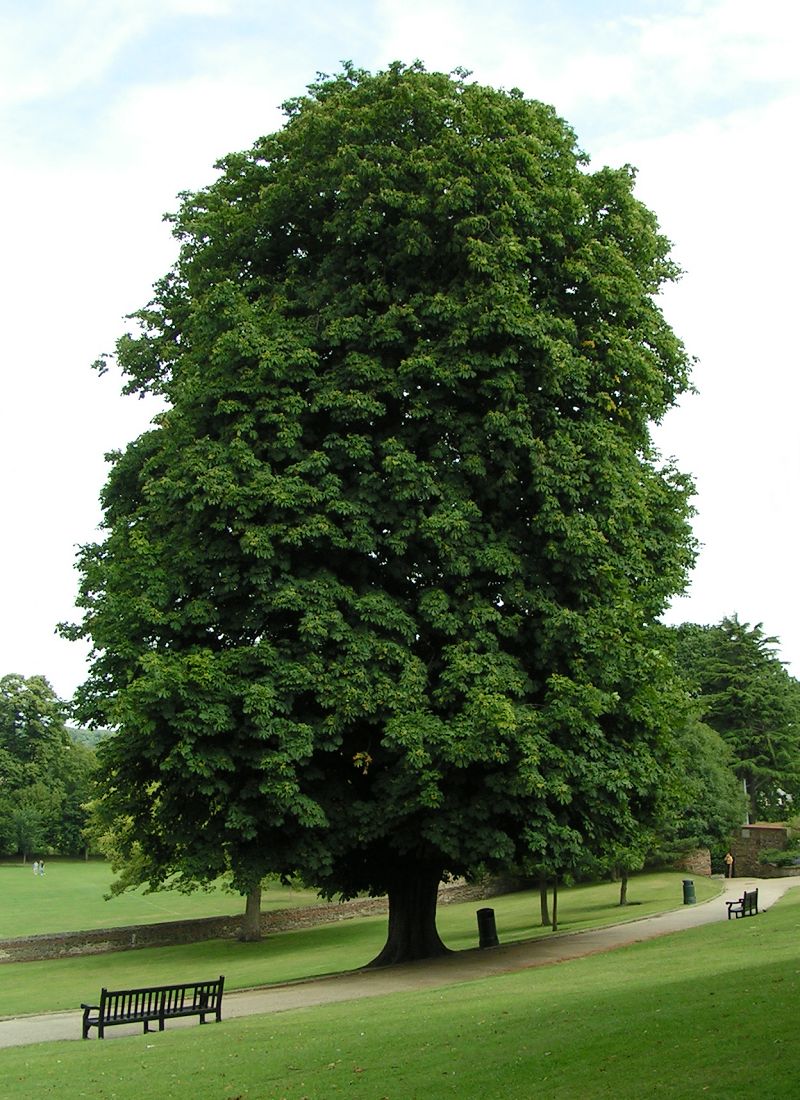
Now, for those of ye who find the science of taxonomy less intrinsically thrillling than do I, we'll return to the subject of the tree itself. It's a handsome tree, which grows reasonably tall (up to seventy feet in height) and can, like its close cousins the maples, produce a prodigious amount of shade. But it does not dish out anything that it can't, in turn, take, for it is itself rather tolerant of shady areas. It is also very tolerant of acidic soils, and indeed prefers soils whose pH is well below neutral, making it a natural companion for pines whose needle-litter is acidic and imparts that quality onto the soil as it rots. It's a reasonably thirsty tree, too, prefering moist soils to dry ones, though it cannot survive much standing water and is seldom seen in boggy sites. In cities, it is most often seen as a park tree, luxuriating in the space and attention lavished on it by urban foresters as it grows tall over the turf beneath. It is seldom planted as a street tree, tho', with the primary reason being the mess and hazard caused by its large nuts on the sidewalk.
I opened this entry by mentioning that A. glabra begins shedding its leaves early in the season, and so let me close it be returning to that theme. Even as soon as early August, the Ohio Buckeye's leaves begin to change color, either to a shining yellow or a brilliant, fire-like orange that lights up the late summer greenery and presages things to come. Soon, all of its leaves are fallen, and the tree is left barren to wait out "December's foggy freeze". But, just as this Stinking Buckeye is the first tree to lose its leaves in the fall, so is it the first to put them out again in the Spring, splitting open its well-prepared buds long before the deciduous trees around it. And soon after that, if the weather remains good, it mimics the showy May flowers at its feet with its own bountiful display of curiously arranged flowers, looking for all the world like a Fourth-of-July fireworks display come several months too early. So keep your eyes peeled for this gift of Flora's right now, before all its leaves are dropped, as it celebrates in the early Autumn air, and then again in the spring be ready to look to the heavens and see the magnificent show which Aesculus glabra has in store. And, if you are the sort of person who (like me!) feels that everything is made more fun when a level of prurient interest is added to it, you may care to remember that those showy displays that the ol' Stinky Buckeye will throw erect into the air are in fact its sex organs, its many thousands of botanical penises and vaginas, and that each buckeye plant is in fact a hermaphrodite, both male and female, and once you have remembered this you will feel like a Stinking Pervert for thus gasping at the beauty of the Stinking Buckeye's flowers, and will then be much pleased with yourself.
Feeling like a Stinking Pervert since 1986,
--mark
edited 9/21/07 at 4:10 PM.
Here in Chicagoland (and, I strongly suspect, in those other climes that other readers of mine inhabit), fall is fast approaching, and so I must be in something of a phrenzied rush to tell you all of those various deciduous species which shall soon loose their foliage and become horrifyingly difficult to identify, let alone to truly appreciate. So, in that spirit, I have this week chosen a plant whose leaves are among the first to change colors and fall from their boughs. Indeed, as long as a month ago, in the middle of August, when the sun beat down at is fiercest and all thoughts of January's snows seemed as distant as Epsilon Eridani, many individuals of this species were already begunning to turn themselves from green to orange, as I saw with my own eyes while making the rounds through the Northern Illinois collection at the Arboretum. The species is, as you already know from this entry's title, Aesculus glabra, commonly known as the Ohio Buckeye.
Members of the genus Aesculus are easily distinguished from other trees by virtue of a number of eccentricities they possess. They have large palmately compound leaves that (in the case of A. glabra) have 5-7 leaflets attached. Furthermore, they have similarly large capsular nuts, and extremely showy flowers.


Distinguishing between the various seperate species of the genus is more difficult, but A. glabra can be rather readily distinguished by several features:
1. It is a tree. This is as opposed to, say, the bottlebrush buckeye (A. parviflora) which is a shrub, though a rather showy and attractive one.
2. Its fruits, as shown in the earlier picture, have a prickly husk surrounding them, unlike certain other members of the genus whose fruits have smoother husks. Though be warned - A. glabra is not the only member of the genus whose fruit has a prickly husk, so that feature is only a clew, and not a clear diagnostic.
3. It typically has many more leaves with five leaflets than it does leaves with seven leaflets, a feature useful in distinguishing between it and the European Horse-Chestnut, A. hippocastanum, which even in these United States of ours so far from its native lands (Greece, in this case) is frequently planted as an ornamental, and whose leaves are far more typically equipped with seven leaflets than with five.
4. Most uniquely distinctive, the leaves of the Ohio Buckeye will, when crushed, release a foetid odor, as will the twigs when scratched. I am afraid that I have never actually tried this experiment myself, but all of the sources that I have consulted in doing my research for this post agree about it, and I plan to check for myself on the next Buckeye I find. I'll post the results later.
It is from this last fact that the tree derives one of its older common names, the Stinking Buckeye. So remember that next time you are in Ohio, and be forewarned by it! For any state which chooses as its mascot so unneighborly a plant is, in all likelihood, not to be trusted.
In fact, its foetid sap is not the only thing unneighborly about the Ohio Buckeye. Like many plants, it is unwilling to share the results of its hard work, the fruits of its labor if you will (ha-ha-ha!), with wandering animal passers-by, and it has gone so far as to protect its nuts with a bitter toxin which is poisonous to most animals, including humans, although there are some species of squirrel that are immune to the venom and so eagerly gobble up the hefty seeds. Whatever toxin it is that its large nuts contain (and I'm afraid that I know not the specific chemical responsible), it acts on the gastrointestinal system and, according to the Canadian government, is actively capable of murdering a human in its self-defense. It is from this poisonousness of all members of the genus that they get their oldest English name, that of "Horse-Chestnut", for their nuts are vaguely reminiscent of chestnuts (tho' in truth the two species be not nearly related), at least in size, and they are as puissant as a horse.
Which provides me with a convenient excuse to launch into a diatribe on taxonomy, for the family of these trees is given the name of the Hippocastanaceae, which is a literal translation of "horse (Hippo-) chestnut (-castanum)" into the Latin. It is a small clan, containing only the genuses Aesculus, Billia, and Handeliodendron, which probably originated (and let me mention that the following is merely an inference of this author's and not necessarily a full initiate of the Dogma of Forestry) in relatively recent geological eras in either North America or China, where there are by far the greatest numbers of species from this family. The rest of the world is graced with but few members of the clan, and in fact to the best of my knowledge the Balkan A. hippocastanum is the only species naturally present outside of those two regions. This family is believed to be a good one, a true clade all of whose members are more closely related to each other than to any other species on the globe.
However...
This small clan has recently been shown to be in truth but an offshoot of an immensely prodigious family, who doubtlessly shall take their poor relatives under the wing! You see, in recent decades the whole science of taxonomy has been revolutionized by the power of genetics, which have revealed that species once thought to be closely related have been shown to be but distant cousins, and species who had previously been only the remotest of acquaintances have proven to be birthed from the same womb. In response to this, a large collection of plant taxonomists have come together to interpret the results of all these new studies and reclassify the flowering plants. Among many other conclusions they reached, was that in order for the vast, sprawling Soapberry family (the Sapindaceae, containing over a thousand species of mostly tropical shrubs) to remain monophyletic (that is, to ensure that all members of it share a unique last common ancestor shared by no other group), it must absorb both the Hippocastanaceae and the mighty Aceraceae, the extraordinarily successful world-straddling family of the Maples. So, it was decreed that it should be so (for the other alternative was to dice up the Sapindaceae into a myriad tiny families, and the botanical world already contains an over-abundance of tiny families whose names are impossible to remember) and lo! it did come to pass that the Hippocastanaceae is no more, and Aesculus glabra is now a member of the even vaster Sapindaceae.
Now, for those of ye who find the science of taxonomy less intrinsically thrillling than do I, we'll return to the subject of the tree itself. It's a handsome tree, which grows reasonably tall (up to seventy feet in height) and can, like its close cousins the maples, produce a prodigious amount of shade. But it does not dish out anything that it can't, in turn, take, for it is itself rather tolerant of shady areas. It is also very tolerant of acidic soils, and indeed prefers soils whose pH is well below neutral, making it a natural companion for pines whose needle-litter is acidic and imparts that quality onto the soil as it rots. It's a reasonably thirsty tree, too, prefering moist soils to dry ones, though it cannot survive much standing water and is seldom seen in boggy sites. In cities, it is most often seen as a park tree, luxuriating in the space and attention lavished on it by urban foresters as it grows tall over the turf beneath. It is seldom planted as a street tree, tho', with the primary reason being the mess and hazard caused by its large nuts on the sidewalk.
I opened this entry by mentioning that A. glabra begins shedding its leaves early in the season, and so let me close it be returning to that theme. Even as soon as early August, the Ohio Buckeye's leaves begin to change color, either to a shining yellow or a brilliant, fire-like orange that lights up the late summer greenery and presages things to come. Soon, all of its leaves are fallen, and the tree is left barren to wait out "December's foggy freeze". But, just as this Stinking Buckeye is the first tree to lose its leaves in the fall, so is it the first to put them out again in the Spring, splitting open its well-prepared buds long before the deciduous trees around it. And soon after that, if the weather remains good, it mimics the showy May flowers at its feet with its own bountiful display of curiously arranged flowers, looking for all the world like a Fourth-of-July fireworks display come several months too early. So keep your eyes peeled for this gift of Flora's right now, before all its leaves are dropped, as it celebrates in the early Autumn air, and then again in the spring be ready to look to the heavens and see the magnificent show which Aesculus glabra has in store. And, if you are the sort of person who (like me!) feels that everything is made more fun when a level of prurient interest is added to it, you may care to remember that those showy displays that the ol' Stinky Buckeye will throw erect into the air are in fact its sex organs, its many thousands of botanical penises and vaginas, and that each buckeye plant is in fact a hermaphrodite, both male and female, and once you have remembered this you will feel like a Stinking Pervert for thus gasping at the beauty of the Stinking Buckeye's flowers, and will then be much pleased with yourself.

Feeling like a Stinking Pervert since 1986,
--mark
edited 9/21/07 at 4:10 PM.
Sunday, September 9, 2007
Tree of the Week for Sept. 9th-Sept. 16th: Populus deltoides
Okay, ladies & gentlemen, today you're going to let Uncle Mark take on you on some motherfucking Adventures in motherfucking Botany. As the subject of this entry suggests, this is going to be a weekly installment, for your edification and viewing pleasure. Every week, I will pick out some kind of tree and write up a little essay about it. And remember, kids: Learning is Fun!
This week's tree is the Eastern Cottonwood, Populus deltoides, and were I in a position where I had the authority to do such a thing, I would choose it as the national tree of the United States of America. It is the dominant, indeed nearly the only, tree species throughout much of the traditional American heartland, from the Dakotas down through Nebraska and Kansas and Illinois and into Texas. It is also physically one of the greatest broadleaf trees in North America, a member of that elite club of temperate flowering trees which can regularly grow to heights of more than 100 feet and breadths of more than 4 feet. Furthermore, it is almost a uniquely American tree. Though there are other members of genus Populus spread throughout the globe, P. deltoides has a native range confined almost entirely to the U.S., only peaking into the southernmost reaches of Canada and the very northermonst reaches of Mexico. And the Cottonwood is an incredibly quickly growing tree, capable of shooting up four feet in a single year of growth, a capacity that suits a national symbol of such a great commericial empire as the U.S. well. The cottonwood is also one of those trees that is of more use to Mankind alive than it is dead - which, again, is a nice quality for a national symbol to have. Alive, it has a long history of serving as an excellent windbreak for farms throughout the Great Plains, and a fast-growing tree for urban and suburban streets. Dead, its timber is of low quality and doesn't even burn well. Finally, the cottonwood is an almost perfect aesthetic match for the great plains states. The pale color of its leaves, and the greyish quality its bark possesses, pair well with the tan brown of the plains grasses and the clear unblemished blue of a Dakota sky, creating an atmosphere that is at once terrifyingly harsh and very subdued.
Moving on to more technical matters, the cottonwood is a member of the willow family, the exotically named Salicaceae. Which fact I have always found amusing, because it is among the least "willowy" of trees, instead growing, as I've already mentioned, quite tall and vigorously. In general, it is instantly recognizable by its large, triangular leaves that, like those of many other members of the genus Populus, flutter characteristically (and dramatically!) in the wind, and also by its deeply fissured and cracked bark. P. deltoides is dioecious, which means that it bears male (staminate) and female (pistilate) flowers on entirely seperate plants. Which means that it is entirely legitimate to call any cottonwoods you meet "him" or "her". The flowers come out in the early spring, when the leaves still haven't emerged. Then, later on, in early June, the female trees begin to bear fruit, in one of the more impressive displays of fertility in the vegetable world. They release thousands upon thousands of the cottony-white tufted seeds that give the plant its common name. So productive can they be that, in an area near a large, old cottonwood Madam, the ground may be covered in a snow-like blanket of the seeds, making it look like winter has come six months early.
It was these seeds that made the cottonwood one of the first tree species I ever developed a relationship. When I was in elementary school, the house my family lived in was near several large cottonwoods, and so every year we would get quite an impressive show, made all the more dramatic by the fact that my mother, brother, and I were all allergic to the downy substance that surrounds the seeds. This made the early June a time of sneezing and runny noses in our household, and gave the three of us ample reason to curse those cottonwoods with the worst language we knew. But it also gave us a magnificent spectacle, for those same downy coverings that we cursed are also rather flammable. So my father would find a large pile of seeds and set a match to them, while the rest of the family "ooh'd" and "aah'd" as the entire pile went up in a sudden, brief burst of flame that died down almost as soon as it began.
Ecologically, P. deltoides is, like many members of the Salicaceae, a water-thirsty tree of river banks, stream banks, and wetlands. It is this water that it sucks up like a sponge that fuels its fantastic growth rate. But it can be found in any sufficiently wet woodland environment, and its prodigious growth and equally prodigious seed production allow it to be a major player in the great temperate forests of the East, holding its own against oaks and maples (see this map for the species' range). It is an exceptionally hardy tree, too, tolerant of very poor soils - which is one of the reason why it will thrive in the Great Plains states where few other trees can - and, as befits a water-loving tree of river banks, it has a very strong root system which makes it very resistant to the effects of flooding and erosion. This vigorous root system also makes it great for stream and river restoration projects, while making it a terrible thing to plant in your front yard (as the roots are capable of cracking house foundations and pipes during their insatiable quest for water). All of this toughness also means that it is an exceptional survivor in urban environments, and one will frequently find cottonwoods growing as weed trees in abandoned lots. And, despite its messiness and invasive roots, its rapid growth occasionally makes it attractive as a street tree in areas where a new tree is needed, and quick. Of course, all of this incredible vim and virility comes with a price: cottonwoods are, despite their huge size, seldom very long-lived, as far as trees go, burning themselves out often well before they finish their first century.
Now, if you, my dear, sweet Gentle Readers, will forgive me, I'm going to babble briefly about a subject which I fear everyone besides me will find even more boring than the preceding: taxonomy. P. deltoides is, as I've already mentioned, a member of the willow family, the Salicaceae. Its genus, Populus, is a very complicated one, with several different subgenera. P. deltoides is, according to the latest classification scheme, a member of the subgenus Aegiros, along with the Black Poplar (P. nigra, which gave birth to the famed Lombardy Poplar, about which more in a later entry) of Europe and Fremont's Cottonwood (P. fremontii) of California. The species itself is a conglomeration of what once were several distinct species, such as the Plains cottonwood and the Rio Grande cottonwood, which are still treated as subspecies. The three subspecies are distinguished on such minute criteria as the precise size of the leaves, and so I doubt it will ever be of much importance for anyone other than a professional forester or botanist to distinguish one kind from another. I have, very rarely, seen P. fremontii classified as a fourth subspecies of P. deltoides, but I don't believe that this is currently accepted.
So, there you have it! More information about cottonwoods then I'm sure any of you ever wanted to know. I hope that I haven't bored y'all stiff and you're looking forward to next week's exciting installment of Adventures in Botany.
Exciting your installment since 1986,
--mark
This week's tree is the Eastern Cottonwood, Populus deltoides, and were I in a position where I had the authority to do such a thing, I would choose it as the national tree of the United States of America. It is the dominant, indeed nearly the only, tree species throughout much of the traditional American heartland, from the Dakotas down through Nebraska and Kansas and Illinois and into Texas. It is also physically one of the greatest broadleaf trees in North America, a member of that elite club of temperate flowering trees which can regularly grow to heights of more than 100 feet and breadths of more than 4 feet. Furthermore, it is almost a uniquely American tree. Though there are other members of genus Populus spread throughout the globe, P. deltoides has a native range confined almost entirely to the U.S., only peaking into the southernmost reaches of Canada and the very northermonst reaches of Mexico. And the Cottonwood is an incredibly quickly growing tree, capable of shooting up four feet in a single year of growth, a capacity that suits a national symbol of such a great commericial empire as the U.S. well. The cottonwood is also one of those trees that is of more use to Mankind alive than it is dead - which, again, is a nice quality for a national symbol to have. Alive, it has a long history of serving as an excellent windbreak for farms throughout the Great Plains, and a fast-growing tree for urban and suburban streets. Dead, its timber is of low quality and doesn't even burn well. Finally, the cottonwood is an almost perfect aesthetic match for the great plains states. The pale color of its leaves, and the greyish quality its bark possesses, pair well with the tan brown of the plains grasses and the clear unblemished blue of a Dakota sky, creating an atmosphere that is at once terrifyingly harsh and very subdued.
Moving on to more technical matters, the cottonwood is a member of the willow family, the exotically named Salicaceae. Which fact I have always found amusing, because it is among the least "willowy" of trees, instead growing, as I've already mentioned, quite tall and vigorously. In general, it is instantly recognizable by its large, triangular leaves that, like those of many other members of the genus Populus, flutter characteristically (and dramatically!) in the wind, and also by its deeply fissured and cracked bark. P. deltoides is dioecious, which means that it bears male (staminate) and female (pistilate) flowers on entirely seperate plants. Which means that it is entirely legitimate to call any cottonwoods you meet "him" or "her". The flowers come out in the early spring, when the leaves still haven't emerged. Then, later on, in early June, the female trees begin to bear fruit, in one of the more impressive displays of fertility in the vegetable world. They release thousands upon thousands of the cottony-white tufted seeds that give the plant its common name. So productive can they be that, in an area near a large, old cottonwood Madam, the ground may be covered in a snow-like blanket of the seeds, making it look like winter has come six months early.

It was these seeds that made the cottonwood one of the first tree species I ever developed a relationship. When I was in elementary school, the house my family lived in was near several large cottonwoods, and so every year we would get quite an impressive show, made all the more dramatic by the fact that my mother, brother, and I were all allergic to the downy substance that surrounds the seeds. This made the early June a time of sneezing and runny noses in our household, and gave the three of us ample reason to curse those cottonwoods with the worst language we knew. But it also gave us a magnificent spectacle, for those same downy coverings that we cursed are also rather flammable. So my father would find a large pile of seeds and set a match to them, while the rest of the family "ooh'd" and "aah'd" as the entire pile went up in a sudden, brief burst of flame that died down almost as soon as it began.
Ecologically, P. deltoides is, like many members of the Salicaceae, a water-thirsty tree of river banks, stream banks, and wetlands. It is this water that it sucks up like a sponge that fuels its fantastic growth rate. But it can be found in any sufficiently wet woodland environment, and its prodigious growth and equally prodigious seed production allow it to be a major player in the great temperate forests of the East, holding its own against oaks and maples (see this map for the species' range). It is an exceptionally hardy tree, too, tolerant of very poor soils - which is one of the reason why it will thrive in the Great Plains states where few other trees can - and, as befits a water-loving tree of river banks, it has a very strong root system which makes it very resistant to the effects of flooding and erosion. This vigorous root system also makes it great for stream and river restoration projects, while making it a terrible thing to plant in your front yard (as the roots are capable of cracking house foundations and pipes during their insatiable quest for water). All of this toughness also means that it is an exceptional survivor in urban environments, and one will frequently find cottonwoods growing as weed trees in abandoned lots. And, despite its messiness and invasive roots, its rapid growth occasionally makes it attractive as a street tree in areas where a new tree is needed, and quick. Of course, all of this incredible vim and virility comes with a price: cottonwoods are, despite their huge size, seldom very long-lived, as far as trees go, burning themselves out often well before they finish their first century.

Now, if you, my dear, sweet Gentle Readers, will forgive me, I'm going to babble briefly about a subject which I fear everyone besides me will find even more boring than the preceding: taxonomy. P. deltoides is, as I've already mentioned, a member of the willow family, the Salicaceae. Its genus, Populus, is a very complicated one, with several different subgenera. P. deltoides is, according to the latest classification scheme, a member of the subgenus Aegiros, along with the Black Poplar (P. nigra, which gave birth to the famed Lombardy Poplar, about which more in a later entry) of Europe and Fremont's Cottonwood (P. fremontii) of California. The species itself is a conglomeration of what once were several distinct species, such as the Plains cottonwood and the Rio Grande cottonwood, which are still treated as subspecies. The three subspecies are distinguished on such minute criteria as the precise size of the leaves, and so I doubt it will ever be of much importance for anyone other than a professional forester or botanist to distinguish one kind from another. I have, very rarely, seen P. fremontii classified as a fourth subspecies of P. deltoides, but I don't believe that this is currently accepted.
So, there you have it! More information about cottonwoods then I'm sure any of you ever wanted to know. I hope that I haven't bored y'all stiff and you're looking forward to next week's exciting installment of Adventures in Botany.
Exciting your installment since 1986,
--mark
Subscribe to:
Posts (Atom)