Friday, December 21, 2007

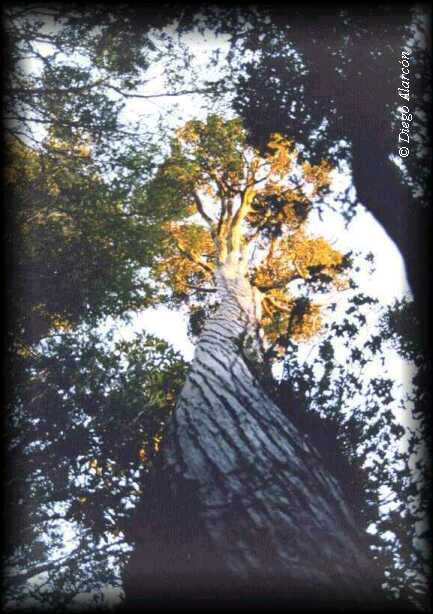
Tree of the Week for Dec. 16th-Dec. 23rd, Picea abies

Well, today is the Midnight of the year, the Winter Solstice. We have not only entered into the night, we are at its middle. The days of light and joy are long behind us, and not even a memory remains. And though light, and spring, and flowers will come again, it shall be many moons before that happens. So come, let us huddle together by our radiators, for warmth, and tell stories of the great northern tree which is held sacred by our society as the ultimate "Christmas Tree".


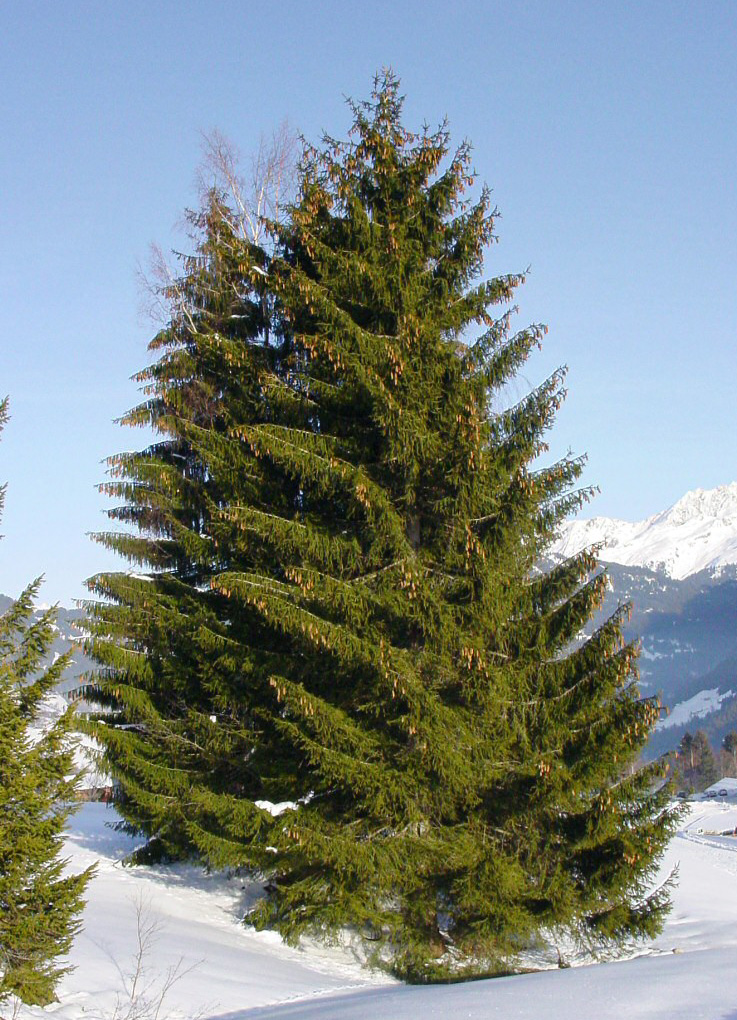
There are many different trees which are used as "Christmas trees" by our culture; everything from pines, to firs, to exotic Southern araucarias are used. But the most stereotypical of christmas trees, the one whose form rather defines what a christmas tree "ought" to look like, and is most aped by the plastic artificial trees many homeowners use, is the spruce genus, Picea. And so, this week, we will look at one of the most successful members of that genus, Picea abies, the Norway Spruce.

It seems fitting, to me, that Spruces should be used as the centerpoint of a celebration that takes place in the dead midnight of the year, when even the hardiest of deciduous trees give up their ghost and prepare for spring, and all but the sempiternal non-migratory birds have fled for warmer climes, taking hosts of retirees and vacationeers with them. For the spruce is a dark tree, and spruce forests always seem to me to have an alien and foreboding air about them. It is in such a place, one thinks, that one might encounter, not merely the ogres and ghosts that people's imaginations have traditionally populated all forests with, but rather with some eldritch Lovecraftian horror from beyond time.

Of course, all this is superstition, just as surely as Santa Claus (no, i do not mean it, my dark masters! i say such things only so that the unconverted may not know of our plans! Iä! Iä! Ph'nglui mglw'nafh Cthulhu R'lyeh wgah'nagl ph'tagn! Iä! Iä!), but I have always thought that Spruce trees had something foreboding and sinister about them. But this is most easily explainable by their shape, for Spruces, members of genus Picea, do have that classic, conical "Christmas Tree" shape. Which is all well and charming when the tree is young, but if, as the tree grows older, the lower branches do not fall off (or are not pruned off), what you will have is a monster, between whose dense boughs one is utterly unable to walk, and who casts a shadow so dense as to make the ground beneath even a fully-clothed maple tree seem bright and sunny. It is a dense mass of hard leaves, hard wood, and hard twigs, and it seems secretive and brooding, aloof and ancient beyond its years.

But moving on from these flights of poetry, how does one identify Picea abies, the Norway Spruce? For Spruces, as a group, are difficult to distinguish from certain relatives of theirs, such as the firs and Douglas-Firs, and so even once one has determined that a given tree is a Spruce, to then proceed to ascertain which kind of spruce it is takes a really keen botanical eye and memory. So, let's begin!

The first thing I always do when I suspect a tree of being a Spruce is examine its needles. Now, in spruces, the needles are attached to the branches by small, wooden pegs, called pulvini (singular pulvinus). Seeing as how an individual Spruce needle has a lifespan of only 4-10 years, then, the branches of a spruce are covered with these rough bumps, allowing one to easily place one's tree squarely within the genus Picea, without even the need to look closely at individual needles, asking "Hmm...is that a pulvinus, or just a lump?".

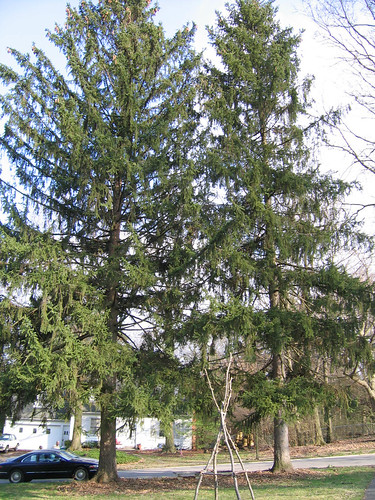
Within the genus, things get trickier, but by the following features can one distinguish one's Picea abies. The Norway Spruce is known for its drooping branches, which make it look as if the tree were but a dead skeleton, and had been draped in wreaths and garlands by mourners. But not all Norway Spruces have this feature; some - especially the trimmed and cropped ones found in well-maintained gardens - have the tighter growth habit that is more stereotypical of the genus.

Returning to the tree's needles, which spiral around their branch in mathematical whorls, they are four-sided and small, typically less than 4/5" in length. They most typically are dark green in color, but P. abies is a rather varied species in this regard, and they can sometimes be lighter.

Contrariwise from their small needles, Norway Spruces have very large cones, much larger than those of most other spruces. These light brown & hairless cones can grow up to 7 or 8 inches in length. Growing downward from the twig (unlike the cones of the true firs, which grow upwards from it), they have numerous diamond-shaped scales that are sharp and pointy, making them great for use as extra armament in a snowball fight.

And of the tree itself? Ignoring these piddling details of identification, what can we say of Picea abies on the whole? Well, as its common name suggests, it is indeed native to the Old World rather than to the New. There, it can be found throughout Eastern europe, from Norway to Poland and the Baltic States to the Balkan highlands to the dark forests of northwestern Russia. It grows in the Carpathian Mountains, in Transylvania, and it is sure that this dark, haunted tree broods around the castle of the infamous Vlad the Impaler, better known in the West as Count Dracula. It grows in those lands most favored by the Romani, and in the homelands of the Vikings. In these ancestral European haunts of P. abies, it is one of the tallest trees around, regularly peeking up to heights of 120 or 130 feet; and the tallest verified specimen, west of Moscow in the Russian Federation, is 160 feet tall. There are, however, unverified reports of giants growing up to 200 feet in height. The dendrological community awaits verification of these with bated breath.

But here in North America, home to so many other giant trees, P. abies does not grow so high, and it normally must be satisfied with a mere 60 or 70 feet. Still, this makes it a respectable forest tree, and there are plenty of individuals who grow taller, whose tops reach some 80 or 90 feet. I do not know why the Western Hemisphere has proven so much less to its liking then the Old Countries; I can think of all manner of superstitious notions to correspond with my fanciful ideas of the genus Picea's association with the Powers of Darkness; but as for reasonable, scientific ideas, I have none.

The Norway Spruce is widely planted here, though, both as an ornamental tree in cities and gardens, and as a harvested tree planted in managed forests. It is grown both for the annual Winter sacrificing of evergreens as "Christmas Trees", and for its wood. In its rôle as the former, it strikes a somewhat paradoxical pose. For, although it is perhaps the most popular Christmas Tree in the world, it is also rather singularly unfitted for that purpose, as it sheds its needles in droves as the tree dries out, making a mess all over one's living room carpet. In timber production this tree, like all spruces, is valued by papermakers, for its straight grains give no impedence to their pulping machines. But despite the numbers of Norway Spruces that have been planted on our continent, it has not become invasive. No, just as the American examples of P. abies are content to reach heights of merely 20 or 30 meters (whoa-pah! ninja units switch!), so are they content to brood in silence, lazily not venturing to conquer more ground than is bequeathed to them by the short-lived Humans who seem to love them so.


Content to brood in silence since 1986,
--mark

Wednesday, December 12, 2007

Tree of the Week for Dec. 9th-Dec. 16th, 2007: Rhamnus cathartica

There are weeks when the claim that Chicago lies in a "Temperate" climate zone seems like a bitter joke; this is one of them. But by the hells is all that snow purty! Anyway, I apologize for the extreme lateness of this entry; it was supposed to be for last week, not this one.


Support our Troops, Ladies 'n Gentleman! They are in the midst of terrible battles, fighting an enemy that seems to sprout up irrepressibly no matter how often he is beaten down. It requires the every effort of our noble fighting men and women merely to prevent this enemy from overrunning our entire nation, in the process destroying the beauty of this great Union. The enemy I am referring to is, of course, the European Buckthorn, Rhamnus cathartica, and the soldiers I am speaking of have no connection to the United States Millitary, but rather are the serried ranks of the nation's arborists, horticulturalists, foresters, gardeners, and park rangers, who are, even as I speak, taking advantage of the roominess which the winter season imparts to deciduous forests to hunt down and destroy as many instances of this tree that they can find.

Why this extreme prejudice against this plant? Are we not taught, as followers in Darwin's footsteps, that no organism is intrinsically wicked, but all are merely doing what they can to survive? Aye, we are, and indeed this is one of the dictums to which I have pledged my life. But if we wish to act in the world, and ourselves engage in the battle for survival, rather than merely become spectators doomed to eventual extinction, than we must make value judgements of some sort; we must say that we prefer some eventualities to others, and then act to ensure that the eventualities we prefer come to fruition, whereas those that we dislike remain the province of 'alternate historians' and others in love with the question "What If?" And despite what many with strong opinions, especially in politics and religion, seem to think, it is possible to make such value judgements without condemning those eventualities, or individuals, that we wish to avoid as 'Evil'.

So it is with R. cathartica. There is nothing wrong with the species; indeed, there is much to admire about it, as you will see as this entry progresses, and in its native Eurasia and Africa, it is a valuable part of the ecological community. But here in America, it is an invader, taking over spaces once inhabited by valuable, rare, and beautiful natives, and marginalizing them, putting them at great risk. Therefore, conservationists in this country are quite right to seek it out with chainsaws and axes, slaying it wherever found. For its spread poses a grave threat to the biodiversity of our country and continent.

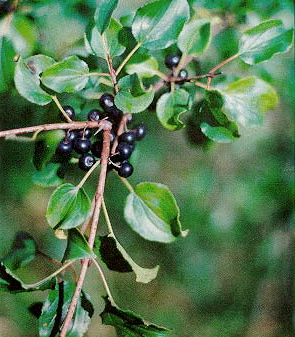
In appearance, a single buckthorn seems a rather unassuming plant. It is oftentimes more shrubby than tree-like, growing up from several thin, closely clustered "trunks", and seldom growing any taller than twenty feet, though very, very occasionally it will reach thirty feet. Its leaves are similarly plain; they are simple, coming in little pointed ellipses between 1.5 and 3 inches in length. These leaves are finely serrated, and have a simplistic and very regular pattern of leaf veins that is characteristic, and is one of the chief ways that I identify the plant. These leaves have a dark, faded green color, a color which seems almost designed not to attract attention amidst the various other hues, both the brighter and more somber ones, of the forest. But, despite this plainness, there is a certain classical symmetry to the buckthorn's leaves that make them appeal to my aesthetic sense in much the same way as do particularly well-designed pieces of modernist architecture. These leaves persist much longer into autumn and winter than do those of many other deciduous plants, one of the reasons why arborists frequently wait until November or December to hunt them down; for in the midst of the barren woods, a still-clothed buckthorn will stand out in a way that it completely fails to do the rest of the year.

And does it ever produce a lot of those leaves! Buckthorns might not be tall trees, but they can grow very densely, both as single, intricately-twisting shrubs, and as thickets, either of single, spindly plants, or even denser stands of bushy buckthorns. Equally as prodigious as their leaf output is their production of berries. The black, centimeter-wide fruit, poisonous to humans, of R. cathartica cluster thickly on its branches, and remains there long into, or sometimes even all the way through, the winter; another reason why it is more easily identifiable, and therefore easier to engage in "Seek-and-Destroy" missions, during the winter.

Its flowers, appearing greenish-yellow and four-petalled late in the spring, in May and June, are small and unobtrusive, though somewhat pretty in clusters, and give little hint of the plague that they prepare. R. cathartica is dioecious, meaning that male and female flowers appear on seperate plants, though they are indistinguishable to all but the acutest of botanical eyes.

Visually, by far the most interesting part of the European Buckthorn is its bark. Scaly and peeling, it has a rather baroque appearance. I have seen a lone buckthorn, straighter in habit than most of its race, standing all alone like a waymarker near the entrance of a forest preserve, and with its flaky bark it presented a most charming appearance. But rare is the chance one has of catching such an isolated buckthorn, and when they grow in thickets it is rare to catch such a glimpse of this pretty bark amidst the dense growths of branch and leaves! This bark is made even gorgeouser when the tree is wounded, for the tissue underneath can take on a bright orange color, looking like the warning colors of some poisonous insects. Ah! How often is this the case in life, that the gravest dangers come in secret, sneaking up on us all unawares, and giving no hint of the deadly peril they bring! Or some shit like that.

If one is curious as to which properties of the buckthorn's make it such a successful invader, one will find almost all of them listed, incognito, in the general description above. The thickets that it forms create shade so dense that almost nothing can grow beneath them, and these fast-spreading thickets not only stop native plants from appearing underneath, but also slowly edge out those that used to grow around them. And these thickets are, indeed, truly dense. Neighboring shrubs will not stop the spread of their branches until those branches actually come in contact with those of a neighboring plant. This creates an almost completely closed canopy, underneath which, even at noontime on a summer's day, all seems dim and twilit; not optimal growing conditions for any plant.

What allows a thicket of buckthorns to spread even more quickly are their berries, which it produces such a prodigial amount of. Wildlife seems to gobble these things down, thereby effecting their spread, but even those left on the tree will eventually fall to earth, and are likely to germinate thatwise. Fortunately, R. cathartica is unable to spread asexually, by suckers, like dandelions and sumacs can, so we are at least spared that horror, but the rapid growth of individual young buckthorns, when combined with their vast numbers, is damaging enough. And to many arborists, it surely seems as if the buckthorn can spread asexually, for they are tenaciously vital, and able to grow back from trunks cut nearly to the ground.

R. cathartica is also capable of growing on a huge variety of different soil types, further enhancing its ability to spread and conquer. Clay, sand, or chalk; well or poorly-drained; the only thing that the European Buckthorn demands of its soil is that it be none too acidic. And although it grows most vigorously under only light shade, it can withstand much denser shade, allowing it to come to dominate a forest's understory. The long wait which its leaves endure before finally falling, and their early return in the spring, gives the plant a chance to do some light-harvesting at times of year when its neighbors produce only very small amounts of shade.

So why should we care if this species is invading? Is this not the way of evolution, that the "more fit" replace the "less fit"? Bah, I say, bah! As all good evolutionary biologists know, to say that an organism is "fit" does not mean that it is particularly strong, or well-engineered; it just means that it's survived. Take, for example, Canis lupus familiaris, the domesticated dog. Now, I have been assured that, under wild conditions, this sub-species of the wolf would soon become extinct. It is not particularly "fit" in the way most people assume the phrase "Survival of the Fittest" means. And yet, evolutionists would consider it a remarkably "fit" organism. Spread widely across not only the six habitable continents, it is also one of the few species that has occasionally endured on that frozen desert which is our earth's seventh continent. And it has done so by forming a tight, symbiotic relationship with another extremely successful organism, Homo sapiens. The evolutionary features that allow that symbiosis are precisely those which would, in the wild, make the dog horribly "unfit". Like Buddhist sages and Jedi Masters, the dog gains strength through its very weakness.

Having thus dispelled any notion that the European Buckthorn's admittedly wide variety of talents makes it somehow 'moral' or 'right' for it to conquer our continent, let us examine the ecological and, indeed, economic damage that it causes. First, and obviously, it supresses the growth of native understory species in forests via its dense shade and rapid spread. But that shade also kills the saplings of taller trees, preventing regeneration of the forest as a whole; including any valuable timber trees that are present. Also, dead buckthorn leaves decay quickly, and have been showed by scientists to encourage the rapid decay of the rest of the forest litter. It turns out that this actually changes the whole composition of the forest's soil, changing slowly the ecology of the forest in a more subtle, but perhaps more important, way than its shade does - for the chemical changes in the soil have been shown to last for some time even after the removal of the Buckthorn. This rapid decay of forest litter also helps to supress forest fires, and so in forests whose health is dependent on regular forest fires it causes this further damage. R. catharticaalso plays host to several diseases and insects which, though not fatal to it, can cause damage to valuable crops like wheat and soybeans.

And so the nation's forestry professionals take their chainsaws to this Buckthorn species, hoping that they can chop down the thickets faster than they can regrow. But the problem is huge. It has spread all across the nation. On a personal level, I have seen, in the Lyman Woods near where my parents live, huge thickets of R. cathartica strangling the bases of the mighty cottonwoods that stand alone over the marshy areas of the forest, while even vaster monospecific strands lurk underneath the elms and silver maples of the forest proper. So oftentimes they resort to fire, that great purgative. This is, in truth, wise, for the European buckthorn is not a very fire resistant plant, and will succumb utterly to regular enough forest fires. But this strategy is unfeasable in some locations, whether because of nearness to human habitation, or because the forest in question is one composed of trees who are themselves vulnerable to fire. And, of course, "elimination" of buckthorns will always be temporary, because they can always return to locations from which they have been removed in the same way they got there in the first place: via their seeds. But forest management is not a societal function which has any foreseeable end; as long as there are forests, and humans who care about and depend upon them, it will be necessary for humans to coöperate with and put work into those forests. For, despite the prattlings of the Jurassic Park character Ian Malcolm, too much chaos in an ecosystem leads, not to adaptation, but to mass extinction.

Back in its native Old World haunts, R. cathartica is an important enough player in the ecosystem that Linnaeus named its family, the Rhamnaceae, after its genus, Rhamnus. This family, which flourishes primarily in subtropical regions, is not well-known in the Temperate regions whence our American civilization has its chiefest roots. But it does contain some seven or eight hundred known species, mostly shrubs and small trees.


Mostly shrubs and small trees since 1986,
--mark

Saturday, December 1, 2007

Late again, is Mark. He attributes this to the two following unfortunate facts: first, that he's been having a rough couple of weeks; and secondly, that the people whose interne Jane & I have been "borrowing" at our apartment has been either on the fritz, or has been told not to let us "borrow" it anymore. But, anyway, we're in double digits now! Cool, n'est-ce-pas?

Our tree this week is not a plant one oftentimes thinks of as a "tree". Although it is common enough in Urban landscapes, and is indeed a great favorite of the horticultural profession, when we city-slickers see it, it is as likely as not in the form of a mere shrub, forming an elegant hedge wall or framing the walk of some stately home or office-bearing massif.

But it in the wilderness, Thuja occidentalis (Thuja is pronounced "Thew-ya", NOT "Thew-ja"), the Eastern Arborvitae, can reach sizes that are more than respectable. The tallest currently known specimen, growing on South Manitou Island in the middle of Lake Michigan, is some 115 feet in height and nearly six feet in diameter. I should add here, for the sake of my own rememberance if nothing else, that next summer, when I take my epic month-long bikeride 'round that great Lake, I am going to have to take the ferry over to South Manitou Island for a "day-trip" to visit the ancient Arborvitae grove where that tree lies.

And when I say "ancient", I do mean it. The oldest living Arborvitae has seen some thousand cyclings of the earth 'round the sun, and stumps of dead arborvitaes have been found that dendochronoligists have calculated as being a millenium and a half in age at their death. I would like to regale you with stories of all the seemingly long lives of Men that can pass in that time, all the epic deeds and great sea-changes of fortune and destiny that humans can witness in such vast stretch of History; but instead of such an anthropocentric fancy, let us instead take a more dendrocentric approach. Consider, not what human deeds can pass in 1500 years, but rather the epic struggles that that tree has had to endure. Imagine the thousands of lightning storms its endured, with those bolts of Zeus far hotter than the surface of the Sun arcing down from the sky towards this tree. Imagine those fifteen hundred winters it saw, enduring cold, bitter cold, without the aid of either shelter or fire, and with neither warm blood in its veins to keep its innrt flame going, nor the blissful hibernation of toads and deciduous trees which bringeth nepenthe and rest. Imagine the numberless droughts it endured, lasting far longer without any water to soothe its thirst than any fragile human could hope to! Imagine its timeless battles with its pestilent predators, the millions of birds, insects, and tearing, biting deer who have feasted on its green succulence for those ages of its life, but all of whom it has out-lived, and laughed at, though it is but an immobile plant and cannot evade their hunger. And imagine its constant exertion, its constant upward and downward growth, building a spire in defiance of all gravity and wind, and cracking the solid, immemorial rocks themselves with its roots as they twine deeper and deeper in their quest food. What could have killed such a thing? Was it humans, whose axes and saws fell it and then mutilated its corpse to serve as the roofing for their dwellings? Was it some lightning bolt which the tree could not evade or survive? Or was it simply old age, simply the slow decay of vitality and life which could now no longer be avoided?

I have no idea, I'm afraid, and, what's more, I fear I am getting quite ahead of myself. I've allowed myself to tell a tale of high drama and storybook legend without first giving any hint of the main character's personality! And though I flatter myself that my friends are intelligent people, capable of deducing much from minimal information, still it would take someone with powers greater than those of Mr. Holmes or M. Dupin to extract much information about Thuja occidentalis from the above rhapsodies.

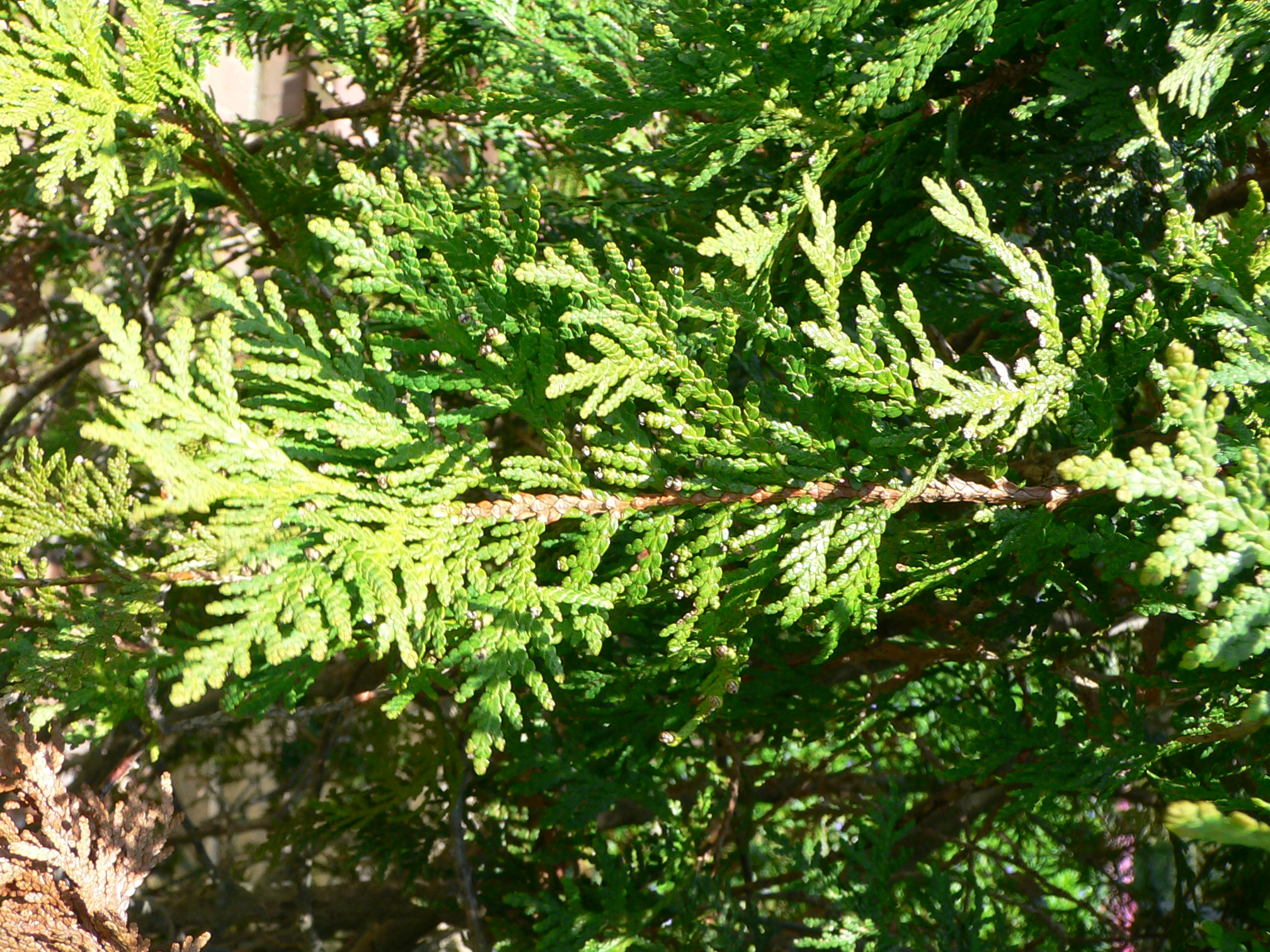
Worldwide, there are five species within the genus Thuja. There is, of course, T. occidentalis, the species under question, which is native to the Northeastern region of our continent. There is another species, T. plicata, native to the West coast. The other three species are found in the far Orient, in China, Korea, and Japan. As a group, these trees are remarkably easy to distinguish from all other trees. Principally, this is because of their branches, which look as if they've been pressed flat by an iron. These branches are enveloped by the small, scale-like leaves that stick out of them. Arborvitae scales are soft, too, quite unlike the jagged needles produced by various junipers. All that being said, distinguishing between one species of Thuja and another can be a real bitch, as can be distinguishing between Thuja species and those of the related genera Platycladus and Thujopsis, also commonly known as "arborvitaes". Now, in general, in urban areas, the arborvitaes you will be seeing are either going to be Thuja occidentalis, or Platycladus orientalis (formerly known as T. orientalis, but now transferred over to the other genus), one of the Chinese species of arborvitaes. You can tell the difference by a close inspection of the leaves. The scales on T. occidentalis are darker and more tightly attached to their branch than those of P. orientalis, whose leaves are a lighter color and have a greater tendency to 'flare' off from their branches. Furthermore, the leaves of true members of the genus Thuja, unlike those of the related Platycladus, will emit a pleasing odor if crushed. Also, if you will look closely at the pictures I linked to above, you will notice that, on the scales of T. occidentalis, you will note that they have on them a tiny "dot". This dot is a gland of some sort (I confess that I know not what its function is) and is unique to T. occidentalis, allowing it to be distinguished from all other arborvitaes.

Being a coniferous plant, the eastern arborvitae reproduces via its cones, slender, elliptical things just a centimeter or two in length. At this time of year, they are brown, ripe, and mature; earlier in the season, before their final ripening, they wore a bright yellow hue. Though the species be long-lived, they are also precocious, and begin producing sexually mature cones at the age of six years or so. But it is not until they enter their adolescence, at their 75th-odd birthday, that they really start to crank out the seeds.

Now, I know that in my lengthy introduction I may have stated that T. occidentalis can be a mighty tree, streaking up over a hundred feet into the air. Technically, this is true. There do exist such mighty specimens of the species. But that tree is an extreme outlier. In general, this arborvitae is a much more humble plant, growing to maybe forty feet in height. It is a slow-growing tree, as well, oftentimes adding significantly less than a foot to its height over the course of an entire year. It is reasonably shade tolerant, and so can often function as an understory tree; but its slow growth and small height makes it rather thoroughly unable to actually compete in the forest canopy. So, instead of trying to compete against foes it knows it can't beat, T. occidentalis opts instead to play a different game. The arborvitae can be found in all sorts of extreme environments where more traditional trees find themselves completely at a loss. On the edges of swamps and bogs, where the soil oxygen content is low, and water regularly washes away both nutrients and the stabilizing soil, the eastern arborvitae will, if not quite thrive, then certainly at the least survive. And many of the very oldest individuals can be found on the sides of cliffs, as simultaneously tiny, stunted, and ancient as Yoda himself. There, they thrust their roots into rocks, cracking the solid mineral apart in their quest for whatever little food they can find in this demanding habitat. Whipped by fierce, biting winds for which they have no protection, they are lucky to hit the two meter mark. But, though stunted, they endure, and without any competition, and isolated from the depradations of their mortal nemesis, the white-tailed deer, Odocoileus virginianus, they have little to fear from Father Time, and can count themselves un-lucky if they do not live to celebrate their 500th birthday. Making it even more difficult to kill, To. occidentalis can grow back from a stump, and can even send out shoots that grow into new trees, allowing it to reproduce asexually; rare feats for a conifer.

Still, despite its ability to survive in such harsh climes, the favored place of growth of the Eastern Arborvitae is in the rich, cool, and moist but well-drained soils at the southern edge of the great Boreal forests of the North. In that habitat, though, it suffers dearly from its inability to compete with the taller, faster-growing firs, spruces, birches, and maples, and also from its vulnerability to the many ravenous stomachs of the white-tailed deer. During the winter, when the broadleaves have lost their foliage, the soft, feathery fronds (which are great for tickling people with, by the way) of T. occidentalis become immensely appealing to these deer, who strip them from the tree with gusto. Given the skyrocketing deer populations that our nation's often misguided wilderness management policies have fostered, in many areas our Eastern Arborvitae is becoming rarer. Not that it is endangered; as a species, it still does flourish and is at no more risk of becoming extinct than Humanity itself. But just as certain populations of humans may come to risk by the local disasters such as floods, droughts, wars, plague, and famine, so are these Arborvitae clans having to face the Plague of Deer, which is for them a disaster most terrible.

Speaking of Humanity, our two species, Homo sapiens and Thuja occidentalis, have a long history of interaction. When the first explorers ventured onto this continent from their native Kamchatka some 12,000 years ago, they discovered that this plant had a bevy of uses. Its leaves had certain medicinal properties that proved efficacious against some ailments, and its bark and wood, though in many respects weak and flimsy, was found to be easy to work with, lightweight, resistant to rot, and very "tough", and so they used it for structural components in their well crafted birchbark canoes. When the next great wave of colonists came to our shores in the 1500 and 1600s, and brought with them that greatest of all human inventions, Literacy, they recorded their encounters with the tree. It was during the voyages of Jacques Cartier that news of the tree first entered into History. For during the winter of 1835-36, M. Cartier and men of his fellow adventurers grew ill with the Scurvy. They were bleeding from their pores; their gums were sloughing off; they were covered in sores; wounds and fractures they had once thought long-healed would re-open. They were miserable. But, being made of that sturdy stuff which anyone, from any age, who decides to become an Adventurer must be made of, if he wants not to die, they kept on. One of their guides, a man named Domagaya, the son of a chief whose people had lived in that area since time immemorial (immemorial to them, perhaps, although doubtlessly the Arborvitae elders would have a different story to tell) had gotten so sick with the scurvy that they had to leave him behind. They couldn't afford to take him with them any further. Continuing on, they were surprised when, in a few days, they encountered their friend Domagaya, looking as hale and hearty as a Grecian athlete! After first ascertaining that he was, indeed, alive, and not some shade from beyond the grave, they asked him how he came to be healed of his scurvy. He told them that he simply made a tea from the leaves of a certain tree, which his people called "annedda", and drank some of it every day, and the officinal virtue contained therein healed his malady. M. Cartier and his comrades, of course, begged Domagaya to show them this wonderous plant, that they too might be relieved of their agonies through its aid. Domagaya then nonchalantly took them to a stand of Thuja occidentalis, and told them that 'twas from this tree that he obtained the leaves. And by following his advice were Jacques Cartier and his band of Frenchmen healed; for the leaves of this arborvitae are rich in Vitamin C, and therefore are indeed capable of curing the scurvy. It was in honor of this life-saving power that the tree was given the name of 'Arborvitae', meaning "Tree of Life", by European horticulturalists. Should any of my readers decide to try to make their own arborvitae tea, in lieu, perhaps, of a glass of OJ in the morning. I would caution you, though it should be obvious, not to brew it from any arborvitae you find growing in a city, for it doubtlessly has, by accident, incorporated into its vital matter some of the toxins that are commonly found in the urban air and earth.

The story of the intermingling of our two species continues, for the Eastern Arborvitae was among the very first trees from the Westlands that European explorers brought back to their home countries for cultivation. It is known for a fact that the gardens of the burgeoning civilizations of that continent were graced by T. occidentalis' prescence as early as the 1560s. The tree is still loved by gardeners, for its unique lacy foliage, its handsome reddish bark and its neat, slender conical form. Its long life and durability help make it popular, too, for if one plant in a gardener's demesne is easy to take care of, then the gardener will have more time to look after his or her more fragile plants. That same slenderness of form and longevity have also made it perfect for the formation of tall hedges, living screens and walls, and other such formal features which many gardeners (for reasons unbeknownst to this one) so enjoy to play with.

Now that you've been formally introduced to T. occidentalis, you can perhaps better appreciate my earlier anecdotes. And, being well-bred individuals all, you probably are now wondering about the lineage from which T. occidentalis has sprung. Allow me to assure you that it comes from a truly noble family; indeed, there are many who would rank its family as the noblest in all the Plant kingdom. That family is the Cupressaceae, the Cypress family. While I said several weeks ago, in my report on Pseudotsuga menziesii, the Douglas-Fir, that the Pinaceae is the coniferous family which has best survived during the past 90 million years of flowering plants, the Cupressaceae must be a close second. And indeed, though the Pinaceae might contain more species, it is purely Northern in its habitat, whereas the Cupressaceae, as befitting such a distinguished lineage, is more cosmopolitan, and can be found growing natively on all continents, save Antarctica. It can count among its members not only the arborvitae, but also such plants as the Junipers, the Cypresses, the Japanese Sugi tree, the massive (and long-living!) Fitzroya of South America, and the strangely beautiful Chamaecyparis.

But, though these are all excellent trees, it is not they who confer on the Cupressaceae their high status. Indeed, it was not until recent times, and the advent of molecular and genetic taxonomy, that it was understood just how exalted a group the Cupressaceae was. For those studies proved that the Taxodiaceae, the Bald-Cypress family, could not be considered as a true monophyletic group, seperate from the Cupressaceae; and that any reasonable evolutionary definition of the Cupressaceae would have to include the Taxodiaceae, as this handy diagram from Wikipedia clearly shows. And the Taxodiaceae, in addition to the magnificent Bald-Cypress, also includes such blue-blooded royals as Sequoia sempervirens, the Coastal Redwood, and Sequoiadendron giganteum, the Giant Sequoia. Now folded in to the new Cupressaceae, they add into an already aristocratic family the blood...er, the sap, anyway...of Emperors.

Containing the sap of emperors since 1986,
--mark