Support our Troops, Ladies 'n Gentleman! They are in the midst of terrible battles, fighting an enemy that seems to sprout up irrepressibly no matter how often he is beaten down. It requires the every effort of our noble fighting men and women merely to prevent this enemy from overrunning our entire nation, in the process destroying the beauty of this great Union. The enemy I am referring to is, of course, the European Buckthorn, Rhamnus cathartica, and the soldiers I am speaking of have no connection to the United States Millitary, but rather are the serried ranks of the nation's arborists, horticulturalists, foresters, gardeners, and park rangers, who are, even as I speak, taking advantage of the roominess which the winter season imparts to deciduous forests to hunt down and destroy as many instances of this tree that they can find.
Why this extreme prejudice against this plant? Are we not taught, as followers in Darwin's footsteps, that no organism is intrinsically wicked, but all are merely doing what they can to survive? Aye, we are, and indeed this is one of the dictums to which I have pledged my life. But if we wish to act in the world, and ourselves engage in the battle for survival, rather than merely become spectators doomed to eventual extinction, than we must make value judgements of some sort; we must say that we prefer some eventualities to others, and then act to ensure that the eventualities we prefer come to fruition, whereas those that we dislike remain the province of 'alternate historians' and others in love with the question "What If?" And despite what many with strong opinions, especially in politics and religion, seem to think, it is possible to make such value judgements without condemning those eventualities, or individuals, that we wish to avoid as 'Evil'.
So it is with R. cathartica. There is nothing wrong with the species; indeed, there is much to admire about it, as you will see as this entry progresses, and in its native Eurasia and Africa, it is a valuable part of the ecological community. But here in America, it is an invader, taking over spaces once inhabited by valuable, rare, and beautiful natives, and marginalizing them, putting them at great risk. Therefore, conservationists in this country are quite right to seek it out with chainsaws and axes, slaying it wherever found. For its spread poses a grave threat to the biodiversity of our country and continent.
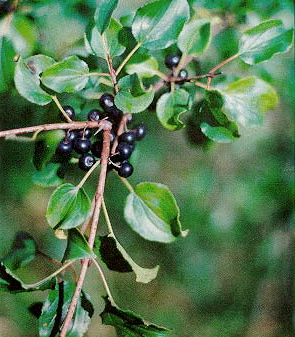
In appearance, a single buckthorn seems a rather unassuming plant. It is oftentimes more shrubby than tree-like, growing up from several thin, closely clustered "trunks", and seldom growing any taller than twenty feet, though very, very occasionally it will reach thirty feet. Its leaves are similarly plain; they are simple, coming in little pointed ellipses between 1.5 and 3 inches in length. These leaves are finely serrated, and have a simplistic and very regular pattern of leaf veins that is characteristic, and is one of the chief ways that I identify the plant. These leaves have a dark, faded green color, a color which seems almost designed not to attract attention amidst the various other hues, both the brighter and more somber ones, of the forest. But, despite this plainness, there is a certain classical symmetry to the buckthorn's leaves that make them appeal to my aesthetic sense in much the same way as do particularly well-designed pieces of modernist architecture. These leaves persist much longer into autumn and winter than do those of many other deciduous plants, one of the reasons why arborists frequently wait until November or December to hunt them down; for in the midst of the barren woods, a still-clothed buckthorn will stand out in a way that it completely fails to do the rest of the year.
And does it ever produce a lot of those leaves! Buckthorns might not be tall trees, but they can grow very densely, both as single, intricately-twisting shrubs, and as thickets, either of single, spindly plants, or even denser stands of bushy buckthorns. Equally as prodigious as their leaf output is their production of berries. The black, centimeter-wide fruit, poisonous to humans, of R. cathartica cluster thickly on its branches, and remains there long into, or sometimes even all the way through, the winter; another reason why it is more easily identifiable, and therefore easier to engage in "Seek-and-Destroy" missions, during the winter.
Its flowers, appearing greenish-yellow and four-petalled late in the spring, in May and June, are small and unobtrusive, though somewhat pretty in clusters, and give little hint of the plague that they prepare. R. cathartica is dioecious, meaning that male and female flowers appear on seperate plants, though they are indistinguishable to all but the acutest of botanical eyes.
Visually, by far the most interesting part of the European Buckthorn is its bark. Scaly and peeling, it has a rather baroque appearance. I have seen a lone buckthorn, straighter in habit than most of its race, standing all alone like a waymarker near the entrance of a forest preserve, and with its flaky bark it presented a most charming appearance. But rare is the chance one has of catching such an isolated buckthorn, and when they grow in thickets it is rare to catch such a glimpse of this pretty bark amidst the dense growths of branch and leaves! This bark is made even gorgeouser when the tree is wounded, for the tissue underneath can take on a bright orange color, looking like the warning colors of some poisonous insects. Ah! How often is this the case in life, that the gravest dangers come in secret, sneaking up on us all unawares, and giving no hint of the deadly peril they bring! Or some shit like that.
If one is curious as to which properties of the buckthorn's make it such a successful invader, one will find almost all of them listed, incognito, in the general description above. The thickets that it forms create shade so dense that almost nothing can grow beneath them, and these fast-spreading thickets not only stop native plants from appearing underneath, but also slowly edge out those that used to grow around them. And these thickets are, indeed, truly dense. Neighboring shrubs will not stop the spread of their branches until those branches actually come in contact with those of a neighboring plant. This creates an almost completely closed canopy, underneath which, even at noontime on a summer's day, all seems dim and twilit; not optimal growing conditions for any plant.
What allows a thicket of buckthorns to spread even more quickly are their berries, which it produces such a prodigial amount of. Wildlife seems to gobble these things down, thereby effecting their spread, but even those left on the tree will eventually fall to earth, and are likely to germinate thatwise. Fortunately, R. cathartica is unable to spread asexually, by suckers, like dandelions and sumacs can, so we are at least spared that horror, but the rapid growth of individual young buckthorns, when combined with their vast numbers, is damaging enough. And to many arborists, it surely seems as if the buckthorn can spread asexually, for they are tenaciously vital, and able to grow back from trunks cut nearly to the ground.
R. cathartica is also capable of growing on a huge variety of different soil types, further enhancing its ability to spread and conquer. Clay, sand, or chalk; well or poorly-drained; the only thing that the European Buckthorn demands of its soil is that it be none too acidic. And although it grows most vigorously under only light shade, it can withstand much denser shade, allowing it to come to dominate a forest's understory. The long wait which its leaves endure before finally falling, and their early return in the spring, gives the plant a chance to do some light-harvesting at times of year when its neighbors produce only very small amounts of shade.
So why should we care if this species is invading? Is this not the way of evolution, that the "more fit" replace the "less fit"? Bah, I say, bah! As all good evolutionary biologists know, to say that an organism is "fit" does not mean that it is particularly strong, or well-engineered; it just means that it's survived. Take, for example, Canis lupus familiaris, the domesticated dog. Now, I have been assured that, under wild conditions, this sub-species of the wolf would soon become extinct. It is not particularly "fit" in the way most people assume the phrase "Survival of the Fittest" means. And yet, evolutionists would consider it a remarkably "fit" organism. Spread widely across not only the six habitable continents, it is also one of the few species that has occasionally endured on that frozen desert which is our earth's seventh continent. And it has done so by forming a tight, symbiotic relationship with another extremely successful organism, Homo sapiens. The evolutionary features that allow that symbiosis are precisely those which would, in the wild, make the dog horribly "unfit". Like Buddhist sages and Jedi Masters, the dog gains strength through its very weakness.
Having thus dispelled any notion that the European Buckthorn's admittedly wide variety of talents makes it somehow 'moral' or 'right' for it to conquer our continent, let us examine the ecological and, indeed, economic damage that it causes. First, and obviously, it supresses the growth of native understory species in forests via its dense shade and rapid spread. But that shade also kills the saplings of taller trees, preventing regeneration of the forest as a whole; including any valuable timber trees that are present. Also, dead buckthorn leaves decay quickly, and have been showed by scientists to encourage the rapid decay of the rest of the forest litter. It turns out that this actually changes the whole composition of the forest's soil, changing slowly the ecology of the forest in a more subtle, but perhaps more important, way than its shade does - for the chemical changes in the soil have been shown to last for some time even after the removal of the Buckthorn. This rapid decay of forest litter also helps to supress forest fires, and so in forests whose health is dependent on regular forest fires it causes this further damage. R. catharticaalso plays host to several diseases and insects which, though not fatal to it, can cause damage to valuable crops like wheat and soybeans.
And so the nation's forestry professionals take their chainsaws to this Buckthorn species, hoping that they can chop down the thickets faster than they can regrow. But the problem is huge. It has spread all across the nation. On a personal level, I have seen, in the Lyman Woods near where my parents live, huge thickets of R. cathartica strangling the bases of the mighty cottonwoods that stand alone over the marshy areas of the forest, while even vaster monospecific strands lurk underneath the elms and silver maples of the forest proper. So oftentimes they resort to fire, that great purgative. This is, in truth, wise, for the European buckthorn is not a very fire resistant plant, and will succumb utterly to regular enough forest fires. But this strategy is unfeasable in some locations, whether because of nearness to human habitation, or because the forest in question is one composed of trees who are themselves vulnerable to fire. And, of course, "elimination" of buckthorns will always be temporary, because they can always return to locations from which they have been removed in the same way they got there in the first place: via their seeds. But forest management is not a societal function which has any foreseeable end; as long as there are forests, and humans who care about and depend upon them, it will be necessary for humans to coöperate with and put work into those forests. For, despite the prattlings of the Jurassic Park character Ian Malcolm, too much chaos in an ecosystem leads, not to adaptation, but to mass extinction.
Back in its native Old World haunts, R. cathartica is an important enough player in the ecosystem that Linnaeus named its family, the Rhamnaceae, after its genus, Rhamnus. This family, which flourishes primarily in subtropical regions, is not well-known in the Temperate regions whence our American civilization has its chiefest roots. But it does contain some seven or eight hundred known species, mostly shrubs and small trees.
Mostly shrubs and small trees since 1986,
--mark




No comments:
Post a Comment