Well, I've gotten my computer back in working order, and I've also gotten up off my lazy ass and back to work, and so the long hiatus is over, and I'm posting a new(!) Tree of the Week entry.
As I may have mentioned before, I am no fan of winter. Aye, I know that it is a mark of the truly refined botanical æsthetic to appreciate the barren, fractal forms of deciduous trees in winter, and certainly they are still pretty. The same cool breath that shears them of their leaves also reveals their underlying architecture in all its complexity, revealing just how bizarre and intricate a thing a tree is. But nevertheless the monotony of winter, its monochromatic grayness (especially in a major urban agglomeration like Chicago), and above all its bloody coldness; after the first few weeks winter loses its charm for me, and all these things begin to take their toll on my mind.
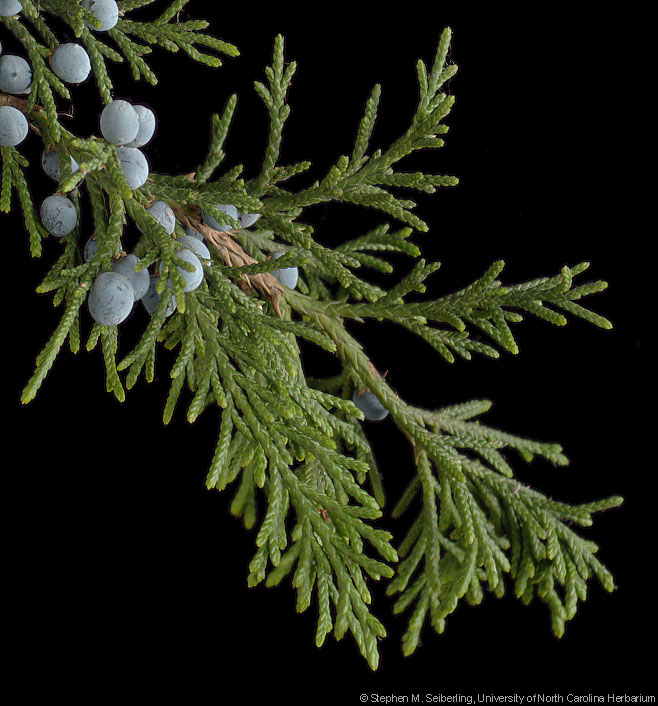
So this week's tree, Juniperus virginiana, the Eastern Redcedar, always appears to me as a piece of vital nourishment during these long months of long nights. Not only is it an evergreen tree, but it is a particularly charming and even fanciful one. Its spiraling and scaly foliage adorns the tree in impressionistic masses, sometimes sharp and jagged, and sometimes softer and gentler. At the same time, its bark has a richred-brown color, and it oftentimes peels off in narrow strips. Between the foliage, which is so different from that of trees we are more used to, whether broadleafs or needled conifers, and the fibrous bark, J. virginiana adds a great deal of texture and charm to a winter scene. Really, it does this all the year long, for it looks as out of place in an urban landscape as Queequeg did, but it is in winter, when the taller trees of the city are shorn of leaves, and when its vibrant leaves and bark are set off bythe whiteness of the snow and the alternating dim grey or shining pale blue of the sky, that its charms become the most noticeable. To my eyes, sighting one of these lovely creatures during the middle of winter in Chicago is like seeing a familiar face while travelling in a foreign country where everyone dresses and behaves strangely.
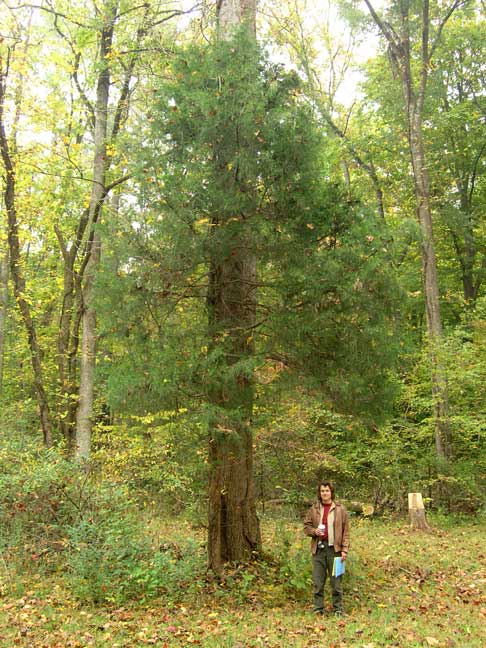
Now, you may have noticed that I earlier mentioned that other urban trees are generally taller than this redcedar. This is true not only of urban trees, but of trees in general. J. virginiana is not, typically, a very tall tree. True, in the Southlands, on good soil, it can reach heroic proportions - the recordholder Eastern Redcedar, in East Texas (according to the Gymnosperm Database, anyway), is 27 m (≈95 ft) tall - but in general, even in those warmer climes where the growing season lasts throughout the year, the redcedar is typically a more humble tree of perhaps ten meters. It is habitually a tree of the understory, though its relegation to such conditions is in large part due to the bullying competition of other trees. J. virginiana is a particularly light-hungry tree, and so in the shade of an established forest it grows but slowly. Still, despite the tree's thirst for light, it is oftentimes found, stunted but surviving, in the shade of bigger trees. According to some botanists, when crowded out by taller neighbors, J. virginiana slows down its own metabolism, especially during the summer months, and waits until the winter months, when the broadleaves are all leafless, to grow. It estivates, sleeping through the drowsy summer months only to work itself into a frenzy during the cold winter.
But while the tree might not be the tallest in the forest, it possesses a tolerance that few of its more massive neighbors can match. It can grow in both acidic and alkaline soils, able to withstand soil pHs of anywhere from 4.7 to 8. Nor does it mind thin, rocky soils; like many other junipers, the redcedar has a dense, fibrous root system that is capable of holding onto any soil it can find. The Eastern Redcedar is ths a force against the actions of erosion, one of the invisible hands which hold the Appalachians in place and prevent all the dirt that covers their slopes from washing down the Ohio and into the Mississippi delta. Of course, in the paradoxical manner of Nature, in different areas this tree also acts as an agent encouraging erosion. On the limestone outcroppings of the lower Midwest, from Starved Rock down to Tennessee (including eastern and central Missouri, where I saw a good many handsome redcedars growing when I journeyed there with Jane last year) J. virginiana will thrust its roots down into cracks in the limestone to seek out soil that is inaccessible to other plants, and incidentally widening those cracks slowly and weakening the structure of the already soft limestone. It is a drought tolerant tree, too, able to survive, according to the USDA, on as little as 15 inches of precipitation a year. For comparison, Phoenix, AZ, a city in the middle of the desert, gets about 8 inches a year, Chicago gets 36 inches, and Baton Rouge, LA, a city in the middle of a swamp, gets 63 inches.
J. virginiana's combined drought tolerance, erosion controlling abilities, and dense foliage have made it a favorite for Midwestern farmers looking for a good windbreak tree. During the dust bowl of the 1930s, the second of these properties especially caused the U.S. government to encourage farmers to plant these trees wherever possible. An excellent idea in principle, but it had unfortunate long-term side effects. Since those days these trees have spread dangerously across the eastern plains states, threatening what little's left of the once vast American prairies. In olden days, before large-scale agriculture was introduced north of the Rio Grande by the European colonists, regular prairie fires were responsible for preventing the spread of this tree, for it is not by any means a fire-resistant species. But the replacement of the tallgrass prairies with wheat, maize, and (more recently) soybean farms, and the understandably strict anti-fire policies of the farmers and the U.S. government, have removed this once formidable barrier to the Redcedar's expansion. So it has spread, becoming an invasive species even in areas to which it has always been native.
It is lamentable fact that this incident is merely one in a long series of ecological disasters that our Republic has unwittingly caused in the Great Plains states. It is my theory that our Euroamerican culture never really understood these vast American steppes, in the way that we understood the forests and mountains of the eastern and western states. In those wooded lands, according to this pet theory of mine, the ecological problems that are currently being faced have been primarily the result of greed and callousness. Whereas in the prairie states of the continents dry center the ecological problems have in large part been caused by ignorance and misguidedness, as illustrated in my above example. It seems that our culture simply has no traditional framework for how to deal with such lands; which only makes sense, since while western Europe was, in its pristine state, filled to the brim with temperate forests and mountains, it was (and is) notably lacking in vast stretches of grassland. However, as is often the case, Science has stepped in to attempt to provide solutions to this problem. Recent research in the development of perennial cereal crops promises to allow for farms that are more in tune with the pre-existing ecological makeup of the open praire. We, as good Botanical Cadets, can only hope that this promise is in time fulfilled.
But I am wandering from the ostensible topic of Juniperus virginiana, so please forgive me for my digression. Now, where was I...? Ah, yes, I was discussing the natural hardiness of J. virginiana. As I said, the tree is adapted to a wide range of environmental situations. Nearly the only place that it cannot make itself at home at is areas with standing water. Redcedars prefer their soil well-drained, and get waterlogged easily. However, this is a minor disadvantage when compared with all their advantages, and the tree can be found, in nature, in all states east of the Mississippi, from Maine to Illinois to Florida, and a good handful west of that river too, from Texas to Minnesota. The only things that stop its spread are the fires of the West, the extreme cold of the boreal North, and the torrid heat of the tropical South.
It might seem that such a tree would be perfect for urban spaces. J. virginiana is of modest size, it possesses a natural grace and charm throughout the year, and its two weaknesses, fire and standing water, are both - one hopes! - notably absent in cities. And, indeed, I have read - although I'm afraid that my memory has lost the particular source - an arborist fervently reccomend that more of these charmers should be planted in our nation's metropolitan areas. But, alas, it seems that his advice has not been heeded. For whatever reason, urban planners seem immune to the Redcedar's charms, and plant them but scarcely. Perhaps it is because the tree's aforementioned dense root system makes it tough to transplant. Perhaps it is simply that, while they endure wonderfully in cities, they are not at their best there, and take some coaxing to grow to the height expected of a street tree. And even once they have grown to such a height, they produce a ponderously dense shade, and require much pruning, especially as they are apt to drop foliage in messy clumps irregularly throughout the year (or at least such has been my observation).
But while in the city proper the Eastern Redcedar is uncommonly planted, in the suburbs the careful eye will find it everywhere. Ocassionally, it is planted with a clear eye to its ornamental value, given a place of prominence in a yard. Such is the case at my parents' house, one corner of whose backyard is quietly dominated by the presence of a twenty-foot Redcedar. At other times, they are used in hedges, forming an unusually tall barrier between houses. The denseness of the tree's foliage, and its rapid growth compared to such other coniferous hedge mainstays as yews, make it perfect for those who believe that "good fences make good neighbors". And, of course, this hardy plant is commmon in forest preserves, woodlots, and other such undeveloped areas. There it will thrive in any place too rocky for other woodland trees to grow, oftentimes springing up in the middle of otherwise empty glades, where the unmolested sunlight illuminates the several colors of this rustic tree.
OK, it's getting late, and I am getting tired, so I'm going to start wrapping up this entry. But before I go, I must impart to you one last factoid about J. virginiana. You see, our Eastern Redcedar grows in two distinct habits: it either grows in a narrow, vaguely domed and spire-like form that puts one in mind of Arborvitaes, or else it grows into a more conical form that recalls the shape of more iconic conifers such as spruces and firs. If one had a poetical turn of mind, one might say that J. virginiana grows either like a minaret or like a church steeple.
Being of a poetical turn of mind since 1986,
--mark
Tuesday, February 26, 2008





Thursday, February 14, 2008
A Temporary Hiatus
I'm taking a Temporary Hiatus whilst my injured laptop either recovers from its injuries or, as is more likely, is finally laid to rest in that Great Dumpster up in the Sky. But soon, soon, o yes, all-too soon, the internet will discover my wrath, and the power that is...MARK'S ADVENTURES IN BOTANY! Ah-hah-hah!
Finally being laid to rest since 1986,
--mark
Finally being laid to rest since 1986,
--mark
Monday, January 7, 2008
Tree of the Week for Dec. 30th, 2007-Jan. 6th 2008: Pinus contorta subsp. latifolia
Okay, so the regularity, or rather lack thereof, of my Trees of the Week recently proves, it seems to me, that my brain requires more fibre in its diet. But, do not you worry, my sweet, gentle, innocent, naïve, angelic Readers. Like McArthur, I have returned, and my form is so fine that, were it a gymnast's performance, all of the judges - even the French and Russian ones - would give me a 10. And although it's being posted a little bit late in the week, that's just 'cuz my apartment's internet is pretty spotty, and also because THE COMPUTER ATE MY FUCKING ENTRY. Twice! Goddamn computers. Well, actually, both times were, technically, my fault, but we'll just blame LiveJournal, m'kay? Now shut up, stop gawking, and read. Ya punks.
This week, I am throwing my mind back to the months I have spent out west in the Rocky Mountain National Park, for the tree we have under our investigation is one which flourishes in those climes, growing there in extensive, nearly monospecific stands that seem to the careful observer to have been planted by the hands of Men. These groves consist of trees that are nearly all the same age, the same height, the same diameter, and doubtlessly are the same kind of creature. But it was not by humans that these groves were planted; no, each of these trees has grown straight from the wild seed, deposited directly thither from the cones of its forebears.
The seeming regularity of these straight, pencil-thin pines is caused because Pinus contorta subsp. latifolia, better (and more easily!) known as the Lodgepole Pine, is one of the world's greatest examples of a fire succession species. Whilst showy flowering trees, with their flashy, fleshy pomes, nuts, and berries spew out these children of theirs into the world with all the rapidity and regularity of a rural third-world family, the Lodgepole bides its sweet time. Its fertilized cones may lie in waiting on the pine's branches for many years, unopened so as to protect the ripened seed within during the years that the tree stands, patient as a martyr, in expectation of the inevitable Time of Flames.
For the eastern slopes of the American Rockies have an arid climate, and wildfires, whether started by one of the lightning bolts that play around the lofty peaks, by Amerind or Federal forest managers, by a thoughtless litterbug's stray cigarette, or by some chance combination of blazing sun and parched earth, are an unavoidable fact of life. And the Lodgepole Pine has been trained under Evolution's strict regimen to do everything in its power to encourage these leaping flames. Its lower branches, slowly killed off by the shade deposited by their younger and more elevated siblings, do not neatly fall off to unburden the main trunk of their wait, but rather are left dangling, to dry and season into good firewood. And, as any youth who has played with a bonfire knows, there are few things that burn with more heat than a pinecone, so the abundant crop of retained cones dangling from the Lodgepole's branches are sure to encourage any chance flare up on to greater intensities. Finally, P. contorta subsp. latifolia has but a thin layer of bark, which means that the heartwood of the trunk is rather unprotected from the heat of the fire, and will itself burst into flames readily. All these characters combine to mean that a fire in a stand of Lodgepoles will have all the characteristics of one of the hotter pits of Hell, or, even worse, of Dresden during the Allied bombing, and will sometimes burn "unappeased till every Lodgepole within reach of its wind-whipped breath is consumed to the roots." [Peattie, A Natural History of Western Trees, 1950]
But this utter destruction is, for the closeted seeds, waiting within their tightly-sealed cones - each of which is one to two inches in length and tipped with stiff prickles (heh, he said "stiff prickle") - the consummation of all their hopes and dreams. For after the Time of Flames comes the Time of Growth. Many of the cones produced by the Pine are not completely consumed in the blaze, you see. Their outer layers contribute to the general holocaust, but their inner layers are protected by copious amounts of sticky resin. So, after all the outer layers have been fried to a crisp, and the resin has all been melted away, the seeds within are free, free to grow in the unadulterated sunshine that is present in the newly-cleared forest. The ashy and bright conditions of a newly-burned landscape present many unique challenges and opportunities for a seedling tree, but seeing as there are other trees besides the Lodgepole that are adapted to such conditions, I will save a discussion of these facts for a later entry, so as to give me something to say and prevent me from repeating myself. The point is, though, that the landscape that results from one of these fires is a homogenous forest of densely-packed Lodgepole Pines of almost identical age.
But not all of a Lodgepole's seeds remain in their secluded convents for so long. In the technical terminology, those cones that do persist on the tree for years and years are called serotinous cones, serotinous referring to any persistant or late-developing botanical feature. Many of the cones on the tree do, however, spew out seeds the year of their formation, just like any normal, non fire dependent species of tree. It might be said that these cones are simply created by the Pine in order that its species retains some measure of independence from the necessity of the Time of Flames. But even these cones cause the production of vast quantities of seeds. In a lodgepole pine forest in Montana, it was shown that the annual rate of seedfall - that is, of seeds actually released into the environment each year, and not kept aside in serotinous cones - ranged from 40,000 seeds per acre and 90,000 seeds per acre (my source can be found on this page, if you're interested). Even given the undoubted fact that tree seeds and seedlings are among the most vulnerable creatures in the world, and suffer casualty rates beyond belief (A study which I am familiar with, tho' do not have in front of me and so cannot quote, showed that of some 7,000 palm tree seeds planted in a given nice, roomy tropical habitat, such as the tree species itself favored, only 3 or 4 actually made it to maturity. As I say, seed and seedling casualty rates are astonishing.), this is still a shocking display of arborial fertility and virility. Is it any wonder that the Lodgepole pine and its two sister subspecies, Pinus contorta subsp. contorta and Pinus contorta subsp. murrayana, grow in such vast stretches of the North American West? These fertile trees are the dominant arborial species in some roughly 15 million acres of forest in the United States, and in some 50 million acres of Canadian forests (my source is the same as above - namely, the USDA Forest Service). For comparison, the state of Illinois (my home state) covers roughly 35.5 million acres, meaning that, between the two nations, there are, even in these days of global climate change, overcomsuption, and general danger to our wild lands, there are nearly two full Illinoises worth of Pinus contorta dominated forests. And these, mind you, are only the forests where P. contorta is dominant; it says nothing of the even vaster lands where P. contorta shares its territory with other trees. And of those four subspecies, subsp. latifolia, the one under consideration today, covers by far the greatest area.
Whether birthed, phoenix-like, from the ashes of its parents, or the more humble result of an ordinary pineseed successfully sprouting in the dry earth, the Lodgepole Pine is a very slow growing tree. Yes, finally, you say! I have given a great deal of attention to many trees which are unusually fast growing, either for trees in general (such as Populus deltoides or Gleditsia triacanthos) or else are unusually fast growing representatives of their genus or family (such as Quercus macrocarpa), but now I am finally giving attention to a tree who changes little from year to year, and grows at the slowest of paces. Unlike the Cottonwood, who shoots up out of the earth at the rate of four feet a year, adding mass to itself much faster than any animal ever could, it takes the Lodgepole pine 20 years to reach a height of 6 feet and a diameter of 3 inches, and will take a full century and a half to reach its ultimate maximum size, a height of seventy-five feet and a width of only a single foot - and that under absolutely optimal conditions! Under more crowded, less kindly conditions, the tree will grow at half that speed, or less. And it is easy to find situations which do not appeal to Lodgepole seedlings. They do not do well under shade, and competition for resources with any other plant - whether seedlings of their own species, mature trees, seedlings of other species, or grasses and other understory plants - will retard their development further, if not outright kill them. Sheep and mountain goats are also particularly fond of Lodgepole seedlings, and will eat them right up. Hm...they like light, they don't like competition...really, the post-apocalyptic world that represents the conditions in a forest immediately after a fire is the perfect environment for a young Lodgepole, which goes a long way to explaining why the expend so much effort to encourage such fires, and to produce seeds that will be ready for them. Despite their vast fertility in the intervening years, which is more than enough to maintain the species, the vast success and spread of the creature is due to its symanbiosis (that's "symbiosis", only with a non-living thing, hence "sym-an-biosis". I just made it up! Do ye like it?), I repeat, due to its symanbiosis with fire.
P. contorta subsp. latifolia might be a slow grower in general, a devilishly slow grower, it still has another trick up its sleeve, besides its faith in and preparation for the inevitable Time of Flames. This is because the Lodgpola Pine reaches sexual maturity much, much earlier than do most trees. At the ripe young age of five or six, when an oak is still just a bare baby, and when a human child is still learning to differentiate between the letters of the alphabet, the Lodgepole is beginning to send out pollen into the wind, and accept pollen from its neighboring Lodgepoles. At that age, the Lodgepole is already sexually mature, and already able to have babies of its own. So while few may survive each generation, and the growth rate is horribly slow, the generation time for a Lodgepole pine is shockingly fast for such a large creature, and you may have, in a mature stand of Lodgepole pines, a tree standing right next to its great-great-great-great-great-grand-sire, and yet may be only some ten feet shorter than that ancient matriach of the forest.
And a true Lodgepole forest really is a curious thing to behold. It is so strictly and so thoroughly dominated by this single species, that it can be in this respect compared to the great Redwood and Sequoia groves of California. But there, obviously, the comparison ends. For, unlike those Titans who have endured since times of the greatest antiquity, the Lodgepole pine is really a rather small tree. While I mentioned 75 or 80 feet as the plant's maximum height, most of the individuals that I have seen in my hikes through the southern Rockies, in the Land of the Red River were closer to fifty feet tall. A fine height for a tree, that, but one sort of immediately feels that a tree which is said to "dominate" a forest - and such vast forests, at that! - ought to be a truly grandiose specimen. This is not the case with the Lodgepole. Indeed, not only are they a shorter kind of tree, especially when compared to all the other great Western conifers of our continent, but the Lodgepole is also a very thin tree. Early, I spoke of a 150 year old tree with a height of 75 feet, and a breadth of only a single foot. Such small ratios between height and diameter are typical. A tree 50 feet in height may often have a breadth of a mere four inches! This is indisputably part of the charm of the lodgepole forest, though. The slim, slim trees sway with even slight breezes, and looking up at them from the ground you can see their rocking motions, motions which remind you that truly, these trees are alive. They are not some inanimate object upon which Humanity can exert its will remorselessly. No, they are living, breathing, adapting creatures, full of change and the quickness of vitality. For there they stand, their tons of organic carbon rocking back and forth in the wind, anxious, nervous to see if the well-laid plans and calculations made by their genes as to what proportions of size, what qualities of wood and bark, what arrangement of trunk and branches and leaves, what qualities and arrangements of roots, can properly allow this thin tree to stand up to the sometimes furious storms that stream across the great peaks of the Rockies.
Sometimes, those calculations prove too risky, too venturesome, and the tree gives way to the wind. Given the density of the Lodgepole groves, the tree will most likely land against one of its fellows, giving a mature Lodgepole grove something of the effect of a matchstick model, bound to come crashing down at a moment's notice. Or, better yet, the forest seems somehow stitched together, as if all of the various trees somehow supported each other together, working to create some vast, but accidental, superstructure. Of course this is pure fancy; though the ecoregion (and even more so the ecosphere) that these pines participate in is doubtlessly a superstructure, or a megastructure, or even, in the full, a gigastructure - whichever superlative you prefer/find more accurate - the arrangement of the dead Lodgepoles propped up by their living brethren is one of the least important parts of this system. Although it does have one effect: namely, that of increasing the shade thrown on the forest floor, thereby decreasing the competition the Lodgepoles may have to, in the future, face.
Now, how to identify a Lodgepole? Obviously, a forest of lodgepoles is utterly characteristic, as the serried ranks of pencil-thin trees announces that they can be no tree other than a lodgepole. But when a lodgepole is growing in a mixed forest, along with Ponderosa and Pinyon pines in the south, and Jack pines in the north, as well as with spruces and firs and other conifers throughout its range, identification can be more tricky. So, here we go. Now, your first hint is going to be the tree's proportions; as has doubtlessly been beaten into your brain by this point, the Lodgepole pine is a thin and straight tree. Its needles are reasonably light in color, yellow-green or bright green, and are long, 1.5 to 3 inches in length. They come in bundles of two, bounded together by a small, papery, blue-gray fascicle. This arrangement of needles into bunches is (as far as I know!) universal among the true Pines, the Pinus genus, and one can tell a good deal about a Pine's genealogy based on the number of needles it has per fascicle. But more on that in a later entry. Its male cones (pollen cones) are bright yellow or orange and sit at the very tips of its branches, and its immature female cones, with their bruised reddish-purple color, stay in the upper crown, difficult for earthbound humans to peer at. Once matured, though, these cones are, as I've said before, 1 to 2 inches in length and equipped with hard prickles (heh! he said it again!) at the end of each scale. They can be somewhat assymetric and "lumpy" at their base. Finally, the bark of the tree is very thin (as mentioned earlier, in the discussion of why the tree is so vulnerable to fire) and is a light grey in shade, and features many small, close scales. Sometimes, though rarely, the bark is much darker, and othertimes it is scarred from the attacks of the dreaded Pine Bark Beetle, one of the tree's deadliest foes.
Of course, while most of this description will hold true for all Lodgepoles, there are certain exceptions I must make to the first part of it, describing its form. See, in a true forest, yes, the Lodgepole will grow eminently straight and tall. But up above the timber line, up near the very top of those mighty peaks that the Earth has thrusted up towards the sky through the exertion of forces, of purely mechanical forces, containing energies greater than those of the much-vaunted Hydrogen Bomb, even the Lodgepole pine fails to grow straight. Instead, it takes stunted, blasted and often even completely fantastical forms, clinging madly to the rock with muscular roots, and curving this way and that with all the drama and elegance of a bansai tree. But, remember, in the details, it is identical to your less dramatic, straight-as-an-arrow lodgepole.
I am wrapping up soon, I swear, but first I must say a word about the tree's taxonomy. As a pine species, it is obviously in the Pinaceae, which I have eulogized so bravely in a previous entry. Of more pressing interest is its several sister subspecies. And these are true subspecies, a clear case of it. There are clear genetic, physiological, and (most importantly) geographical distinctions between the various races of P. contorta, making them more than mere varieties, but they still intermingle freely with one another, and along the edges of their respective ranges one finds a variety of intermediate forms who are simply P. contorta, no real definable subspecies. Now, most accounts I have seen list three subspecies of P. contorta: P. contorta subsp. contorta, the Coast pine of the Pacific Northwest, a stunted, scrubby, but gorgeous tree; P. contorta subsp. latifolia, the Lodgepole pine of the interior of the continent, about which you now are experts on, doubtlessly; and P. contorta subsp. murrayana, the Sierra Lodgepole Pine, a tree of the Sierra Nevada ranges of California, which is a taller and thicker tree than the Lodgepole, but which shares a propensity for somewhat bizarre growth habits with subsp. contorta. Some experts further subdivide the genus by cutting off from subsp. contorta another subspecies, subsp. bolanderi, which grows further south than most of the other members of subsp. murrayana, down on the coast of Mendocino County in California. I have no idea whether to accept or deny this claim; the USDA does, though, so if you're susceptible to the ol' "Argument from Authority", well, there's a damn good authority for ya. Anyway, here's a nice map from Wikipedia showing the distributions of the three universally accepted subspecies. It should be noted that, as genetically distinct populations living with some geographical seperation from each other, these various different seperate types of P. contorta make an excellent example of how species are formed; if we wait another 10,000 years or so (and leave things reasonably close to how they are, which I doubt is possible; even in my most ecologically obsessed moments, I have no doubt that even the most ecologically obsessed of human societies will cause vast, vast, vast, VAST [but very very interesting, and potentially very very cool, it should be pointed out! not all change is bad!] changes in the Earth's ecosystem over the course of ten more bloomin' millenia) we will perhaps see this various subspecies achieve full (or at least partial) reproductive isolation from each other, and become true species.
So go put that in your pipe and smoke it, ye goddamn Young Earth Creationists!
Putting that in his pipe and smoking it since 1986,
--mark
This week, I am throwing my mind back to the months I have spent out west in the Rocky Mountain National Park, for the tree we have under our investigation is one which flourishes in those climes, growing there in extensive, nearly monospecific stands that seem to the careful observer to have been planted by the hands of Men. These groves consist of trees that are nearly all the same age, the same height, the same diameter, and doubtlessly are the same kind of creature. But it was not by humans that these groves were planted; no, each of these trees has grown straight from the wild seed, deposited directly thither from the cones of its forebears.
The seeming regularity of these straight, pencil-thin pines is caused because Pinus contorta subsp. latifolia, better (and more easily!) known as the Lodgepole Pine, is one of the world's greatest examples of a fire succession species. Whilst showy flowering trees, with their flashy, fleshy pomes, nuts, and berries spew out these children of theirs into the world with all the rapidity and regularity of a rural third-world family, the Lodgepole bides its sweet time. Its fertilized cones may lie in waiting on the pine's branches for many years, unopened so as to protect the ripened seed within during the years that the tree stands, patient as a martyr, in expectation of the inevitable Time of Flames.

For the eastern slopes of the American Rockies have an arid climate, and wildfires, whether started by one of the lightning bolts that play around the lofty peaks, by Amerind or Federal forest managers, by a thoughtless litterbug's stray cigarette, or by some chance combination of blazing sun and parched earth, are an unavoidable fact of life. And the Lodgepole Pine has been trained under Evolution's strict regimen to do everything in its power to encourage these leaping flames. Its lower branches, slowly killed off by the shade deposited by their younger and more elevated siblings, do not neatly fall off to unburden the main trunk of their wait, but rather are left dangling, to dry and season into good firewood. And, as any youth who has played with a bonfire knows, there are few things that burn with more heat than a pinecone, so the abundant crop of retained cones dangling from the Lodgepole's branches are sure to encourage any chance flare up on to greater intensities. Finally, P. contorta subsp. latifolia has but a thin layer of bark, which means that the heartwood of the trunk is rather unprotected from the heat of the fire, and will itself burst into flames readily. All these characters combine to mean that a fire in a stand of Lodgepoles will have all the characteristics of one of the hotter pits of Hell, or, even worse, of Dresden during the Allied bombing, and will sometimes burn "unappeased till every Lodgepole within reach of its wind-whipped breath is consumed to the roots." [Peattie, A Natural History of Western Trees, 1950]
But this utter destruction is, for the closeted seeds, waiting within their tightly-sealed cones - each of which is one to two inches in length and tipped with stiff prickles (heh, he said "stiff prickle") - the consummation of all their hopes and dreams. For after the Time of Flames comes the Time of Growth. Many of the cones produced by the Pine are not completely consumed in the blaze, you see. Their outer layers contribute to the general holocaust, but their inner layers are protected by copious amounts of sticky resin. So, after all the outer layers have been fried to a crisp, and the resin has all been melted away, the seeds within are free, free to grow in the unadulterated sunshine that is present in the newly-cleared forest. The ashy and bright conditions of a newly-burned landscape present many unique challenges and opportunities for a seedling tree, but seeing as there are other trees besides the Lodgepole that are adapted to such conditions, I will save a discussion of these facts for a later entry, so as to give me something to say and prevent me from repeating myself. The point is, though, that the landscape that results from one of these fires is a homogenous forest of densely-packed Lodgepole Pines of almost identical age.


But not all of a Lodgepole's seeds remain in their secluded convents for so long. In the technical terminology, those cones that do persist on the tree for years and years are called serotinous cones, serotinous referring to any persistant or late-developing botanical feature. Many of the cones on the tree do, however, spew out seeds the year of their formation, just like any normal, non fire dependent species of tree. It might be said that these cones are simply created by the Pine in order that its species retains some measure of independence from the necessity of the Time of Flames. But even these cones cause the production of vast quantities of seeds. In a lodgepole pine forest in Montana, it was shown that the annual rate of seedfall - that is, of seeds actually released into the environment each year, and not kept aside in serotinous cones - ranged from 40,000 seeds per acre and 90,000 seeds per acre (my source can be found on this page, if you're interested). Even given the undoubted fact that tree seeds and seedlings are among the most vulnerable creatures in the world, and suffer casualty rates beyond belief (A study which I am familiar with, tho' do not have in front of me and so cannot quote, showed that of some 7,000 palm tree seeds planted in a given nice, roomy tropical habitat, such as the tree species itself favored, only 3 or 4 actually made it to maturity. As I say, seed and seedling casualty rates are astonishing.), this is still a shocking display of arborial fertility and virility. Is it any wonder that the Lodgepole pine and its two sister subspecies, Pinus contorta subsp. contorta and Pinus contorta subsp. murrayana, grow in such vast stretches of the North American West? These fertile trees are the dominant arborial species in some roughly 15 million acres of forest in the United States, and in some 50 million acres of Canadian forests (my source is the same as above - namely, the USDA Forest Service). For comparison, the state of Illinois (my home state) covers roughly 35.5 million acres, meaning that, between the two nations, there are, even in these days of global climate change, overcomsuption, and general danger to our wild lands, there are nearly two full Illinoises worth of Pinus contorta dominated forests. And these, mind you, are only the forests where P. contorta is dominant; it says nothing of the even vaster lands where P. contorta shares its territory with other trees. And of those four subspecies, subsp. latifolia, the one under consideration today, covers by far the greatest area.

Whether birthed, phoenix-like, from the ashes of its parents, or the more humble result of an ordinary pineseed successfully sprouting in the dry earth, the Lodgepole Pine is a very slow growing tree. Yes, finally, you say! I have given a great deal of attention to many trees which are unusually fast growing, either for trees in general (such as Populus deltoides or Gleditsia triacanthos) or else are unusually fast growing representatives of their genus or family (such as Quercus macrocarpa), but now I am finally giving attention to a tree who changes little from year to year, and grows at the slowest of paces. Unlike the Cottonwood, who shoots up out of the earth at the rate of four feet a year, adding mass to itself much faster than any animal ever could, it takes the Lodgepole pine 20 years to reach a height of 6 feet and a diameter of 3 inches, and will take a full century and a half to reach its ultimate maximum size, a height of seventy-five feet and a width of only a single foot - and that under absolutely optimal conditions! Under more crowded, less kindly conditions, the tree will grow at half that speed, or less. And it is easy to find situations which do not appeal to Lodgepole seedlings. They do not do well under shade, and competition for resources with any other plant - whether seedlings of their own species, mature trees, seedlings of other species, or grasses and other understory plants - will retard their development further, if not outright kill them. Sheep and mountain goats are also particularly fond of Lodgepole seedlings, and will eat them right up. Hm...they like light, they don't like competition...really, the post-apocalyptic world that represents the conditions in a forest immediately after a fire is the perfect environment for a young Lodgepole, which goes a long way to explaining why the expend so much effort to encourage such fires, and to produce seeds that will be ready for them. Despite their vast fertility in the intervening years, which is more than enough to maintain the species, the vast success and spread of the creature is due to its symanbiosis (that's "symbiosis", only with a non-living thing, hence "sym-an-biosis". I just made it up! Do ye like it?), I repeat, due to its symanbiosis with fire.
P. contorta subsp. latifolia might be a slow grower in general, a devilishly slow grower, it still has another trick up its sleeve, besides its faith in and preparation for the inevitable Time of Flames. This is because the Lodgpola Pine reaches sexual maturity much, much earlier than do most trees. At the ripe young age of five or six, when an oak is still just a bare baby, and when a human child is still learning to differentiate between the letters of the alphabet, the Lodgepole is beginning to send out pollen into the wind, and accept pollen from its neighboring Lodgepoles. At that age, the Lodgepole is already sexually mature, and already able to have babies of its own. So while few may survive each generation, and the growth rate is horribly slow, the generation time for a Lodgepole pine is shockingly fast for such a large creature, and you may have, in a mature stand of Lodgepole pines, a tree standing right next to its great-great-great-great-great-grand-sire, and yet may be only some ten feet shorter than that ancient matriach of the forest.
And a true Lodgepole forest really is a curious thing to behold. It is so strictly and so thoroughly dominated by this single species, that it can be in this respect compared to the great Redwood and Sequoia groves of California. But there, obviously, the comparison ends. For, unlike those Titans who have endured since times of the greatest antiquity, the Lodgepole pine is really a rather small tree. While I mentioned 75 or 80 feet as the plant's maximum height, most of the individuals that I have seen in my hikes through the southern Rockies, in the Land of the Red River were closer to fifty feet tall. A fine height for a tree, that, but one sort of immediately feels that a tree which is said to "dominate" a forest - and such vast forests, at that! - ought to be a truly grandiose specimen. This is not the case with the Lodgepole. Indeed, not only are they a shorter kind of tree, especially when compared to all the other great Western conifers of our continent, but the Lodgepole is also a very thin tree. Early, I spoke of a 150 year old tree with a height of 75 feet, and a breadth of only a single foot. Such small ratios between height and diameter are typical. A tree 50 feet in height may often have a breadth of a mere four inches! This is indisputably part of the charm of the lodgepole forest, though. The slim, slim trees sway with even slight breezes, and looking up at them from the ground you can see their rocking motions, motions which remind you that truly, these trees are alive. They are not some inanimate object upon which Humanity can exert its will remorselessly. No, they are living, breathing, adapting creatures, full of change and the quickness of vitality. For there they stand, their tons of organic carbon rocking back and forth in the wind, anxious, nervous to see if the well-laid plans and calculations made by their genes as to what proportions of size, what qualities of wood and bark, what arrangement of trunk and branches and leaves, what qualities and arrangements of roots, can properly allow this thin tree to stand up to the sometimes furious storms that stream across the great peaks of the Rockies.


Sometimes, those calculations prove too risky, too venturesome, and the tree gives way to the wind. Given the density of the Lodgepole groves, the tree will most likely land against one of its fellows, giving a mature Lodgepole grove something of the effect of a matchstick model, bound to come crashing down at a moment's notice. Or, better yet, the forest seems somehow stitched together, as if all of the various trees somehow supported each other together, working to create some vast, but accidental, superstructure. Of course this is pure fancy; though the ecoregion (and even more so the ecosphere) that these pines participate in is doubtlessly a superstructure, or a megastructure, or even, in the full, a gigastructure - whichever superlative you prefer/find more accurate - the arrangement of the dead Lodgepoles propped up by their living brethren is one of the least important parts of this system. Although it does have one effect: namely, that of increasing the shade thrown on the forest floor, thereby decreasing the competition the Lodgepoles may have to, in the future, face.


Now, how to identify a Lodgepole? Obviously, a forest of lodgepoles is utterly characteristic, as the serried ranks of pencil-thin trees announces that they can be no tree other than a lodgepole. But when a lodgepole is growing in a mixed forest, along with Ponderosa and Pinyon pines in the south, and Jack pines in the north, as well as with spruces and firs and other conifers throughout its range, identification can be more tricky. So, here we go. Now, your first hint is going to be the tree's proportions; as has doubtlessly been beaten into your brain by this point, the Lodgepole pine is a thin and straight tree. Its needles are reasonably light in color, yellow-green or bright green, and are long, 1.5 to 3 inches in length. They come in bundles of two, bounded together by a small, papery, blue-gray fascicle. This arrangement of needles into bunches is (as far as I know!) universal among the true Pines, the Pinus genus, and one can tell a good deal about a Pine's genealogy based on the number of needles it has per fascicle. But more on that in a later entry. Its male cones (pollen cones) are bright yellow or orange and sit at the very tips of its branches, and its immature female cones, with their bruised reddish-purple color, stay in the upper crown, difficult for earthbound humans to peer at. Once matured, though, these cones are, as I've said before, 1 to 2 inches in length and equipped with hard prickles (heh! he said it again!) at the end of each scale. They can be somewhat assymetric and "lumpy" at their base. Finally, the bark of the tree is very thin (as mentioned earlier, in the discussion of why the tree is so vulnerable to fire) and is a light grey in shade, and features many small, close scales. Sometimes, though rarely, the bark is much darker, and othertimes it is scarred from the attacks of the dreaded Pine Bark Beetle, one of the tree's deadliest foes.


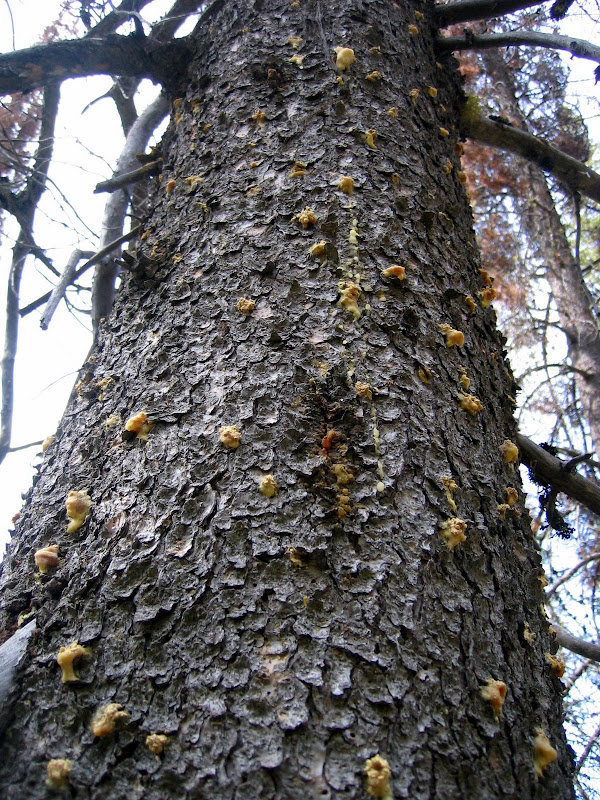
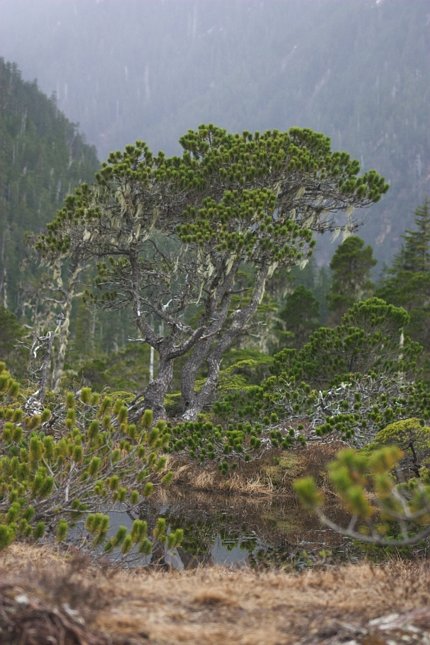
Of course, while most of this description will hold true for all Lodgepoles, there are certain exceptions I must make to the first part of it, describing its form. See, in a true forest, yes, the Lodgepole will grow eminently straight and tall. But up above the timber line, up near the very top of those mighty peaks that the Earth has thrusted up towards the sky through the exertion of forces, of purely mechanical forces, containing energies greater than those of the much-vaunted Hydrogen Bomb, even the Lodgepole pine fails to grow straight. Instead, it takes stunted, blasted and often even completely fantastical forms, clinging madly to the rock with muscular roots, and curving this way and that with all the drama and elegance of a bansai tree. But, remember, in the details, it is identical to your less dramatic, straight-as-an-arrow lodgepole.


I am wrapping up soon, I swear, but first I must say a word about the tree's taxonomy. As a pine species, it is obviously in the Pinaceae, which I have eulogized so bravely in a previous entry. Of more pressing interest is its several sister subspecies. And these are true subspecies, a clear case of it. There are clear genetic, physiological, and (most importantly) geographical distinctions between the various races of P. contorta, making them more than mere varieties, but they still intermingle freely with one another, and along the edges of their respective ranges one finds a variety of intermediate forms who are simply P. contorta, no real definable subspecies. Now, most accounts I have seen list three subspecies of P. contorta: P. contorta subsp. contorta, the Coast pine of the Pacific Northwest, a stunted, scrubby, but gorgeous tree; P. contorta subsp. latifolia, the Lodgepole pine of the interior of the continent, about which you now are experts on, doubtlessly; and P. contorta subsp. murrayana, the Sierra Lodgepole Pine, a tree of the Sierra Nevada ranges of California, which is a taller and thicker tree than the Lodgepole, but which shares a propensity for somewhat bizarre growth habits with subsp. contorta. Some experts further subdivide the genus by cutting off from subsp. contorta another subspecies, subsp. bolanderi, which grows further south than most of the other members of subsp. murrayana, down on the coast of Mendocino County in California. I have no idea whether to accept or deny this claim; the USDA does, though, so if you're susceptible to the ol' "Argument from Authority", well, there's a damn good authority for ya. Anyway, here's a nice map from Wikipedia showing the distributions of the three universally accepted subspecies. It should be noted that, as genetically distinct populations living with some geographical seperation from each other, these various different seperate types of P. contorta make an excellent example of how species are formed; if we wait another 10,000 years or so (and leave things reasonably close to how they are, which I doubt is possible; even in my most ecologically obsessed moments, I have no doubt that even the most ecologically obsessed of human societies will cause vast, vast, vast, VAST [but very very interesting, and potentially very very cool, it should be pointed out! not all change is bad!] changes in the Earth's ecosystem over the course of ten more bloomin' millenia) we will perhaps see this various subspecies achieve full (or at least partial) reproductive isolation from each other, and become true species.


So go put that in your pipe and smoke it, ye goddamn Young Earth Creationists!
Putting that in his pipe and smoking it since 1986,
--mark
Friday, December 21, 2007
Tree of the Week for Dec. 16th-Dec. 23rd, Picea abies
Well, today is the Midnight of the year, the Winter Solstice. We have not only entered into the night, we are at its middle. The days of light and joy are long behind us, and not even a memory remains. And though light, and spring, and flowers will come again, it shall be many moons before that happens. So come, let us huddle together by our radiators, for warmth, and tell stories of the great northern tree which is held sacred by our society as the ultimate "Christmas Tree".
There are many different trees which are used as "Christmas trees" by our culture; everything from pines, to firs, to exotic Southern araucarias are used. But the most stereotypical of christmas trees, the one whose form rather defines what a christmas tree "ought" to look like, and is most aped by the plastic artificial trees many homeowners use, is the spruce genus, Picea. And so, this week, we will look at one of the most successful members of that genus, Picea abies, the Norway Spruce.
It seems fitting, to me, that Spruces should be used as the centerpoint of a celebration that takes place in the dead midnight of the year, when even the hardiest of deciduous trees give up their ghost and prepare for spring, and all but the sempiternal non-migratory birds have fled for warmer climes, taking hosts of retirees and vacationeers with them. For the spruce is a dark tree, and spruce forests always seem to me to have an alien and foreboding air about them. It is in such a place, one thinks, that one might encounter, not merely the ogres and ghosts that people's imaginations have traditionally populated all forests with, but rather with some eldritch Lovecraftian horror from beyond time.
Of course, all this is superstition, just as surely as Santa Claus (no, i do not mean it, my dark masters! i say such things only so that the unconverted may not know of our plans! Iä! Iä! Ph'nglui mglw'nafh Cthulhu R'lyeh wgah'nagl ph'tagn! Iä! Iä!), but I have always thought that Spruce trees had something foreboding and sinister about them. But this is most easily explainable by their shape, for Spruces, members of genus Picea, do have that classic, conical "Christmas Tree" shape. Which is all well and charming when the tree is young, but if, as the tree grows older, the lower branches do not fall off (or are not pruned off), what you will have is a monster, between whose dense boughs one is utterly unable to walk, and who casts a shadow so dense as to make the ground beneath even a fully-clothed maple tree seem bright and sunny. It is a dense mass of hard leaves, hard wood, and hard twigs, and it seems secretive and brooding, aloof and ancient beyond its years.
But moving on from these flights of poetry, how does one identify Picea abies, the Norway Spruce? For Spruces, as a group, are difficult to distinguish from certain relatives of theirs, such as the firs and Douglas-Firs, and so even once one has determined that a given tree is a Spruce, to then proceed to ascertain which kind of spruce it is takes a really keen botanical eye and memory. So, let's begin!
The first thing I always do when I suspect a tree of being a Spruce is examine its needles. Now, in spruces, the needles are attached to the branches by small, wooden pegs, called pulvini (singular pulvinus). Seeing as how an individual Spruce needle has a lifespan of only 4-10 years, then, the branches of a spruce are covered with these rough bumps, allowing one to easily place one's tree squarely within the genus Picea, without even the need to look closely at individual needles, asking "Hmm...is that a pulvinus, or just a lump?".
Within the genus, things get trickier, but by the following features can one distinguish one's Picea abies. The Norway Spruce is known for its drooping branches, which make it look as if the tree were but a dead skeleton, and had been draped in wreaths and garlands by mourners. But not all Norway Spruces have this feature; some - especially the trimmed and cropped ones found in well-maintained gardens - have the tighter growth habit that is more stereotypical of the genus.
Returning to the tree's needles, which spiral around their branch in mathematical whorls, they are four-sided and small, typically less than 4/5" in length. They most typically are dark green in color, but P. abies is a rather varied species in this regard, and they can sometimes be lighter.
Contrariwise from their small needles, Norway Spruces have very large cones, much larger than those of most other spruces. These light brown & hairless cones can grow up to 7 or 8 inches in length. Growing downward from the twig (unlike the cones of the true firs, which grow upwards from it), they have numerous diamond-shaped scales that are sharp and pointy, making them great for use as extra armament in a snowball fight.
And of the tree itself? Ignoring these piddling details of identification, what can we say of Picea abies on the whole? Well, as its common name suggests, it is indeed native to the Old World rather than to the New. There, it can be found throughout Eastern europe, from Norway to Poland and the Baltic States to the Balkan highlands to the dark forests of northwestern Russia. It grows in the Carpathian Mountains, in Transylvania, and it is sure that this dark, haunted tree broods around the castle of the infamous Vlad the Impaler, better known in the West as Count Dracula. It grows in those lands most favored by the Romani, and in the homelands of the Vikings. In these ancestral European haunts of P. abies, it is one of the tallest trees around, regularly peeking up to heights of 120 or 130 feet; and the tallest verified specimen, west of Moscow in the Russian Federation, is 160 feet tall. There are, however, unverified reports of giants growing up to 200 feet in height. The dendrological community awaits verification of these with bated breath.
But here in North America, home to so many other giant trees, P. abies does not grow so high, and it normally must be satisfied with a mere 60 or 70 feet. Still, this makes it a respectable forest tree, and there are plenty of individuals who grow taller, whose tops reach some 80 or 90 feet. I do not know why the Western Hemisphere has proven so much less to its liking then the Old Countries; I can think of all manner of superstitious notions to correspond with my fanciful ideas of the genus Picea's association with the Powers of Darkness; but as for reasonable, scientific ideas, I have none.
The Norway Spruce is widely planted here, though, both as an ornamental tree in cities and gardens, and as a harvested tree planted in managed forests. It is grown both for the annual Winter sacrificing of evergreens as "Christmas Trees", and for its wood. In its rôle as the former, it strikes a somewhat paradoxical pose. For, although it is perhaps the most popular Christmas Tree in the world, it is also rather singularly unfitted for that purpose, as it sheds its needles in droves as the tree dries out, making a mess all over one's living room carpet. In timber production this tree, like all spruces, is valued by papermakers, for its straight grains give no impedence to their pulping machines. But despite the numbers of Norway Spruces that have been planted on our continent, it has not become invasive. No, just as the American examples of P. abies are content to reach heights of merely 20 or 30 meters (whoa-pah! ninja units switch!), so are they content to brood in silence, lazily not venturing to conquer more ground than is bequeathed to them by the short-lived Humans who seem to love them so.
Content to brood in silence since 1986,
--mark
There are many different trees which are used as "Christmas trees" by our culture; everything from pines, to firs, to exotic Southern araucarias are used. But the most stereotypical of christmas trees, the one whose form rather defines what a christmas tree "ought" to look like, and is most aped by the plastic artificial trees many homeowners use, is the spruce genus, Picea. And so, this week, we will look at one of the most successful members of that genus, Picea abies, the Norway Spruce.
It seems fitting, to me, that Spruces should be used as the centerpoint of a celebration that takes place in the dead midnight of the year, when even the hardiest of deciduous trees give up their ghost and prepare for spring, and all but the sempiternal non-migratory birds have fled for warmer climes, taking hosts of retirees and vacationeers with them. For the spruce is a dark tree, and spruce forests always seem to me to have an alien and foreboding air about them. It is in such a place, one thinks, that one might encounter, not merely the ogres and ghosts that people's imaginations have traditionally populated all forests with, but rather with some eldritch Lovecraftian horror from beyond time.
_forest_from_Vestfold_county_in_Norway.jpg)


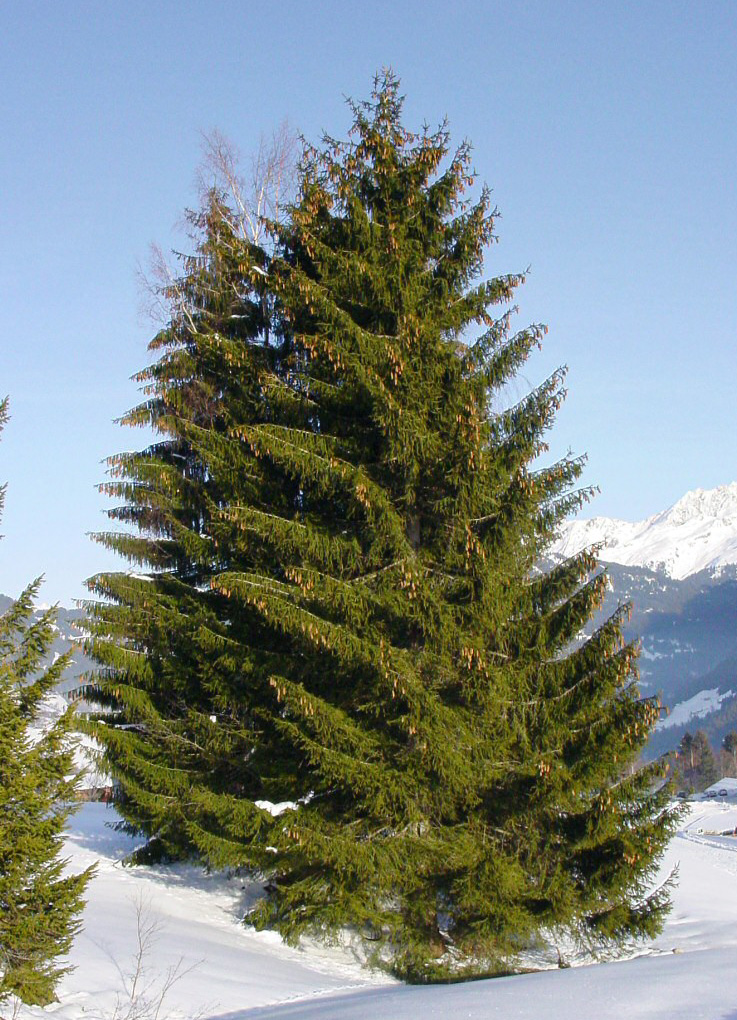
Of course, all this is superstition, just as surely as Santa Claus (no, i do not mean it, my dark masters! i say such things only so that the unconverted may not know of our plans! Iä! Iä! Ph'nglui mglw'nafh Cthulhu R'lyeh wgah'nagl ph'tagn! Iä! Iä!), but I have always thought that Spruce trees had something foreboding and sinister about them. But this is most easily explainable by their shape, for Spruces, members of genus Picea, do have that classic, conical "Christmas Tree" shape. Which is all well and charming when the tree is young, but if, as the tree grows older, the lower branches do not fall off (or are not pruned off), what you will have is a monster, between whose dense boughs one is utterly unable to walk, and who casts a shadow so dense as to make the ground beneath even a fully-clothed maple tree seem bright and sunny. It is a dense mass of hard leaves, hard wood, and hard twigs, and it seems secretive and brooding, aloof and ancient beyond its years.


But moving on from these flights of poetry, how does one identify Picea abies, the Norway Spruce? For Spruces, as a group, are difficult to distinguish from certain relatives of theirs, such as the firs and Douglas-Firs, and so even once one has determined that a given tree is a Spruce, to then proceed to ascertain which kind of spruce it is takes a really keen botanical eye and memory. So, let's begin!
The first thing I always do when I suspect a tree of being a Spruce is examine its needles. Now, in spruces, the needles are attached to the branches by small, wooden pegs, called pulvini (singular pulvinus). Seeing as how an individual Spruce needle has a lifespan of only 4-10 years, then, the branches of a spruce are covered with these rough bumps, allowing one to easily place one's tree squarely within the genus Picea, without even the need to look closely at individual needles, asking "Hmm...is that a pulvinus, or just a lump?".
Within the genus, things get trickier, but by the following features can one distinguish one's Picea abies. The Norway Spruce is known for its drooping branches, which make it look as if the tree were but a dead skeleton, and had been draped in wreaths and garlands by mourners. But not all Norway Spruces have this feature; some - especially the trimmed and cropped ones found in well-maintained gardens - have the tighter growth habit that is more stereotypical of the genus.
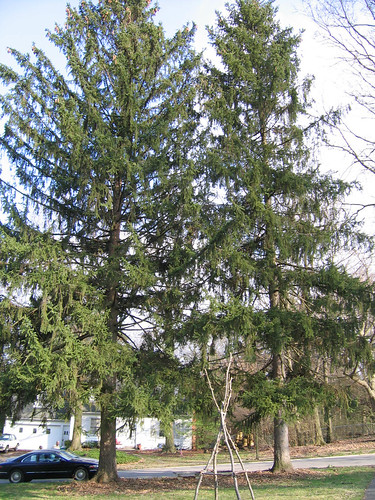

Returning to the tree's needles, which spiral around their branch in mathematical whorls, they are four-sided and small, typically less than 4/5" in length. They most typically are dark green in color, but P. abies is a rather varied species in this regard, and they can sometimes be lighter.


Contrariwise from their small needles, Norway Spruces have very large cones, much larger than those of most other spruces. These light brown & hairless cones can grow up to 7 or 8 inches in length. Growing downward from the twig (unlike the cones of the true firs, which grow upwards from it), they have numerous diamond-shaped scales that are sharp and pointy, making them great for use as extra armament in a snowball fight.


And of the tree itself? Ignoring these piddling details of identification, what can we say of Picea abies on the whole? Well, as its common name suggests, it is indeed native to the Old World rather than to the New. There, it can be found throughout Eastern europe, from Norway to Poland and the Baltic States to the Balkan highlands to the dark forests of northwestern Russia. It grows in the Carpathian Mountains, in Transylvania, and it is sure that this dark, haunted tree broods around the castle of the infamous Vlad the Impaler, better known in the West as Count Dracula. It grows in those lands most favored by the Romani, and in the homelands of the Vikings. In these ancestral European haunts of P. abies, it is one of the tallest trees around, regularly peeking up to heights of 120 or 130 feet; and the tallest verified specimen, west of Moscow in the Russian Federation, is 160 feet tall. There are, however, unverified reports of giants growing up to 200 feet in height. The dendrological community awaits verification of these with bated breath.
But here in North America, home to so many other giant trees, P. abies does not grow so high, and it normally must be satisfied with a mere 60 or 70 feet. Still, this makes it a respectable forest tree, and there are plenty of individuals who grow taller, whose tops reach some 80 or 90 feet. I do not know why the Western Hemisphere has proven so much less to its liking then the Old Countries; I can think of all manner of superstitious notions to correspond with my fanciful ideas of the genus Picea's association with the Powers of Darkness; but as for reasonable, scientific ideas, I have none.
The Norway Spruce is widely planted here, though, both as an ornamental tree in cities and gardens, and as a harvested tree planted in managed forests. It is grown both for the annual Winter sacrificing of evergreens as "Christmas Trees", and for its wood. In its rôle as the former, it strikes a somewhat paradoxical pose. For, although it is perhaps the most popular Christmas Tree in the world, it is also rather singularly unfitted for that purpose, as it sheds its needles in droves as the tree dries out, making a mess all over one's living room carpet. In timber production this tree, like all spruces, is valued by papermakers, for its straight grains give no impedence to their pulping machines. But despite the numbers of Norway Spruces that have been planted on our continent, it has not become invasive. No, just as the American examples of P. abies are content to reach heights of merely 20 or 30 meters (whoa-pah! ninja units switch!), so are they content to brood in silence, lazily not venturing to conquer more ground than is bequeathed to them by the short-lived Humans who seem to love them so.
Content to brood in silence since 1986,
--mark
Subscribe to:
Posts (Atom)