Well, I've gotten my computer back in working order, and I've also gotten up off my lazy ass and back to work, and so the long hiatus is over, and I'm posting a new(!) Tree of the Week entry.
As I may have mentioned before, I am no fan of winter. Aye, I know that it is a mark of the truly refined botanical æsthetic to appreciate the barren, fractal forms of deciduous trees in winter, and certainly they are still pretty. The same cool breath that shears them of their leaves also reveals their underlying architecture in all its complexity, revealing just how bizarre and intricate a thing a tree is. But nevertheless the monotony of winter, its monochromatic grayness (especially in a major urban agglomeration like Chicago), and above all its bloody coldness; after the first few weeks winter loses its charm for me, and all these things begin to take their toll on my mind.
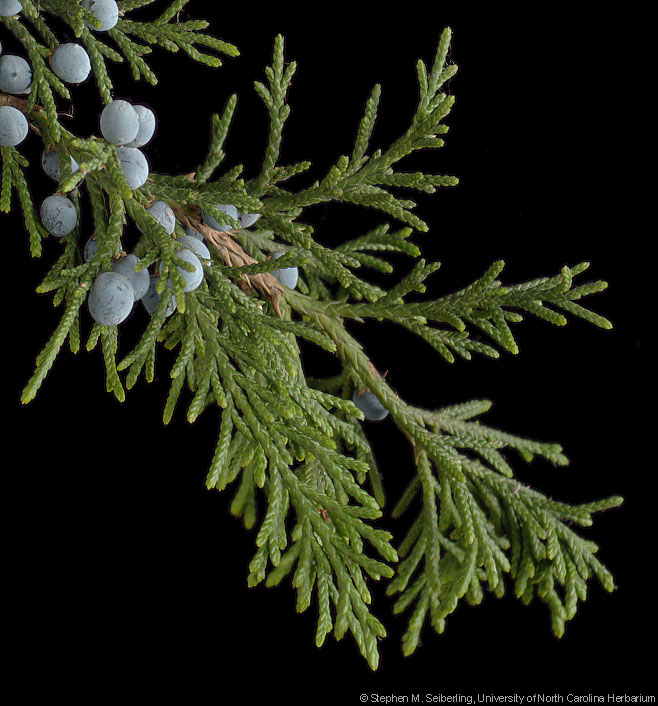
So this week's tree, Juniperus virginiana, the Eastern Redcedar, always appears to me as a piece of vital nourishment during these long months of long nights. Not only is it an evergreen tree, but it is a particularly charming and even fanciful one. Its spiraling and scaly foliage adorns the tree in impressionistic masses, sometimes sharp and jagged, and sometimes softer and gentler. At the same time, its bark has a richred-brown color, and it oftentimes peels off in narrow strips. Between the foliage, which is so different from that of trees we are more used to, whether broadleafs or needled conifers, and the fibrous bark, J. virginiana adds a great deal of texture and charm to a winter scene. Really, it does this all the year long, for it looks as out of place in an urban landscape as Queequeg did, but it is in winter, when the taller trees of the city are shorn of leaves, and when its vibrant leaves and bark are set off bythe whiteness of the snow and the alternating dim grey or shining pale blue of the sky, that its charms become the most noticeable. To my eyes, sighting one of these lovely creatures during the middle of winter in Chicago is like seeing a familiar face while travelling in a foreign country where everyone dresses and behaves strangely.
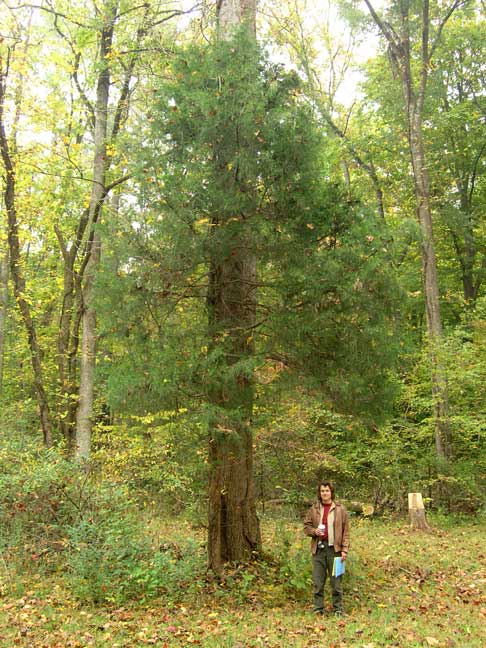
Now, you may have noticed that I earlier mentioned that other urban trees are generally taller than this redcedar. This is true not only of urban trees, but of trees in general. J. virginiana is not, typically, a very tall tree. True, in the Southlands, on good soil, it can reach heroic proportions - the recordholder Eastern Redcedar, in East Texas (according to the Gymnosperm Database, anyway), is 27 m (≈95 ft) tall - but in general, even in those warmer climes where the growing season lasts throughout the year, the redcedar is typically a more humble tree of perhaps ten meters. It is habitually a tree of the understory, though its relegation to such conditions is in large part due to the bullying competition of other trees. J. virginiana is a particularly light-hungry tree, and so in the shade of an established forest it grows but slowly. Still, despite the tree's thirst for light, it is oftentimes found, stunted but surviving, in the shade of bigger trees. According to some botanists, when crowded out by taller neighbors, J. virginiana slows down its own metabolism, especially during the summer months, and waits until the winter months, when the broadleaves are all leafless, to grow. It estivates, sleeping through the drowsy summer months only to work itself into a frenzy during the cold winter.
But while the tree might not be the tallest in the forest, it possesses a tolerance that few of its more massive neighbors can match. It can grow in both acidic and alkaline soils, able to withstand soil pHs of anywhere from 4.7 to 8. Nor does it mind thin, rocky soils; like many other junipers, the redcedar has a dense, fibrous root system that is capable of holding onto any soil it can find. The Eastern Redcedar is ths a force against the actions of erosion, one of the invisible hands which hold the Appalachians in place and prevent all the dirt that covers their slopes from washing down the Ohio and into the Mississippi delta. Of course, in the paradoxical manner of Nature, in different areas this tree also acts as an agent encouraging erosion. On the limestone outcroppings of the lower Midwest, from Starved Rock down to Tennessee (including eastern and central Missouri, where I saw a good many handsome redcedars growing when I journeyed there with Jane last year) J. virginiana will thrust its roots down into cracks in the limestone to seek out soil that is inaccessible to other plants, and incidentally widening those cracks slowly and weakening the structure of the already soft limestone. It is a drought tolerant tree, too, able to survive, according to the USDA, on as little as 15 inches of precipitation a year. For comparison, Phoenix, AZ, a city in the middle of the desert, gets about 8 inches a year, Chicago gets 36 inches, and Baton Rouge, LA, a city in the middle of a swamp, gets 63 inches.
J. virginiana's combined drought tolerance, erosion controlling abilities, and dense foliage have made it a favorite for Midwestern farmers looking for a good windbreak tree. During the dust bowl of the 1930s, the second of these properties especially caused the U.S. government to encourage farmers to plant these trees wherever possible. An excellent idea in principle, but it had unfortunate long-term side effects. Since those days these trees have spread dangerously across the eastern plains states, threatening what little's left of the once vast American prairies. In olden days, before large-scale agriculture was introduced north of the Rio Grande by the European colonists, regular prairie fires were responsible for preventing the spread of this tree, for it is not by any means a fire-resistant species. But the replacement of the tallgrass prairies with wheat, maize, and (more recently) soybean farms, and the understandably strict anti-fire policies of the farmers and the U.S. government, have removed this once formidable barrier to the Redcedar's expansion. So it has spread, becoming an invasive species even in areas to which it has always been native.
It is lamentable fact that this incident is merely one in a long series of ecological disasters that our Republic has unwittingly caused in the Great Plains states. It is my theory that our Euroamerican culture never really understood these vast American steppes, in the way that we understood the forests and mountains of the eastern and western states. In those wooded lands, according to this pet theory of mine, the ecological problems that are currently being faced have been primarily the result of greed and callousness. Whereas in the prairie states of the continents dry center the ecological problems have in large part been caused by ignorance and misguidedness, as illustrated in my above example. It seems that our culture simply has no traditional framework for how to deal with such lands; which only makes sense, since while western Europe was, in its pristine state, filled to the brim with temperate forests and mountains, it was (and is) notably lacking in vast stretches of grassland. However, as is often the case, Science has stepped in to attempt to provide solutions to this problem. Recent research in the development of perennial cereal crops promises to allow for farms that are more in tune with the pre-existing ecological makeup of the open praire. We, as good Botanical Cadets, can only hope that this promise is in time fulfilled.
But I am wandering from the ostensible topic of Juniperus virginiana, so please forgive me for my digression. Now, where was I...? Ah, yes, I was discussing the natural hardiness of J. virginiana. As I said, the tree is adapted to a wide range of environmental situations. Nearly the only place that it cannot make itself at home at is areas with standing water. Redcedars prefer their soil well-drained, and get waterlogged easily. However, this is a minor disadvantage when compared with all their advantages, and the tree can be found, in nature, in all states east of the Mississippi, from Maine to Illinois to Florida, and a good handful west of that river too, from Texas to Minnesota. The only things that stop its spread are the fires of the West, the extreme cold of the boreal North, and the torrid heat of the tropical South.
It might seem that such a tree would be perfect for urban spaces. J. virginiana is of modest size, it possesses a natural grace and charm throughout the year, and its two weaknesses, fire and standing water, are both - one hopes! - notably absent in cities. And, indeed, I have read - although I'm afraid that my memory has lost the particular source - an arborist fervently reccomend that more of these charmers should be planted in our nation's metropolitan areas. But, alas, it seems that his advice has not been heeded. For whatever reason, urban planners seem immune to the Redcedar's charms, and plant them but scarcely. Perhaps it is because the tree's aforementioned dense root system makes it tough to transplant. Perhaps it is simply that, while they endure wonderfully in cities, they are not at their best there, and take some coaxing to grow to the height expected of a street tree. And even once they have grown to such a height, they produce a ponderously dense shade, and require much pruning, especially as they are apt to drop foliage in messy clumps irregularly throughout the year (or at least such has been my observation).
But while in the city proper the Eastern Redcedar is uncommonly planted, in the suburbs the careful eye will find it everywhere. Ocassionally, it is planted with a clear eye to its ornamental value, given a place of prominence in a yard. Such is the case at my parents' house, one corner of whose backyard is quietly dominated by the presence of a twenty-foot Redcedar. At other times, they are used in hedges, forming an unusually tall barrier between houses. The denseness of the tree's foliage, and its rapid growth compared to such other coniferous hedge mainstays as yews, make it perfect for those who believe that "good fences make good neighbors". And, of course, this hardy plant is commmon in forest preserves, woodlots, and other such undeveloped areas. There it will thrive in any place too rocky for other woodland trees to grow, oftentimes springing up in the middle of otherwise empty glades, where the unmolested sunlight illuminates the several colors of this rustic tree.
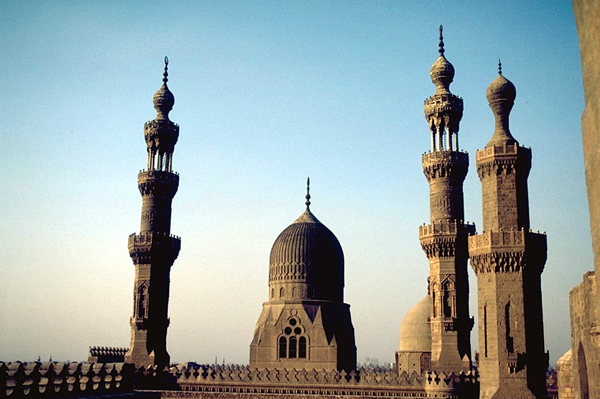
OK, it's getting late, and I am getting tired, so I'm going to start wrapping up this entry. But before I go, I must impart to you one last factoid about J. virginiana. You see, our Eastern Redcedar grows in two distinct habits: it either grows in a narrow, vaguely domed and spire-like form that puts one in mind of Arborvitaes, or else it grows into a more conical form that recalls the shape of more iconic conifers such as spruces and firs. If one had a poetical turn of mind, one might say that J. virginiana grows either like a minaret or like a church steeple.
Being of a poetical turn of mind since 1986,
--mark




Subscribe to:
Post Comments (Atom)
1 comment:
幽默並不是諷刺,它或許帶有溫和的嘲諷,卻不傷人,它可能是以別人,也可以用自己為對象。........................................
Post a Comment