I'm even later than usual with my Tree of the Week this time around, for I was supposed to post this entry sometime last week. Since I know that all my pleas of occupying business will avail me not, I shan't give them, and instead shall promise you a Very Special tree of the week this week. Hallowe'en is tomorrow, and therefore here at Harvester of Eyes Enterprises, we've decided to feature one of the creepiest members of North America's sylva. So, if ye have the stomach for it, keep on reading..
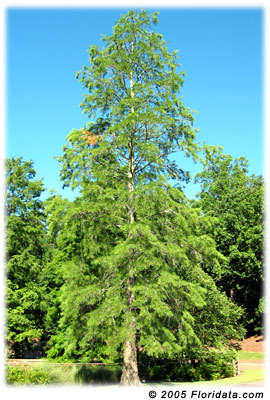
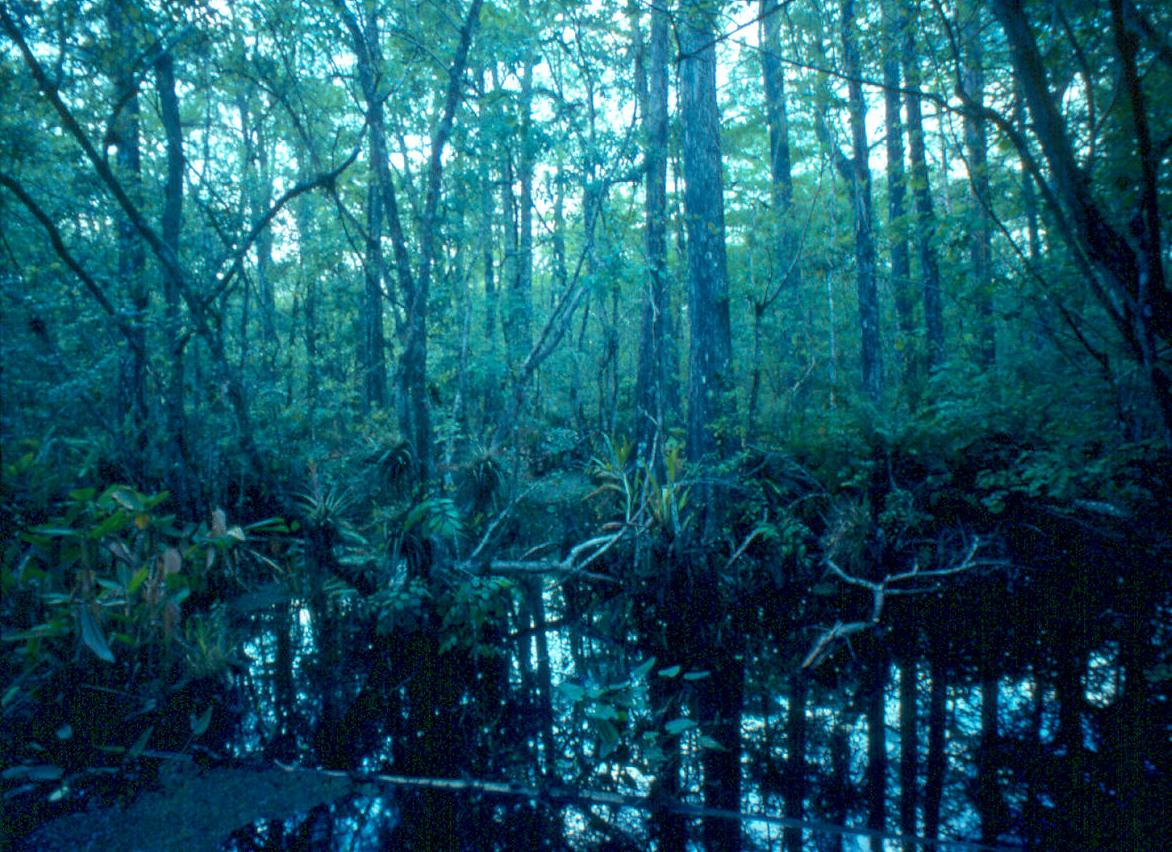
No truly epic horror movie is complete without a journey into some forbidden swamp or other, where alligators languidly lie in wait, old crones mumble mystic incantations over black pots of foul-smelling stew, rustics sit on the front porch of their stilt-footed shanty, shotgun in hands, and Spanish Moss droops like garlands from the ancient boughs of this week's tree, Taxodium distichum, the Bald Cypress.
But, despite this tree's legendary and well-deserved association with the eeriest of the Southland's swamps and bogs, you don't have to go down to Louisiana or Florida to see this grand conifer. For the Bald Cypress fares surprisingly well (at least, I was shocked to learn this fact) in cultivation, and has been successfully planted as a street tree as far north as motherfuckin' Minneapolis, Minnesota. Indeed, the Society of Municipal Arborists declared T. distichum 2007's Urban Tree of the Year, based on the results of an online poll held by that organization. The tree deals very well with the wretched soil conditions of big cities, not caring one whit how compacted and nutrient-poor the dirt it sinks its feet into may be. It positively loves acid, able to flourish in soils whose pH is as low as 4.0. To give a comparison which my various readers, almost all of whom are enrolled in some institution of tertiary education, may be immediately familiar with, beer has a pH of around 4.5. And not only will it grow and survive under such conditions but, unlike many coniferous plants, T. distichum will grow quickly, sometimes achieving a rate of two feet a year in its unstoppable heavenward rise. This rise is rather perfectly straight, too, and the tree almost without exception has that vertical, columnar habit so beloved by many landscape architects.
City life isn't all fun and games for the Bald Cypress, though, for despite its vigor and unquenchable inner strength, it can be very picky about certain aspects of its environment. As befits a swamp plant, it needs all the water it can find, and requires a minimum of four feet of precipitation a year. To give an example of exactly how much that is, Chicago, which once was a swamp itself, annually gets a mere three feet of water. So Cypresses grown in climates that are less than saturated with water do require some regular watering. Furthermore, although it loves acidic soil, it cannot tolerate any alkalinity in its environment, and won't grow in areas with a pH greater than 7.5. It also requires a great deal of sunlight to power the chemical fires that fuel its growth. I know this seems odd, that a plant of the deepest swamplands would require the full light of the sun to grow well, but remember that T. distichum is, in general, the tallest plant in those wetlands, and therefore up in the canopy where its photosynthetic organs are placed, there is nothing to block the sun's rays. Of course, this means that life is difficult for Bald Cypress seedlings underneath their parent's spreading branches, but given how little competition they face in the standing water environments they favor, and given how ancient a Bald Cypress can become (there are known examples who have survived for well over a millenia), a Bald Cypress forest is difficult to oust by non-human means.
Speaking of its seedlings, they represent another difficulty that T. distichum faces in adapting to urban environments. For although an adult Cypress can easily withstand the cold spells of Minneapolis and Buffalo, Cypress youths are infinitely more fragile creatures and can be killed by even the briefest frost. It is this culling of the young that has prevented this hardy tree from spreading too far north by its own power. Outside of regions where our civilization has planted it, T. distichum goes no farther north than the southern reaches of Illinois, Indiana, and Ohio. But we Americans are a crafty people, and our arboriculturists are capable of growing young treelings indoors, and then transporting them to their out-of-doors destinations when they've grown large enough to withstand the ice and snow that they may there be subject to.
Of course, although seeing a Bald Cypress in the middle of a Chicago winter, needle-bare and covered with snow, may be an esthetically rewarding experience, it cannot compare to seeing them in their native homeland, the swamps of the Gulf coast and the lower Mississippi. This is not an experience I can claim to have had myself, but it is certainly one which I look forward to. In that wet vale, T. distichum is one of the largest trees around, not only growing up to 40 m (130 ft.) in height, but also having enormous girths. The by-volume largest individual Bald Cypress in these fifty United States of ours, nicknamed "The Senator" and found in Longwood, Florida, has a diameter at breast height of some dozen feet, and contains over 3500 cubic feet of wood. It is also in these riparian environments that T. distichum shows its most characteristic and famous feature, the woody "knees" that it projects out of the water around its base. These knees are extensions of the plant's root system. Their precise function is still unknown to science. For many decades it was assumed that they were used to provide oxygen to the roots of the tree, which are trapped 'neath both ground and water in a very deoxygenated environment. This is a trick which mangrove trees are known to pull, and so it seemed natural to conclude that T. distichum was doing the same thing. But recent research suggests that these knees do not, in fact, have any measurable effect on the amount of oxygen contained in the cells in the tree's roots, and so some other hypothesis had to be devised.
It is therefore currently believed that these projections serve primarily to stabilize the great tree. It is already a very sturdy tree, for a Baldcypress' trunk is heavily flanged and buttressed at the base. When this is combined with its extensive root system, and these great projections anchoring it in place, you have a tree that can withstand hurricanes. I mean that quite literally, by the by, for in the course of researching this tree, I have read reports of Bald Cypresses standing quite unmolested through the worst winds a full-force hurricane can muster - winds that will tear even modern, well-built homes and office buildings utterly to pieces.
Given that one of my aims in writing these essays is to encourage my readership to take notice of the trees around them, I would be remiss if I did not here mention a certain place where many of my readers can make a pilgrimage to in order to see T. distichum in its full glory. Jess, you, of course, won't have to do such a thing; Tenessee and Alabama are both near enough to this Cypress' greatest strongholds that a daytrip will allow you to kneel in awe before some of the mightiest individuals this species has ever produced. But for us damned Yankees, who can see this tree only when it's planted abnaturally in parks and along streets, a minor pilgrimage to the Chicago Botanical Garden is in order. For at that location, there are planted some rather gorgeous Baldcypresses right along the banks of the large pond that the Botanic Garden lies among. This pilgrimage is in order not only because these are unusually pretty examples of the species for these northern climes, but also because, in the partially submerged environment where they grow, they have had the opportunity and the inclination to develop those famous knees of theirs.
Now, the attentive among my readership may have noticed that a few paragraphs ago, I mentioned Baldcypresses standing bare of needles in winter. This was not a typo; the Baldcypress derives its common name from the fact that it is among that small group of coniferous trees who are deciduous, not evergreen. So every fall, its needles turn a coppery red or golden brown before falling from their twigs.
These needles are also rather distinctive, and bear a good looking at while still on the tree. soft and feathery in appearence, their light blue-green or yellow-green tinge can produce a variety of esthetic effects. In an urban environment, it lends a certain tropical vitality to a scene, whereas in their native swampland it allows for the eerie atmospherics that make it such a staple of horror flicks. The needles march out along the branch in just two rows, not in the whorling pattern of more familiar conifers like the spruce.
It would seem, by all these features - its columnar growth habit, red-brown bark, thick and buttressed trunk, knee-producing roots, and feathery foliage - that T. distichum should be an easy enough tree to identify. But you must be careful, my readership, for there are several species that are closely related to it and which might easily be mistaken for it by a not sufficiently attentive observer. The first of these is the Dawn Redwood, Metasequoia glyptostroboides, a strange native of China which is in many respects almost identical to T. distichum. But a close examination of the twigs will show that, on the Bald Cypress, the needles are arranged alternately and have pointed tips, whereas the Metasequoia's needles are rounded at the tip and are arranged directly opposite each other. Also, Metasequoia is as kneeless as a multiple amputee; instead, it features its own distinctive pseudo-anatomical marker. These are the so-called "Armpits" which grow beneath its limbs.
There is also another member of the genus Taxodium, namely the Montezuma baldcypress (or "ahuehuete" in Nahuatl), T. mucronatum. Though this primarily tropical & subtropical genus, native to México, will probably not be encountered any time soon by most of my readership, should one find oneself in south Texas, where the ranges of T. mucronatum and T. distichum intermingle, it will be good to know the differences. In general, these two species are so similar as to be indistinguishable to all but the trained botanical eye, but there are several prominent differences which, though they shan't universally allow one to differentiate between the two species, can oftentimes allow one to make one's ID. Namely, T. mucronatum never produces any knees, and although it does shed its leaves, it does so on a different schedule than T. distichum. The latter sheds them in the fall or winter, whereas the Ahuehuete rids itself of 'em when the dry season comes along. These two seasons sometimes correspond, and sometimes do not, making using this feature for accurate IDing very difficult. The two species are so similar that some authorities suggest combining them.
These authorities are also the ones who insist that the Pond Cypress is merely a variety of Baldcypress. There has been much debate over whether this is a seperate species or not, but the most reliable information that I have seen classes it as a subvariety of T. distichum, namely T. distichum var. imbricatum. It is a slightly smaller tree than the main variety, but it is still quite grand, growing 90 ft. in height or more. Unlike the main variety (T. distichum var. distichum), the Pondcypress prefers brackish and still waters to flowing ones. Also, its needles are not arranged in two rows, but rather in slender, upwards-pointing whorls.
Because I am unbelievably tired, I am going to restrain myself from talking at all about the taxonomic relationships of T. distichum - about which I assure you you'll hear of at a future date - and instead wish a Happy Hallowe'en to all, and to all a good night!
Wishing everyone a Happy Hallowe'en since 1986,
--mark
Tuesday, October 30, 2007






Tuesday, October 16, 2007
Tree of the Week for Oct. 21st-Oct 28th 2007: Pseudotsuga menziesii
Ah-harr, me hearties! Well, I've got a long one for ya this week, so I hope you have the stamina to take it all in. Enjoy!
Whelp, seeing as how this week a full two members of my audience - including the one person whom I know actually reads all the way through these miraculous Adventures each week - are out in Portland right now, it seemed fitting to me that I should focus my attentions on the tree most eblematic of the great, rugged temperate rainforests of the Pacific Northwest: Pseudostuga menziesii, the Douglas-Fir.
When I merely mention that name, by the way, you, my readers, in your rôle as Botanical Boyscouts, should feel stir within your bones a sense of awe, of humility in the face of the unendurable majesty of one of the mightiest and noblest organisms on the face of this round earth. In those great Northwestern forests, P. menziesii can reach heights well over 300 feet, and live to ages in excess of a millenium; the tallest living specimen, the Brummit fir (also known as the "Doerner Fir") measures some 329 feet (about 100 meters even) from its intersection with the ground to its highest peak, and has a diameter of 11 1/2 feet. This monster, this prodigy of nature, can be found outside the town of Roseburg, in southern Oregon just off of U.S. Route 5 (hint, hint, guys).
But though it may be found so near to Roseburg, the mighty Douglas-Fir is no rose! No, nor is it any sort of flowering plant. For the Douglas-Fir belongs to a lineage more ancient by far than the late-blooming (hah!) Angiosperms. The flowering plants first unfolded their buds to the sun in the Cretaceous period, some ninety million years ago; but at that time the Conifers (the Pinophyta or Coniferae, as they are variously known in the scientific world) had already been possesed of a history stretching back some 200 million years, to the end of the Carboniferous Period. And this Division of life's grand family has never produced any ignoble weedy herb, for all of its members are woody plants, trees or shrubs which build for themselves strong, sempiternal bones of minutely organized plastic.
I can hear you now, my readers, as you scream in incredulity when I claim that wood is made of plastic. After all, in common parlance the two are held almost as antonyms. But my statement is in fact true - though, admittedly, for a rather loosey-goosey definition of plastic. Plastic is, you see, a polymer of some given organic molecule, repeated over and over again in vast chains. Now wood, wood is similarly composed primarily of cellulose (which is organic, natch) molecules repeated over and over again in vast chains. Certainly, there are many differences between wood and synthetic plastics - not least of which being the radically different manufacturing process - but surely you, my Coniferous Cadets, can recognize the distinct similarities between the two substances revealed in the above all-too brief comparison.
Returning to my previous theme, though, the Conifers have, almost alone among the non-flowering trees, managed to not merely survive but even to flourish in these latter days of Oaks and Wheatgrass. The Cycads, Ginkgos, and Tree-Ferns are now reduced to miniscule remnants of their once awesome biodiversity; the Lycopods and the giant Horsetails are utterly extinct, and have been for many millions of years, for aeons upon aeons. But the Conifers adapt and endure, thriving in some of the globe's harshest climates. And though the Coniferous order contains within itself many clans, it is primarily due to a single family that the Conifers are such a common and well-known group in the Northern world. This family, this diverse family of unbelievable resourcefulness, is the Pinaceae, the Pine Clan. Under its needle-wreathed boughs, it encompasses all the world's pines, firs, spruce trees, true cedars, hemlocks, and larches. And, of course, the awesome Douglas-fir.
Though there has been little doubt that the Douglas-fir belongs among the Pine family (save for some early botanists who wanted to place it in the genus Sequoia, along with the mighty redwood, which lies in the Cupressaceae) its precise location within that family, and its precise relation to other members of that family, was for many years in much doubt. It had been variably grouped in the same genus as the firs, the spruces, the pines (tho' why the pines, I know not), and the hemlocks before finally, in 1867, being given its own elite genus Pseudotsuga (meaning "fake hemlock") by the french botanist Élie-Abel Carrière. But even this did not end the debate, for the genus is a complicated one, with divisions between species resting sometimes on the minutest of criteria. Indeed, the precise number of species within this genus is even still open to much doubt; while the generally accepted number is five, there are those who would place it as high as thirteen. We will stick with the generally accepted five, for the sake of both brevity and agreement with the widest scope of the scientific literature possible.
Of these five, there is only one species that we are considering today, and it is the prince of not only its genus, but also of its family, and perhaps (if certain legends of old are to be believed) of all the trees that grow on this green earth. This species is, as I'm sure I've mentioned once already, Pseudotsuga menziesii, pronounced roughly "sue-doe-t'sue-guh men-zee-see-aye". If you will bear with me for a few more sentences, I would like to round out this lengthy discussion of the plant's genealogy with the important fact that there are two seperate subspecies of P. menziesii, which are sometimes considered quite distinct species - and understandably enough, for they do each have a noticeably different character about them. These two species are the Coast Douglas-Fir, P. menziesii menziesii, and the Rocky Mountain Douglas-Fir, P. menziesii glauca. For the rest of this essay, we will be concentrating on the Coast Douglas-Fir, but we will not ignore the inland race, and give it its due.
Members of the genus Pseudotsuga can be most easily distinguished from all other coniferous trees by virtue of a certain unique characteristic of their cones, namely the long, three-pointed bracts that stick out from beneath its scales. Note that what I am referring to here, following the common usage among non-Botanists, as the "cone" of the tree is in reality merely the female cone, which is handsome, medium-sized, and not-too showy at its two to four inches in length.. The male cones of the tree - which produce the pollen grains that, after being set adrift into the air, relentlessly fuck the countless thousands of ovules of their female siblings - are smallish things, an inch in length at the very outside. Every spring, towards the end of March, they spew out their flying jizz ("Flying Jizz" - what a great name for a band!) which is borne by the treacherous skies to the sticky embrace of the female cones - sticky, for in the Spring, the young, virgin female cones are indeed coated in a resinous material which entraps the manly pollen. I shall note, to conclude this racy tale, that since Douglas-Firs are all hermaphroditic, it sometimes is the case that a male's pollen will end up locked in the womb of the lady cone on the branch right next to it! Once this voluptuous ritual has been accomplished, the seeds will mature underneath the female cone's scaly bosom until they are ripe a half-year later, in the Autumn. At this time, the entire cone drops to the ground, breaking open and scattering its contents.
Now, you two readers of mine fortunate enough to be spending this week in the state of Oregon may be wondering how you are to ascertain whether or not a given tree is a Douglas-Fir if it has already shed all its cones. Worry not, though, friends! The tree has other characteristics that may speak to you and tell you its name, if you will but pause to listen. Its needles, for example, are about an inch or so in length, and are soft to the touch, not pricking the grasping finger. They are typically a bright, light green color, though they can also be a darker green, or else actively yellow-green (which is more common among the Coastal subspecies) or bluish green (which is more common among the Inland subspecies). These needles have, upon their underside, two narrow whitish strands. These needles are arranged in spirals about the twigs of the tree, and at their base they narrow and twist a bit in a way that is rather characteristic. This narrowing and twisting gives their needles a little bit of an herbaceous stem, a phenomenon rare among the Pinaceae, and a good clew if ye need one. This is as opposed to, say, spruce needles, which are attached to the twig by a woody 'peg', or those of the True Firs (genus Abies), which bud straight out from the twig without any appreciable stem. Finally, if all this avails you not, you can look at the leaf scar of the needles, for it is raised slightly above the twig - though this raising should not be confused with the small woody cushions of the hemlock.
I am sorry if all of those very similar looking needles caused you any confusion, O reader. I, too, have oftentimes found the various abstruse differences between the needles of the diverse conifers rather confusing. But I found that experience proved as educational as it is oftentimes claimed to be, and I would suggest that you follow my advice. Go and find some trees whose identity (due to their clearly present cones, for example) is not at all in question, and study their needles for some time, keeping your mind on just those points listed above. You will develop in your brain a "search image", a model, which can be used to mark those items about the needle that are most important, most distinguishable, for comparison to future specimens. It will be, I assure you, time well spent, for it will allow you to hear the Douglas-Fir proclaim its name into the Western sky.
And, once again, what a name it is! What awe and majesty it possesses! I hinted, above, of certain old legends which, if true, would make the Douglas-Fir the Prince of Sylva. The story is this: Several times, during the end of the 19th and dawn of the 20th centuries, there were reports, from lumbermen, of the felling of Douglas-Firs of truly prodigious proportions. The tallest of these was, it was claimed, some 415 feet in height. Not only is this some ninety feet taller than the tallest Douglas-Fir now alive, it is even 35 feet taller than the tallest tree currently living on the entire globe, the Redwood of northern California known as Hyperion, who is 379 feet in height. Now, it is true that lumbermen are as full of tall tales as all adventurers, and love to exagerrate their successes, and so none of these reports are given full credence by the scientific community. But there is such a number of them, and they are so far above even the grandest claims made by redwood lumbermen (no lumberjack had ever claimed to have felled a redwood of more than 380 feet, the approximate height of the current champion) that it seems plausible that mayhap, in the days when the saw had not dug its teeth into the wood of this species, there were indeed giants more than 400 feet tall.
If this is in fact the case, then within the lifetime of our children there may well again be such titans, assuming always that the last remaining old-growth forests of Douglas-Fir are not clear-cut by the shortsighted. P. menziesii is not a fast growing tree by any standard, but neither is it some creeping, cautious thing that inches its way towards heaven. It grows at the perfectly respectable rate of a foot or so a year. That being said, at a foot a year, it still will take the Doerner tree 70 years to break 400 feet.
But, although the ancientest and hugest Douglas-Firs have doubtlessly been felled, the species as a whole is in no danger. Indeed, the massive logging operations undertaken in the pacific Northwest are precisely what has allowed the Douglas-Fir to conquer vast new lands for its empire. Despite its awesome grandeur, which would make one think that it prefers to grow in the oldest of old forests, P. menziesii is, like the White Ash discussed several weeks ago, a successor species. It loathes shade and darkness, and will fare poorly if not exposed to the full light of the sun. So in an older forest, where the forest floor is constantly in the shadow of the huge conifers that dominate the landscape, Douglas-Fir seedlings are seldom seen, and no new crop of this species will be had.
But once the ancient trees of an area are removed - either by fire, by windstorm, or by the hands of Man - P. menziesii's advantages come to the fore. Its thick bark makes it terribly resistant to fire, and it is also famed for its ability to withstand droughts. And though such disasters may have been rare in past centuries, the millenial lifespan of a Douglas-Fir means that an elder is able to wait patiently for such an event to occur. Once the disaster's over, the Douglas-Fir is more likely to be left standing than its less fire-resistant neighbors, and its children are able to sprout up into the sweet sunshine unrivalled by any other trees - and, given their hardiness, each of these seedlings are reasonably likely to survive and flourish, ensuring that this disturbed region of the forest will remain dominated by Pseudotsuga for many centuries to come.
Which means, if you can dig it, that the massive lumber-harvesting enterprises undertaken in the area over the past several hundred years have been something of a boon for the Douglas-Fir, at least in areas that have been left alone to heal since they first felt the blade of man. In the areas where less enlightened policies have held sway, and the old forests have not been allowed to regrow at all, obviously the Douglas-Fir, like all trees, is injured horribly by humanity's shortsightedness. But, in those areas given time to heal, P. menziesii has staged a comeback, and now dominates much greater sections of these forests than it did of old.
Furthermore, because of the excellence of its wood, it has been planted by long-sighted human foresters all over the globe. Hard, stiff, and durable, this wood finds one of its chiefest uses in construction, where its strength under all kinds of pressure is appreciated. It is turned into wharves, bridges, trestles, etc. Not one of those sissy trees used for mere decorative purposes, the brawny Douglas-fir even in death brags of its ability to support crushing loads without flinching. And it has, of course, escaped from its plantations in these far-off lands, and has conquered some colonies in lands as distant from its native home as New Zealand, Germany, England, and South Africa. In some of these places, the tree's hardiness has even made it a 'problem', as it does what it is programmed to do: grow in disturbed areas. Poorly managed native forests that have been clear-cut by loggers sometimes find themselves suddenly awash in a sea of strange foreign invaders, all too often including the mighty Douglas-Fir.
There is infinitely more that I could say about the Douglas-Fir, about its relations with animals, with the soil, with other plants, and with humans, but I shall restrain myself, so that I may at least claim not to be too exceedingly boring. Once again, I must apologize for the obscene length of my entry, but in my defense may I claim that I am merely luxuriating in a discussion of my absolute favorite tree. For of all the trees I have ever met, P. menziesii is the one I love best. It is a noble, majestic, and grandiose tree, that flourishes in the exotic coniferous and temperate rainforests of Columbia. And yet, far from being some vulnerable relic of ancient days, infinitely sensitive to the New World Order established by mankind, P. menziesii is a rugged survivor, not only capable of lasting for centuries but also opportunistically conquering new land wherever new land presents itself to be conquered. So, my Western friends who luxuriantly repose in the Conifer Kingdom, go out there and sing the praises of the Prince of the Forest, Pseudotsuga menziesii, the Douglas-fir!
Singing the praises of the Prince of the Forest since 1986,
--mark
Whelp, seeing as how this week a full two members of my audience - including the one person whom I know actually reads all the way through these miraculous Adventures each week - are out in Portland right now, it seemed fitting to me that I should focus my attentions on the tree most eblematic of the great, rugged temperate rainforests of the Pacific Northwest: Pseudostuga menziesii, the Douglas-Fir.
When I merely mention that name, by the way, you, my readers, in your rôle as Botanical Boyscouts, should feel stir within your bones a sense of awe, of humility in the face of the unendurable majesty of one of the mightiest and noblest organisms on the face of this round earth. In those great Northwestern forests, P. menziesii can reach heights well over 300 feet, and live to ages in excess of a millenium; the tallest living specimen, the Brummit fir (also known as the "Doerner Fir") measures some 329 feet (about 100 meters even) from its intersection with the ground to its highest peak, and has a diameter of 11 1/2 feet. This monster, this prodigy of nature, can be found outside the town of Roseburg, in southern Oregon just off of U.S. Route 5 (hint, hint, guys).

But though it may be found so near to Roseburg, the mighty Douglas-Fir is no rose! No, nor is it any sort of flowering plant. For the Douglas-Fir belongs to a lineage more ancient by far than the late-blooming (hah!) Angiosperms. The flowering plants first unfolded their buds to the sun in the Cretaceous period, some ninety million years ago; but at that time the Conifers (the Pinophyta or Coniferae, as they are variously known in the scientific world) had already been possesed of a history stretching back some 200 million years, to the end of the Carboniferous Period. And this Division of life's grand family has never produced any ignoble weedy herb, for all of its members are woody plants, trees or shrubs which build for themselves strong, sempiternal bones of minutely organized plastic.
I can hear you now, my readers, as you scream in incredulity when I claim that wood is made of plastic. After all, in common parlance the two are held almost as antonyms. But my statement is in fact true - though, admittedly, for a rather loosey-goosey definition of plastic. Plastic is, you see, a polymer of some given organic molecule, repeated over and over again in vast chains. Now wood, wood is similarly composed primarily of cellulose (which is organic, natch) molecules repeated over and over again in vast chains. Certainly, there are many differences between wood and synthetic plastics - not least of which being the radically different manufacturing process - but surely you, my Coniferous Cadets, can recognize the distinct similarities between the two substances revealed in the above all-too brief comparison.

Returning to my previous theme, though, the Conifers have, almost alone among the non-flowering trees, managed to not merely survive but even to flourish in these latter days of Oaks and Wheatgrass. The Cycads, Ginkgos, and Tree-Ferns are now reduced to miniscule remnants of their once awesome biodiversity; the Lycopods and the giant Horsetails are utterly extinct, and have been for many millions of years, for aeons upon aeons. But the Conifers adapt and endure, thriving in some of the globe's harshest climates. And though the Coniferous order contains within itself many clans, it is primarily due to a single family that the Conifers are such a common and well-known group in the Northern world. This family, this diverse family of unbelievable resourcefulness, is the Pinaceae, the Pine Clan. Under its needle-wreathed boughs, it encompasses all the world's pines, firs, spruce trees, true cedars, hemlocks, and larches. And, of course, the awesome Douglas-fir.
Though there has been little doubt that the Douglas-fir belongs among the Pine family (save for some early botanists who wanted to place it in the genus Sequoia, along with the mighty redwood, which lies in the Cupressaceae) its precise location within that family, and its precise relation to other members of that family, was for many years in much doubt. It had been variably grouped in the same genus as the firs, the spruces, the pines (tho' why the pines, I know not), and the hemlocks before finally, in 1867, being given its own elite genus Pseudotsuga (meaning "fake hemlock") by the french botanist Élie-Abel Carrière. But even this did not end the debate, for the genus is a complicated one, with divisions between species resting sometimes on the minutest of criteria. Indeed, the precise number of species within this genus is even still open to much doubt; while the generally accepted number is five, there are those who would place it as high as thirteen. We will stick with the generally accepted five, for the sake of both brevity and agreement with the widest scope of the scientific literature possible.
Of these five, there is only one species that we are considering today, and it is the prince of not only its genus, but also of its family, and perhaps (if certain legends of old are to be believed) of all the trees that grow on this green earth. This species is, as I'm sure I've mentioned once already, Pseudotsuga menziesii, pronounced roughly "sue-doe-t'sue-guh men-zee-see-aye". If you will bear with me for a few more sentences, I would like to round out this lengthy discussion of the plant's genealogy with the important fact that there are two seperate subspecies of P. menziesii, which are sometimes considered quite distinct species - and understandably enough, for they do each have a noticeably different character about them. These two species are the Coast Douglas-Fir, P. menziesii menziesii, and the Rocky Mountain Douglas-Fir, P. menziesii glauca. For the rest of this essay, we will be concentrating on the Coast Douglas-Fir, but we will not ignore the inland race, and give it its due.


Members of the genus Pseudotsuga can be most easily distinguished from all other coniferous trees by virtue of a certain unique characteristic of their cones, namely the long, three-pointed bracts that stick out from beneath its scales. Note that what I am referring to here, following the common usage among non-Botanists, as the "cone" of the tree is in reality merely the female cone, which is handsome, medium-sized, and not-too showy at its two to four inches in length.. The male cones of the tree - which produce the pollen grains that, after being set adrift into the air, relentlessly fuck the countless thousands of ovules of their female siblings - are smallish things, an inch in length at the very outside. Every spring, towards the end of March, they spew out their flying jizz ("Flying Jizz" - what a great name for a band!) which is borne by the treacherous skies to the sticky embrace of the female cones - sticky, for in the Spring, the young, virgin female cones are indeed coated in a resinous material which entraps the manly pollen. I shall note, to conclude this racy tale, that since Douglas-Firs are all hermaphroditic, it sometimes is the case that a male's pollen will end up locked in the womb of the lady cone on the branch right next to it! Once this voluptuous ritual has been accomplished, the seeds will mature underneath the female cone's scaly bosom until they are ripe a half-year later, in the Autumn. At this time, the entire cone drops to the ground, breaking open and scattering its contents.


Now, you two readers of mine fortunate enough to be spending this week in the state of Oregon may be wondering how you are to ascertain whether or not a given tree is a Douglas-Fir if it has already shed all its cones. Worry not, though, friends! The tree has other characteristics that may speak to you and tell you its name, if you will but pause to listen. Its needles, for example, are about an inch or so in length, and are soft to the touch, not pricking the grasping finger. They are typically a bright, light green color, though they can also be a darker green, or else actively yellow-green (which is more common among the Coastal subspecies) or bluish green (which is more common among the Inland subspecies). These needles have, upon their underside, two narrow whitish strands. These needles are arranged in spirals about the twigs of the tree, and at their base they narrow and twist a bit in a way that is rather characteristic. This narrowing and twisting gives their needles a little bit of an herbaceous stem, a phenomenon rare among the Pinaceae, and a good clew if ye need one. This is as opposed to, say, spruce needles, which are attached to the twig by a woody 'peg', or those of the True Firs (genus Abies), which bud straight out from the twig without any appreciable stem. Finally, if all this avails you not, you can look at the leaf scar of the needles, for it is raised slightly above the twig - though this raising should not be confused with the small woody cushions of the hemlock.


I am sorry if all of those very similar looking needles caused you any confusion, O reader. I, too, have oftentimes found the various abstruse differences between the needles of the diverse conifers rather confusing. But I found that experience proved as educational as it is oftentimes claimed to be, and I would suggest that you follow my advice. Go and find some trees whose identity (due to their clearly present cones, for example) is not at all in question, and study their needles for some time, keeping your mind on just those points listed above. You will develop in your brain a "search image", a model, which can be used to mark those items about the needle that are most important, most distinguishable, for comparison to future specimens. It will be, I assure you, time well spent, for it will allow you to hear the Douglas-Fir proclaim its name into the Western sky.

And, once again, what a name it is! What awe and majesty it possesses! I hinted, above, of certain old legends which, if true, would make the Douglas-Fir the Prince of Sylva. The story is this: Several times, during the end of the 19th and dawn of the 20th centuries, there were reports, from lumbermen, of the felling of Douglas-Firs of truly prodigious proportions. The tallest of these was, it was claimed, some 415 feet in height. Not only is this some ninety feet taller than the tallest Douglas-Fir now alive, it is even 35 feet taller than the tallest tree currently living on the entire globe, the Redwood of northern California known as Hyperion, who is 379 feet in height. Now, it is true that lumbermen are as full of tall tales as all adventurers, and love to exagerrate their successes, and so none of these reports are given full credence by the scientific community. But there is such a number of them, and they are so far above even the grandest claims made by redwood lumbermen (no lumberjack had ever claimed to have felled a redwood of more than 380 feet, the approximate height of the current champion) that it seems plausible that mayhap, in the days when the saw had not dug its teeth into the wood of this species, there were indeed giants more than 400 feet tall.
If this is in fact the case, then within the lifetime of our children there may well again be such titans, assuming always that the last remaining old-growth forests of Douglas-Fir are not clear-cut by the shortsighted. P. menziesii is not a fast growing tree by any standard, but neither is it some creeping, cautious thing that inches its way towards heaven. It grows at the perfectly respectable rate of a foot or so a year. That being said, at a foot a year, it still will take the Doerner tree 70 years to break 400 feet.
But, although the ancientest and hugest Douglas-Firs have doubtlessly been felled, the species as a whole is in no danger. Indeed, the massive logging operations undertaken in the pacific Northwest are precisely what has allowed the Douglas-Fir to conquer vast new lands for its empire. Despite its awesome grandeur, which would make one think that it prefers to grow in the oldest of old forests, P. menziesii is, like the White Ash discussed several weeks ago, a successor species. It loathes shade and darkness, and will fare poorly if not exposed to the full light of the sun. So in an older forest, where the forest floor is constantly in the shadow of the huge conifers that dominate the landscape, Douglas-Fir seedlings are seldom seen, and no new crop of this species will be had.
But once the ancient trees of an area are removed - either by fire, by windstorm, or by the hands of Man - P. menziesii's advantages come to the fore. Its thick bark makes it terribly resistant to fire, and it is also famed for its ability to withstand droughts. And though such disasters may have been rare in past centuries, the millenial lifespan of a Douglas-Fir means that an elder is able to wait patiently for such an event to occur. Once the disaster's over, the Douglas-Fir is more likely to be left standing than its less fire-resistant neighbors, and its children are able to sprout up into the sweet sunshine unrivalled by any other trees - and, given their hardiness, each of these seedlings are reasonably likely to survive and flourish, ensuring that this disturbed region of the forest will remain dominated by Pseudotsuga for many centuries to come.

Which means, if you can dig it, that the massive lumber-harvesting enterprises undertaken in the area over the past several hundred years have been something of a boon for the Douglas-Fir, at least in areas that have been left alone to heal since they first felt the blade of man. In the areas where less enlightened policies have held sway, and the old forests have not been allowed to regrow at all, obviously the Douglas-Fir, like all trees, is injured horribly by humanity's shortsightedness. But, in those areas given time to heal, P. menziesii has staged a comeback, and now dominates much greater sections of these forests than it did of old.
Furthermore, because of the excellence of its wood, it has been planted by long-sighted human foresters all over the globe. Hard, stiff, and durable, this wood finds one of its chiefest uses in construction, where its strength under all kinds of pressure is appreciated. It is turned into wharves, bridges, trestles, etc. Not one of those sissy trees used for mere decorative purposes, the brawny Douglas-fir even in death brags of its ability to support crushing loads without flinching. And it has, of course, escaped from its plantations in these far-off lands, and has conquered some colonies in lands as distant from its native home as New Zealand, Germany, England, and South Africa. In some of these places, the tree's hardiness has even made it a 'problem', as it does what it is programmed to do: grow in disturbed areas. Poorly managed native forests that have been clear-cut by loggers sometimes find themselves suddenly awash in a sea of strange foreign invaders, all too often including the mighty Douglas-Fir.
There is infinitely more that I could say about the Douglas-Fir, about its relations with animals, with the soil, with other plants, and with humans, but I shall restrain myself, so that I may at least claim not to be too exceedingly boring. Once again, I must apologize for the obscene length of my entry, but in my defense may I claim that I am merely luxuriating in a discussion of my absolute favorite tree. For of all the trees I have ever met, P. menziesii is the one I love best. It is a noble, majestic, and grandiose tree, that flourishes in the exotic coniferous and temperate rainforests of Columbia. And yet, far from being some vulnerable relic of ancient days, infinitely sensitive to the New World Order established by mankind, P. menziesii is a rugged survivor, not only capable of lasting for centuries but also opportunistically conquering new land wherever new land presents itself to be conquered. So, my Western friends who luxuriantly repose in the Conifer Kingdom, go out there and sing the praises of the Prince of the Forest, Pseudotsuga menziesii, the Douglas-fir!
Singing the praises of the Prince of the Forest since 1986,
--mark
Thursday, October 11, 2007
Tree of the Week for Oct. 7th-Oct. 14th 2007: Rhus typhina
Although it did seem over the week-end that fall was retreating before an Indian Summer of unbelievable vigour (Sunday was the hottest October 7th on record for Chicago, beating the previous record established some 61 years ago, in 1946), the autumnal season has, at least here in the Middle West, reclaimed its predominance, as the temperatures have plummeted a full forty degrees in the past four days. Of course, Chicago weather is always chaotic and unpredictable, but Global Climate Change is making it worse. Because that will be the primary effect, for many decades, of this phenomenon - if all that were happening was that every day was 2 degrees Fahrenheit or so warmer than the old averages, then we humans would hardly notice Global Warming. But, the effect of this seemingly slight warming change is that all weather is going to become more disturbingly unpredictable. So not only may we soon have to face more heat waves in October, but we may also have to face snowstorms in June. O, poor Chicago; poor Lake Michigan! Born in ice but twelve thousand years ago, ye now already lie in the throes of the hot and cold flashes of old age! But to get to the point, since Autumn has returned, with a vengeance, this week I'm highlighting a tree with some beautiful fall foliage that's just beginning to become visible.
Everybody loves big trees. The redwoods, sequoias and douglas-firs of the American West; the ancient Oaks of both the Old World and the New; and the mammoth Ruling Eucalypts and Kauri Trees of Australia and New Zealand, respectively; all of these trees do not want for attention. But this week we are focusing our attentions on a tree of infinitely more modest proportions. After all, Americans are legendary for their love of an underdog - although you'd never know it by the current administration's foreign policy (oh man! look! two current events references in one post! who's the freaking blogmaster now, eh? eh?) - and so it seems only proper to spend some time showcasing the more subtle beauties of those plants whose tops will never be accused of piercing any heavens.
Which is not to say that this week's tree, Rhus typhina, the Staghorn Sumac, is at all humble! No, in its own way, this tree is as feisty as they come. Though it is small - reaching an absolute maximum height of thirty feet, and more frequently being even shorter than that - in the fall its leaves turn a brilliant scarlet color, as if they had been thrust into a can of paint. It is a doughty plant, too, able to withstand rather acidic soils, and having a high tolerance for the terrors of both droughts and fires. A quick growing tree, it is able to reach its maximum height in little more than a decade, and is famed among horticulturalists for its ability to create dense colonies by sending out underground stems, or "rhizomes", as they call 'em in the business, which then proceed to grow up into new sumac clones all around the original tree.
If all these characteristics sound to you like precisely the sort of properties one would expect to find in a weed plant, then you would be absolutely correct. Rhus typhina can, indeed, be quite weedy, opportunistically growing anywhere it can and sprouting dense stands virtually overnight. In some areas, it can become quite invasive and dangerous, blocking out the sunlight and preventing any other species of plant from growing around or 'neath it - although it's something of a hypocrite, as R. typhina itself loathes the shade. But despite this, it has found a home in many gardens, both urban and otherwise. For as has already been mentioned, its fall color is utterly stunning, and it also produces, in June, large, conical, alien-looking clusters of vividly red fruit which will slowly ripen over the course of many months and persists on the plant until well into fall. Its long, graceful leaves and smooth gray bark are also pretty, and the shrub has, overall, a strange, otherworldly look prized by many gardeners. There are also two popular cut-leaved cultivars of the plant, R. typhina 'dissecta' and R. typhina 'laciniata', that add yet another element of visual interest to this already stunning plant.
The staghorn sumac is an easy tree to identify. If its aforementioned fruit doesn't give it away, either because it's too early in the year or because the tree's a male - for R. typhina is most commonly dioecious (an' if ye forget what that means, look it up!) - then either its flowers, branching clusters of yellow, green or white florets that appear in late Spring and early Summer, or its leaves, long compound things up to two feet(!) in length with up to thirty serrated leaflets coming off it, will allow you to know it on sight. And should ye be left at all confused, either because winter's cold has shorn the tree of all its leaves and fruit, or because you have, like me, read too much and are wondering whether what you are looking it is not in truth a shining or glabrous sumac (R. copallina and R. glabra, respectively), then you have only to look to the plant's twigs. For R. typhina's twigs are covered with fine velvety hair that helps to give the plant its common name, out of analogy to the velvety fur that covers the antlers of bucks.
But be careful! Before you get close enough to examine any Sumac's twigs, you should make sure that it is not the dreaded Poison Sumac, the sexily named Toxicodendron vernix. T. vernix is a far more dangerous plant than even the closely related Poison Ivy, Toxicodendron radicans. Both produce the compound urushiol, which produces nasty rashes and even blisters lasting for several weeks in susceptible individuals. But it is easy to distinguish Poison Sumac from its more benificent brethren. First of all, T. vernix prefers to live in swampy areas, and therefore is not frequently found in close association with human settlements, nor with R. typhina, which, despite its general opportunism, best loves to dig its feet into dry but fertile upland soils. Also, T. vernix has wider, non-serrated leaflets growing out from a red, non-hairy central stalk (or "raceme"). As for its fruits, instead of vermillion spears shooting up like rockets, the Poison Sumac has sickly white or yellow berries that dangle in long, branched chains.
But R. typhina, unlike its misanthropic relative, is not only an attractive but also, to the knowledgeable woodsman, a useful plant. For its fruits, when washed, strained, and sweetened, can be made into an agreeable-tasting pink beverage, similar (I'm told) to lemonade, and rich in Vitamin C. In olden days, Native Americans made a tea from the fruit, as well, equally rich in that essential nutrient, and valued as a restorative. Wildlife enjoys the taste of the fruit as well, and so staghorn sumac is beloved by birds of all sorts, from sparrows to turkeys. Squirrels and rabbits like the taste of the tree's bark, and deer will eat both fruits and leaves. This continent's aboriginal people would also use the plant's leaves, crushing them and mixing them with tobacco to add a pleasant flavor to their smokes. Though I have no desire to smoke tobacco, whose addictive properties scare me, I should very much like to someday buy a pipe, harvest some sumac leaves, and see how their smoke tastes. The plant also contains a natural dye once used to color and treat clothes, although this is not done any more.
The genus Rhus is a complex and large one, containing, according to some taxonomists, 250(!) different species, most of whom live in tropical climates; in fact, southern Africa has the greatest diversity of species. Our staghorn sumac is one of the northernmost members of the genus. The inter-relationships amongst the various sumacs is not well known, and most authorities suggest breaking up the genus into several, an idea which has gained further support from recent molecular studies. But one will still find some scientists including not only all the members of Toxicodendron in the genus, but also the gorgeous American Smoketree, which is usually classed in the seperate genus Cotinus. Whichever source you use, though, the staghorn sumac is certainly a member of the genus Rhus. Sometimes, though, it is given the species name of Rhus hirta, but these two names - R. typhina and R. hirta - are synonyms. I am using R. typhina here because that seems to be the preferred name. But I reiterate, they are precise synonyms. The USDA, for example, though it lists the plant as Rhus typhina, gives its characteristics as R. hirta. The whole genus is included in the Anacardiaceae, the cashew family, a mostly tropical clan which also contains mangoes and pistachios, and which is in turn a part of the great Order of the Soapberry, the Sapindales. If you will throw your minds back, O my Gentle Readers you will recall that the Sapindales also contains the eponymous Sapindaceae, the mighty Soapberry Family whose fame in the Northern World rests primarily on its inclusion of the Maples and the Horsechestnuts. The Sapindales is in turn a part of the Rosid clade, one of the three great groups of flowering plants.
So! There you have it. Rhus typhina, the Staghorn Sumac, in all its glory. Now go out there and look for it, folks! Go out to your friendly Suburban forest preserve, where you'll doubtlessly see some examples of this wonderful plant in some of the thinner sections of the woods - except for you, Sam, for this sumac is primarily an eastern plant. Also, y'all can look right for it right in your own urban areas, for I have sometimes seen staghorns growing alongside railroad tracks and in abandoned lots, and of course the decorative cultivars are often planted alongside fancy buildings, as Greg, Abram, and I witnessed at Northwestern on Sunday. So now that their leaves are turning their fiery red, go out there and admire 'em, ye daft fucks!
Admiring daft fucks since 1986,
--mark
Everybody loves big trees. The redwoods, sequoias and douglas-firs of the American West; the ancient Oaks of both the Old World and the New; and the mammoth Ruling Eucalypts and Kauri Trees of Australia and New Zealand, respectively; all of these trees do not want for attention. But this week we are focusing our attentions on a tree of infinitely more modest proportions. After all, Americans are legendary for their love of an underdog - although you'd never know it by the current administration's foreign policy (oh man! look! two current events references in one post! who's the freaking blogmaster now, eh? eh?) - and so it seems only proper to spend some time showcasing the more subtle beauties of those plants whose tops will never be accused of piercing any heavens.


Which is not to say that this week's tree, Rhus typhina, the Staghorn Sumac, is at all humble! No, in its own way, this tree is as feisty as they come. Though it is small - reaching an absolute maximum height of thirty feet, and more frequently being even shorter than that - in the fall its leaves turn a brilliant scarlet color, as if they had been thrust into a can of paint. It is a doughty plant, too, able to withstand rather acidic soils, and having a high tolerance for the terrors of both droughts and fires. A quick growing tree, it is able to reach its maximum height in little more than a decade, and is famed among horticulturalists for its ability to create dense colonies by sending out underground stems, or "rhizomes", as they call 'em in the business, which then proceed to grow up into new sumac clones all around the original tree.


If all these characteristics sound to you like precisely the sort of properties one would expect to find in a weed plant, then you would be absolutely correct. Rhus typhina can, indeed, be quite weedy, opportunistically growing anywhere it can and sprouting dense stands virtually overnight. In some areas, it can become quite invasive and dangerous, blocking out the sunlight and preventing any other species of plant from growing around or 'neath it - although it's something of a hypocrite, as R. typhina itself loathes the shade. But despite this, it has found a home in many gardens, both urban and otherwise. For as has already been mentioned, its fall color is utterly stunning, and it also produces, in June, large, conical, alien-looking clusters of vividly red fruit which will slowly ripen over the course of many months and persists on the plant until well into fall. Its long, graceful leaves and smooth gray bark are also pretty, and the shrub has, overall, a strange, otherworldly look prized by many gardeners. There are also two popular cut-leaved cultivars of the plant, R. typhina 'dissecta' and R. typhina 'laciniata', that add yet another element of visual interest to this already stunning plant.


The staghorn sumac is an easy tree to identify. If its aforementioned fruit doesn't give it away, either because it's too early in the year or because the tree's a male - for R. typhina is most commonly dioecious (an' if ye forget what that means, look it up!) - then either its flowers, branching clusters of yellow, green or white florets that appear in late Spring and early Summer, or its leaves, long compound things up to two feet(!) in length with up to thirty serrated leaflets coming off it, will allow you to know it on sight. And should ye be left at all confused, either because winter's cold has shorn the tree of all its leaves and fruit, or because you have, like me, read too much and are wondering whether what you are looking it is not in truth a shining or glabrous sumac (R. copallina and R. glabra, respectively), then you have only to look to the plant's twigs. For R. typhina's twigs are covered with fine velvety hair that helps to give the plant its common name, out of analogy to the velvety fur that covers the antlers of bucks.


But be careful! Before you get close enough to examine any Sumac's twigs, you should make sure that it is not the dreaded Poison Sumac, the sexily named Toxicodendron vernix. T. vernix is a far more dangerous plant than even the closely related Poison Ivy, Toxicodendron radicans. Both produce the compound urushiol, which produces nasty rashes and even blisters lasting for several weeks in susceptible individuals. But it is easy to distinguish Poison Sumac from its more benificent brethren. First of all, T. vernix prefers to live in swampy areas, and therefore is not frequently found in close association with human settlements, nor with R. typhina, which, despite its general opportunism, best loves to dig its feet into dry but fertile upland soils. Also, T. vernix has wider, non-serrated leaflets growing out from a red, non-hairy central stalk (or "raceme"). As for its fruits, instead of vermillion spears shooting up like rockets, the Poison Sumac has sickly white or yellow berries that dangle in long, branched chains.


But R. typhina, unlike its misanthropic relative, is not only an attractive but also, to the knowledgeable woodsman, a useful plant. For its fruits, when washed, strained, and sweetened, can be made into an agreeable-tasting pink beverage, similar (I'm told) to lemonade, and rich in Vitamin C. In olden days, Native Americans made a tea from the fruit, as well, equally rich in that essential nutrient, and valued as a restorative. Wildlife enjoys the taste of the fruit as well, and so staghorn sumac is beloved by birds of all sorts, from sparrows to turkeys. Squirrels and rabbits like the taste of the tree's bark, and deer will eat both fruits and leaves. This continent's aboriginal people would also use the plant's leaves, crushing them and mixing them with tobacco to add a pleasant flavor to their smokes. Though I have no desire to smoke tobacco, whose addictive properties scare me, I should very much like to someday buy a pipe, harvest some sumac leaves, and see how their smoke tastes. The plant also contains a natural dye once used to color and treat clothes, although this is not done any more.
The genus Rhus is a complex and large one, containing, according to some taxonomists, 250(!) different species, most of whom live in tropical climates; in fact, southern Africa has the greatest diversity of species. Our staghorn sumac is one of the northernmost members of the genus. The inter-relationships amongst the various sumacs is not well known, and most authorities suggest breaking up the genus into several, an idea which has gained further support from recent molecular studies. But one will still find some scientists including not only all the members of Toxicodendron in the genus, but also the gorgeous American Smoketree, which is usually classed in the seperate genus Cotinus. Whichever source you use, though, the staghorn sumac is certainly a member of the genus Rhus. Sometimes, though, it is given the species name of Rhus hirta, but these two names - R. typhina and R. hirta - are synonyms. I am using R. typhina here because that seems to be the preferred name. But I reiterate, they are precise synonyms. The USDA, for example, though it lists the plant as Rhus typhina, gives its characteristics as R. hirta. The whole genus is included in the Anacardiaceae, the cashew family, a mostly tropical clan which also contains mangoes and pistachios, and which is in turn a part of the great Order of the Soapberry, the Sapindales. If you will throw your minds back, O my Gentle Readers you will recall that the Sapindales also contains the eponymous Sapindaceae, the mighty Soapberry Family whose fame in the Northern World rests primarily on its inclusion of the Maples and the Horsechestnuts. The Sapindales is in turn a part of the Rosid clade, one of the three great groups of flowering plants.

So! There you have it. Rhus typhina, the Staghorn Sumac, in all its glory. Now go out there and look for it, folks! Go out to your friendly Suburban forest preserve, where you'll doubtlessly see some examples of this wonderful plant in some of the thinner sections of the woods - except for you, Sam, for this sumac is primarily an eastern plant. Also, y'all can look right for it right in your own urban areas, for I have sometimes seen staghorns growing alongside railroad tracks and in abandoned lots, and of course the decorative cultivars are often planted alongside fancy buildings, as Greg, Abram, and I witnessed at Northwestern on Sunday. So now that their leaves are turning their fiery red, go out there and admire 'em, ye daft fucks!


Admiring daft fucks since 1986,
--mark
Tuesday, October 2, 2007
Tree of the Week for Sept. 30th-Oct 7th, 2007: Fraxinus americana
Well, folks, it's October, which means that it's really, really, really fall now. 'Tis the season of apple cider, pumpkin pies, and watching Jamie Lee Curtis narrowly avoid being stabbed to death. It's also, of course, in the deciduous hardwood forests of Eastern America, the time when the trees begin that slow burning slumber, igniting the crisp air with their flamboyantly dying leaves. However, although this week's tree most certainly can display some gorgeous fall color, it is not for that reason that I am writing about it. Indeed, this tree shan't really get into the spirit of the season for a good little while yet, and I am writing about it for the purely selfish reason that I, mark, want to be able to properly identify and know more about trees of this kind. But enough of this over-long explanation. Let's cut to the chase...
No matter what perspective one looks at it from, wood is a wonderful thing. Material engineers and chemists pour phenomenal amounts of research and brain-work into the development of new and fascinating substances with particular combinations of traits and properties for various sophisticated uses, but, as science writer Colin Tudge puts it: "If all the greatest aesthetes and engineers that ever lived were assembled in some heavenly workshop and commissioned to devise a material with the strength, versatility, and beauty of wood I believe they would fall far short. Wood is one of the wonders of the universe." I concur wholeheartedly with Mr. Tudge. Consider: Can you think of any other single material that can be put to as many divers uses as cathedral-building, fishing rods, chess pieces, whittled objets d'art, furniture, tool handles, barrels, etc., etc., and is a renewable, environmentally-friendly source of fuel? I tell you no, there is no other such material in this world. Even from the strictest of utilitarian perspectives, wood is amazing.
I mention this here because this week's tree, Fraxinus americana, the White Ash, produces some marvelous lumber. Its wood is, in fact, one of the great staples of American childhood, for it is from the wood of this tree, and almost exclusively the wood of this tree, that wooden baseball bats - real baseball bats - are made. Indeed, it is the preferred material for the vast majority of wooden sporting goods (including the floors of bowling alleys!), and also for all manner of more utilitarian tools, from lightweight airplane parts to the handles of garden implements. It combines the properties of durability, strength, shock-absorption, and a healthy modicum of elasticity with a weight that is significantly less than most comparably strong materials.
The White Ash also serves humanity well as a shade tree in urban and sub-urban streets. After Dutch Elm disease laid low many of the old elms that had once graced our nation's thoroughfares, a search was made for other trees that matched them in stateliness and would grow quickly enough to replace the fallen elms in a reasonable time. F. americana heard this call, and answered it. White Ashes, with their erect trunks tapering slowly up to a wide-spreading crown, are certainly stately and graceful trees, and, unlike last week's tree, they answer well to people's notions of how trees "ought" to look. F. americana is reasonably tolerant of poor soil conditions, too, being resistant to acidic and densely packed soils. Still, it is a far from optimal urban tree, for it is very sensitive to air pollution, being the sort of majestic woodland tree that requires its atmosphere clean.
I said above that the White Ash is a fast-growing tree, and this is true. When young, it can shoot up at a solid two feet a year, and will continue this rate well into maturity. But it hates the darkness, and requires sunlight to shoot up so quickly. Aye, of course it requires light - would ye not expect such a handsome tree as this to rejoice in the bright, clear rays of the sun? And so by virtue of this property, F. americana is a classic example of what is called, in ecology, a "successor" species. For when a section of forest has been cleared, whether by fire, by tornado, or by the hands of Man, this tree is one of the first to re-establish itself, sending up quickly growing seedlings into the undiluted sunlight. But, as the other, lazier trees grow up around it, it soon finds its own children unable to compete, for the forest floor is then covered in the densest shade. Still, though it is most common in young forests, F. americana can find a niche even in a crowded copse, for the young seedlings are more shade tolerant than their more mature peers, and if one can merely find enough light to at all maintain itself, it will throw down into the living dirt a prodigious root system, while above ground it grows at less than a snail's pace. So it bides its time, until some single nearby tree, or even some single overhead branch, falls - a common enough occurrence in any forest - and lets the sun's rays fall onto this tiny ash tree. Then, propelled by its expansive underground self, the tree shoots up into the air even quicker than is usual for a member of its species, and takes its place high up in the canopy.
And F. americana is indeed a true canopy tree, easily the largest of our native ashes. An adult tree, seventy years of age, will almost certainly reach a solid ninety feet in height and two feet in breadth. I have seen claims that, in days of yore, before the axe and the chainsaw felled so many of our continent's mightiest trees, the White Ash could reach heights of 175 feet, but I discount such incredible claims. After all, the current "National Champion" White Ash is 95 feet in height and 7 feet in breadth, and it is estimated at being over 350 years old - truly ancient for one of its species. I therefore conclude that if, in three and a half centuries, an ash cannot break the hundred-foot mark, then even the tallest trees of eld would doubtlessly have remained far shorter than 175 feet in height.
The tree has a wide distribution across the Eastern states - which means that I'm afraid that out in Portland, Sam, the only examples of F. americana you'll see will be recently-planted street trees. Nowhere in America is it a dominant tree of whatever environment it's found in, but it is rather ubiquitous and everywhere forms an important member of the local ecology, whose fruits are eagerly eaten by a variety of birds and rodents. Though F. americana can survive in a wide variety of conditions, it strongly prefers over all other sites one with a deep, rich, loamy soil ('loamy' meaning that the soil has a good mixture of sand, clay, and organic matter, and is well-drained, staying moist but never accumulating any standing water) where its grand root system can be put to its best use, and is principally a tree of upland groves, though, again, it is not too picky in its habits, and will grow anywhere with enough light and where there's no standing water.
Ashes are, as a group, easy to identify, with their long, pinnately compound leaves, each broken into some seven-odd broad leaflets, their unique-looking, knobby twigs, and their fruit, which is a wingéd samara, similar to that of the Maples, though the ash's fruit comes in singletons rather than in the pairs of maple trees. Ashes are, like Populus deltoides mentioned a few weeks ago, dioecious, which means that each tree has flowers of only a single sex, so that it is proper to speak of 'He-ashes' and 'She-ashes'. These flowers appear (for F. americana, at least) in April or May, at about the same time as the tree's leaves are unfolding from their buds, but a He-ash's small, bushy-looking flowers, which obviously do not turn into fruits, can persist for months and months, and even now, in October, I occasionally se one with dead, browning flower clusters dangling off its twigs. The bark of the tree is ridged and furrowed in interweaving braids, and I have long thought that it looks as if the wood were running down the trunk in long rivulets, like a gentle stream slowly cascading down a rocky slope.
Despite all this uniqueness, as a group, I for one find it very difficult to tell one species of ash apart from another, to distinguish my F. americana from my F. pennsylvanica and my F. nigra. The various guidebooks I have read list a whole host of minor features that can be used for that purpose, but I, for one, find them bewildering and confusing. So, I will, for now, focus on the one feature that will infallibly allow you, my Readers, to distinguish the White Ash from all other ashes. Should ye see an ash, and should ye suspect it of being a White Ash, ye should go up to it and take a close look at its twigs, looking for some place where a leaf has fallen off the tree. The leaves that have fallen will leave a "leaf scar", and it is this feature that allows one to easily and infallibly ID F. americana. For, in this species the leaf scar has a pronounced U-shape, deep and curved. Other ashes have a leaf scar that looks more like a capital "D" or a crescent moon, but in F. americana it is a deeply lobed U. And, should ye be unable to see any leaf scars, or should ye think that the scars ye see are at all difficult to read, then pluck thineself a full compound leaf from off its twiggy root, and look closely at its base. This base will invariably share that same pronounced deep U shape, providing the definite clew as to the tree's identity.
Speaking of which, Fraxinus americana has, as part of its innate identity, a membership in the Oleaceae, the olive family. Aye, I ken well how surprising this is! I, too, was surprised to learn that the straight and stately ash tree, with its wingéd samaras, is in the same family as the writhing and stunted (though still undeniably gorgeous) olive tree, with its luscious, oily fruits. But then again, this family also contains the beautiful lilacs and jasmine flowers, so it does seem to be a rather odd compendium of plants. I'm sure that there must be quite a few long, awkward silences at family gatherings. Still, the family is of almost entirely Northern and temperate provenance, so one supposes they could at least talk about the weather and the news.
The Oleaceae is, in turn, a member of the order Lamiales, which also includes the Bignoniaceae, the family of the Catalpa(!), and the Lamiaceae, which (recent genetic studies suggest) includes such an odd combination of plants as the Teak tree and oregano. This whole order has been shuffled and re-shuffled of late in the most confusing way, as genetic evidence shows that what had once been thought to be perfectly good groupings are really horrible polyphyletic messes. Still, it's good to keep these taxonomists on their toes; it builds character. The Lamiales itself is then a member of the giant asterid clade, one of the three great subdivisions of the flowering plants - the other two being the rosids, which includes everything from oaks to plums to mangoes to maples to, well, roses, and the monocots, which consists of your palms, grasses, bamboos, pineapples, lillys, asparagi, and yuccas, among others. The asterid clade includes, besides the already mentioned members, daisies, dogwoods, carrots, coffee, and tea - and remember, folks, coffee is a fruit juice.
So that's all for this week, ladies and germs. I'm leaving you for now, but have a good time, think of the glories of the White Ash, and, in keeping with the spirit of this week's Tree, go out there and...play ball!
Playing ball since 1986,
--mark
No matter what perspective one looks at it from, wood is a wonderful thing. Material engineers and chemists pour phenomenal amounts of research and brain-work into the development of new and fascinating substances with particular combinations of traits and properties for various sophisticated uses, but, as science writer Colin Tudge puts it: "If all the greatest aesthetes and engineers that ever lived were assembled in some heavenly workshop and commissioned to devise a material with the strength, versatility, and beauty of wood I believe they would fall far short. Wood is one of the wonders of the universe." I concur wholeheartedly with Mr. Tudge. Consider: Can you think of any other single material that can be put to as many divers uses as cathedral-building, fishing rods, chess pieces, whittled objets d'art, furniture, tool handles, barrels, etc., etc., and is a renewable, environmentally-friendly source of fuel? I tell you no, there is no other such material in this world. Even from the strictest of utilitarian perspectives, wood is amazing.
I mention this here because this week's tree, Fraxinus americana, the White Ash, produces some marvelous lumber. Its wood is, in fact, one of the great staples of American childhood, for it is from the wood of this tree, and almost exclusively the wood of this tree, that wooden baseball bats - real baseball bats - are made. Indeed, it is the preferred material for the vast majority of wooden sporting goods (including the floors of bowling alleys!), and also for all manner of more utilitarian tools, from lightweight airplane parts to the handles of garden implements. It combines the properties of durability, strength, shock-absorption, and a healthy modicum of elasticity with a weight that is significantly less than most comparably strong materials.
The White Ash also serves humanity well as a shade tree in urban and sub-urban streets. After Dutch Elm disease laid low many of the old elms that had once graced our nation's thoroughfares, a search was made for other trees that matched them in stateliness and would grow quickly enough to replace the fallen elms in a reasonable time. F. americana heard this call, and answered it. White Ashes, with their erect trunks tapering slowly up to a wide-spreading crown, are certainly stately and graceful trees, and, unlike last week's tree, they answer well to people's notions of how trees "ought" to look. F. americana is reasonably tolerant of poor soil conditions, too, being resistant to acidic and densely packed soils. Still, it is a far from optimal urban tree, for it is very sensitive to air pollution, being the sort of majestic woodland tree that requires its atmosphere clean.


I said above that the White Ash is a fast-growing tree, and this is true. When young, it can shoot up at a solid two feet a year, and will continue this rate well into maturity. But it hates the darkness, and requires sunlight to shoot up so quickly. Aye, of course it requires light - would ye not expect such a handsome tree as this to rejoice in the bright, clear rays of the sun? And so by virtue of this property, F. americana is a classic example of what is called, in ecology, a "successor" species. For when a section of forest has been cleared, whether by fire, by tornado, or by the hands of Man, this tree is one of the first to re-establish itself, sending up quickly growing seedlings into the undiluted sunlight. But, as the other, lazier trees grow up around it, it soon finds its own children unable to compete, for the forest floor is then covered in the densest shade. Still, though it is most common in young forests, F. americana can find a niche even in a crowded copse, for the young seedlings are more shade tolerant than their more mature peers, and if one can merely find enough light to at all maintain itself, it will throw down into the living dirt a prodigious root system, while above ground it grows at less than a snail's pace. So it bides its time, until some single nearby tree, or even some single overhead branch, falls - a common enough occurrence in any forest - and lets the sun's rays fall onto this tiny ash tree. Then, propelled by its expansive underground self, the tree shoots up into the air even quicker than is usual for a member of its species, and takes its place high up in the canopy.

And F. americana is indeed a true canopy tree, easily the largest of our native ashes. An adult tree, seventy years of age, will almost certainly reach a solid ninety feet in height and two feet in breadth. I have seen claims that, in days of yore, before the axe and the chainsaw felled so many of our continent's mightiest trees, the White Ash could reach heights of 175 feet, but I discount such incredible claims. After all, the current "National Champion" White Ash is 95 feet in height and 7 feet in breadth, and it is estimated at being over 350 years old - truly ancient for one of its species. I therefore conclude that if, in three and a half centuries, an ash cannot break the hundred-foot mark, then even the tallest trees of eld would doubtlessly have remained far shorter than 175 feet in height.
The tree has a wide distribution across the Eastern states - which means that I'm afraid that out in Portland, Sam, the only examples of F. americana you'll see will be recently-planted street trees. Nowhere in America is it a dominant tree of whatever environment it's found in, but it is rather ubiquitous and everywhere forms an important member of the local ecology, whose fruits are eagerly eaten by a variety of birds and rodents. Though F. americana can survive in a wide variety of conditions, it strongly prefers over all other sites one with a deep, rich, loamy soil ('loamy' meaning that the soil has a good mixture of sand, clay, and organic matter, and is well-drained, staying moist but never accumulating any standing water) where its grand root system can be put to its best use, and is principally a tree of upland groves, though, again, it is not too picky in its habits, and will grow anywhere with enough light and where there's no standing water.

Ashes are, as a group, easy to identify, with their long, pinnately compound leaves, each broken into some seven-odd broad leaflets, their unique-looking, knobby twigs, and their fruit, which is a wingéd samara, similar to that of the Maples, though the ash's fruit comes in singletons rather than in the pairs of maple trees. Ashes are, like Populus deltoides mentioned a few weeks ago, dioecious, which means that each tree has flowers of only a single sex, so that it is proper to speak of 'He-ashes' and 'She-ashes'. These flowers appear (for F. americana, at least) in April or May, at about the same time as the tree's leaves are unfolding from their buds, but a He-ash's small, bushy-looking flowers, which obviously do not turn into fruits, can persist for months and months, and even now, in October, I occasionally se one with dead, browning flower clusters dangling off its twigs. The bark of the tree is ridged and furrowed in interweaving braids, and I have long thought that it looks as if the wood were running down the trunk in long rivulets, like a gentle stream slowly cascading down a rocky slope.


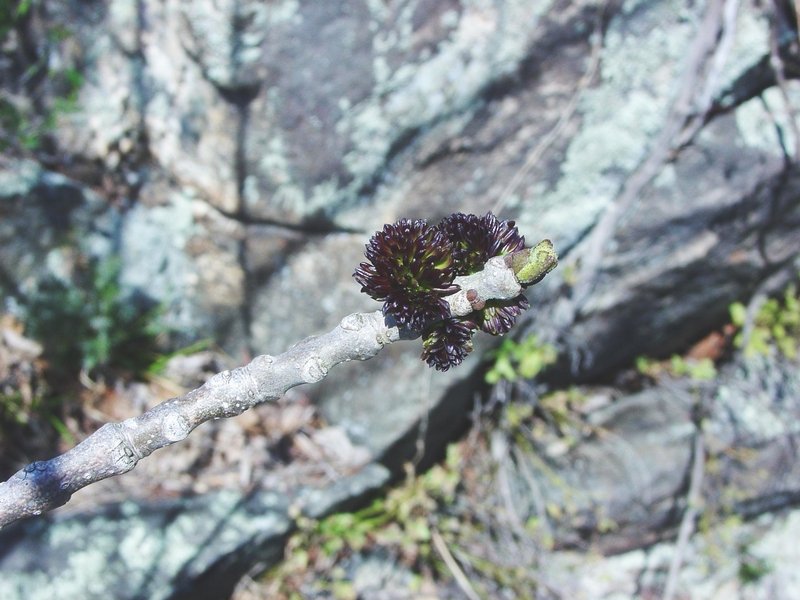


Despite all this uniqueness, as a group, I for one find it very difficult to tell one species of ash apart from another, to distinguish my F. americana from my F. pennsylvanica and my F. nigra. The various guidebooks I have read list a whole host of minor features that can be used for that purpose, but I, for one, find them bewildering and confusing. So, I will, for now, focus on the one feature that will infallibly allow you, my Readers, to distinguish the White Ash from all other ashes. Should ye see an ash, and should ye suspect it of being a White Ash, ye should go up to it and take a close look at its twigs, looking for some place where a leaf has fallen off the tree. The leaves that have fallen will leave a "leaf scar", and it is this feature that allows one to easily and infallibly ID F. americana. For, in this species the leaf scar has a pronounced U-shape, deep and curved. Other ashes have a leaf scar that looks more like a capital "D" or a crescent moon, but in F. americana it is a deeply lobed U. And, should ye be unable to see any leaf scars, or should ye think that the scars ye see are at all difficult to read, then pluck thineself a full compound leaf from off its twiggy root, and look closely at its base. This base will invariably share that same pronounced deep U shape, providing the definite clew as to the tree's identity.
Speaking of which, Fraxinus americana has, as part of its innate identity, a membership in the Oleaceae, the olive family. Aye, I ken well how surprising this is! I, too, was surprised to learn that the straight and stately ash tree, with its wingéd samaras, is in the same family as the writhing and stunted (though still undeniably gorgeous) olive tree, with its luscious, oily fruits. But then again, this family also contains the beautiful lilacs and jasmine flowers, so it does seem to be a rather odd compendium of plants. I'm sure that there must be quite a few long, awkward silences at family gatherings. Still, the family is of almost entirely Northern and temperate provenance, so one supposes they could at least talk about the weather and the news.


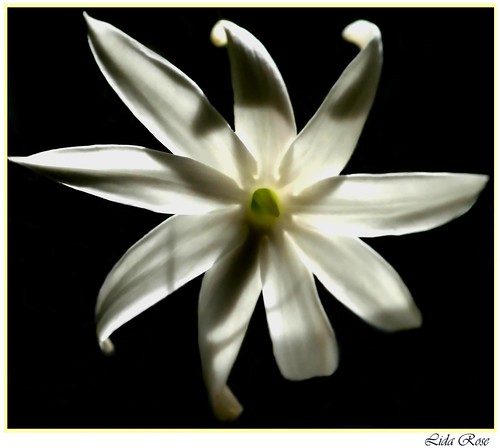
The Oleaceae is, in turn, a member of the order Lamiales, which also includes the Bignoniaceae, the family of the Catalpa(!), and the Lamiaceae, which (recent genetic studies suggest) includes such an odd combination of plants as the Teak tree and oregano. This whole order has been shuffled and re-shuffled of late in the most confusing way, as genetic evidence shows that what had once been thought to be perfectly good groupings are really horrible polyphyletic messes. Still, it's good to keep these taxonomists on their toes; it builds character. The Lamiales itself is then a member of the giant asterid clade, one of the three great subdivisions of the flowering plants - the other two being the rosids, which includes everything from oaks to plums to mangoes to maples to, well, roses, and the monocots, which consists of your palms, grasses, bamboos, pineapples, lillys, asparagi, and yuccas, among others. The asterid clade includes, besides the already mentioned members, daisies, dogwoods, carrots, coffee, and tea - and remember, folks, coffee is a fruit juice.
So that's all for this week, ladies and germs. I'm leaving you for now, but have a good time, think of the glories of the White Ash, and, in keeping with the spirit of this week's Tree, go out there and...play ball!
Playing ball since 1986,
--mark
Subscribe to:
Posts (Atom)