Well, folks, it's October, which means that it's really, really, really fall now. 'Tis the season of apple cider, pumpkin pies, and watching Jamie Lee Curtis narrowly avoid being stabbed to death. It's also, of course, in the deciduous hardwood forests of Eastern America, the time when the trees begin that slow burning slumber, igniting the crisp air with their flamboyantly dying leaves. However, although this week's tree most certainly can display some gorgeous fall color, it is not for that reason that I am writing about it. Indeed, this tree shan't really get into the spirit of the season for a good little while yet, and I am writing about it for the purely selfish reason that I, mark, want to be able to properly identify and know more about trees of this kind. But enough of this over-long explanation. Let's cut to the chase...
No matter what perspective one looks at it from, wood is a wonderful thing. Material engineers and chemists pour phenomenal amounts of research and brain-work into the development of new and fascinating substances with particular combinations of traits and properties for various sophisticated uses, but, as science writer Colin Tudge puts it: "If all the greatest aesthetes and engineers that ever lived were assembled in some heavenly workshop and commissioned to devise a material with the strength, versatility, and beauty of wood I believe they would fall far short. Wood is one of the wonders of the universe." I concur wholeheartedly with Mr. Tudge. Consider: Can you think of any other single material that can be put to as many divers uses as cathedral-building, fishing rods, chess pieces, whittled objets d'art, furniture, tool handles, barrels, etc., etc., and is a renewable, environmentally-friendly source of fuel? I tell you no, there is no other such material in this world. Even from the strictest of utilitarian perspectives, wood is amazing.
I mention this here because this week's tree, Fraxinus americana, the White Ash, produces some marvelous lumber. Its wood is, in fact, one of the great staples of American childhood, for it is from the wood of this tree, and almost exclusively the wood of this tree, that wooden baseball bats - real baseball bats - are made. Indeed, it is the preferred material for the vast majority of wooden sporting goods (including the floors of bowling alleys!), and also for all manner of more utilitarian tools, from lightweight airplane parts to the handles of garden implements. It combines the properties of durability, strength, shock-absorption, and a healthy modicum of elasticity with a weight that is significantly less than most comparably strong materials.
The White Ash also serves humanity well as a shade tree in urban and sub-urban streets. After Dutch Elm disease laid low many of the old elms that had once graced our nation's thoroughfares, a search was made for other trees that matched them in stateliness and would grow quickly enough to replace the fallen elms in a reasonable time. F. americana heard this call, and answered it. White Ashes, with their erect trunks tapering slowly up to a wide-spreading crown, are certainly stately and graceful trees, and, unlike last week's tree, they answer well to people's notions of how trees "ought" to look. F. americana is reasonably tolerant of poor soil conditions, too, being resistant to acidic and densely packed soils. Still, it is a far from optimal urban tree, for it is very sensitive to air pollution, being the sort of majestic woodland tree that requires its atmosphere clean.
I said above that the White Ash is a fast-growing tree, and this is true. When young, it can shoot up at a solid two feet a year, and will continue this rate well into maturity. But it hates the darkness, and requires sunlight to shoot up so quickly. Aye, of course it requires light - would ye not expect such a handsome tree as this to rejoice in the bright, clear rays of the sun? And so by virtue of this property, F. americana is a classic example of what is called, in ecology, a "successor" species. For when a section of forest has been cleared, whether by fire, by tornado, or by the hands of Man, this tree is one of the first to re-establish itself, sending up quickly growing seedlings into the undiluted sunlight. But, as the other, lazier trees grow up around it, it soon finds its own children unable to compete, for the forest floor is then covered in the densest shade. Still, though it is most common in young forests, F. americana can find a niche even in a crowded copse, for the young seedlings are more shade tolerant than their more mature peers, and if one can merely find enough light to at all maintain itself, it will throw down into the living dirt a prodigious root system, while above ground it grows at less than a snail's pace. So it bides its time, until some single nearby tree, or even some single overhead branch, falls - a common enough occurrence in any forest - and lets the sun's rays fall onto this tiny ash tree. Then, propelled by its expansive underground self, the tree shoots up into the air even quicker than is usual for a member of its species, and takes its place high up in the canopy.
And F. americana is indeed a true canopy tree, easily the largest of our native ashes. An adult tree, seventy years of age, will almost certainly reach a solid ninety feet in height and two feet in breadth. I have seen claims that, in days of yore, before the axe and the chainsaw felled so many of our continent's mightiest trees, the White Ash could reach heights of 175 feet, but I discount such incredible claims. After all, the current "National Champion" White Ash is 95 feet in height and 7 feet in breadth, and it is estimated at being over 350 years old - truly ancient for one of its species. I therefore conclude that if, in three and a half centuries, an ash cannot break the hundred-foot mark, then even the tallest trees of eld would doubtlessly have remained far shorter than 175 feet in height.
The tree has a wide distribution across the Eastern states - which means that I'm afraid that out in Portland, Sam, the only examples of F. americana you'll see will be recently-planted street trees. Nowhere in America is it a dominant tree of whatever environment it's found in, but it is rather ubiquitous and everywhere forms an important member of the local ecology, whose fruits are eagerly eaten by a variety of birds and rodents. Though F. americana can survive in a wide variety of conditions, it strongly prefers over all other sites one with a deep, rich, loamy soil ('loamy' meaning that the soil has a good mixture of sand, clay, and organic matter, and is well-drained, staying moist but never accumulating any standing water) where its grand root system can be put to its best use, and is principally a tree of upland groves, though, again, it is not too picky in its habits, and will grow anywhere with enough light and where there's no standing water.
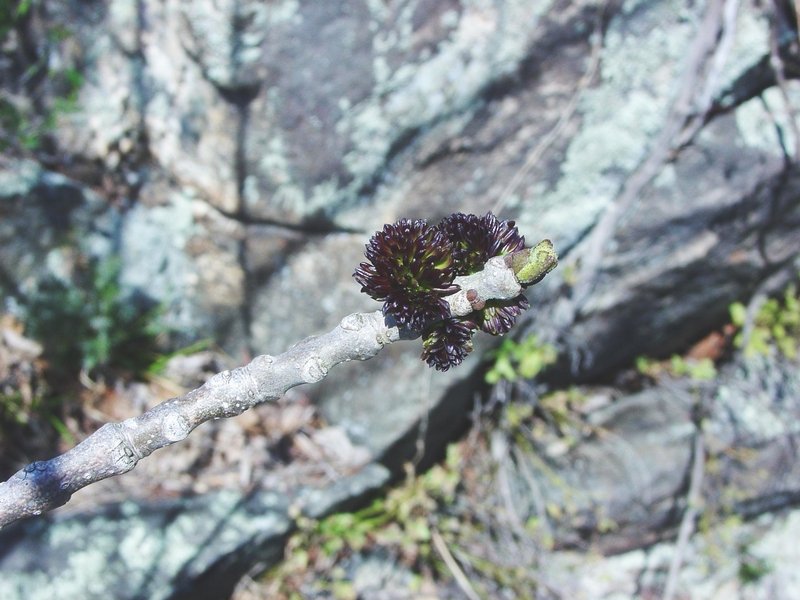
Ashes are, as a group, easy to identify, with their long, pinnately compound leaves, each broken into some seven-odd broad leaflets, their unique-looking, knobby twigs, and their fruit, which is a wingéd samara, similar to that of the Maples, though the ash's fruit comes in singletons rather than in the pairs of maple trees. Ashes are, like Populus deltoides mentioned a few weeks ago, dioecious, which means that each tree has flowers of only a single sex, so that it is proper to speak of 'He-ashes' and 'She-ashes'. These flowers appear (for F. americana, at least) in April or May, at about the same time as the tree's leaves are unfolding from their buds, but a He-ash's small, bushy-looking flowers, which obviously do not turn into fruits, can persist for months and months, and even now, in October, I occasionally se one with dead, browning flower clusters dangling off its twigs. The bark of the tree is ridged and furrowed in interweaving braids, and I have long thought that it looks as if the wood were running down the trunk in long rivulets, like a gentle stream slowly cascading down a rocky slope.
Despite all this uniqueness, as a group, I for one find it very difficult to tell one species of ash apart from another, to distinguish my F. americana from my F. pennsylvanica and my F. nigra. The various guidebooks I have read list a whole host of minor features that can be used for that purpose, but I, for one, find them bewildering and confusing. So, I will, for now, focus on the one feature that will infallibly allow you, my Readers, to distinguish the White Ash from all other ashes. Should ye see an ash, and should ye suspect it of being a White Ash, ye should go up to it and take a close look at its twigs, looking for some place where a leaf has fallen off the tree. The leaves that have fallen will leave a "leaf scar", and it is this feature that allows one to easily and infallibly ID F. americana. For, in this species the leaf scar has a pronounced U-shape, deep and curved. Other ashes have a leaf scar that looks more like a capital "D" or a crescent moon, but in F. americana it is a deeply lobed U. And, should ye be unable to see any leaf scars, or should ye think that the scars ye see are at all difficult to read, then pluck thineself a full compound leaf from off its twiggy root, and look closely at its base. This base will invariably share that same pronounced deep U shape, providing the definite clew as to the tree's identity.
Speaking of which, Fraxinus americana has, as part of its innate identity, a membership in the Oleaceae, the olive family. Aye, I ken well how surprising this is! I, too, was surprised to learn that the straight and stately ash tree, with its wingéd samaras, is in the same family as the writhing and stunted (though still undeniably gorgeous) olive tree, with its luscious, oily fruits. But then again, this family also contains the beautiful lilacs and jasmine flowers, so it does seem to be a rather odd compendium of plants. I'm sure that there must be quite a few long, awkward silences at family gatherings. Still, the family is of almost entirely Northern and temperate provenance, so one supposes they could at least talk about the weather and the news.
The Oleaceae is, in turn, a member of the order Lamiales, which also includes the Bignoniaceae, the family of the Catalpa(!), and the Lamiaceae, which (recent genetic studies suggest) includes such an odd combination of plants as the Teak tree and oregano. This whole order has been shuffled and re-shuffled of late in the most confusing way, as genetic evidence shows that what had once been thought to be perfectly good groupings are really horrible polyphyletic messes. Still, it's good to keep these taxonomists on their toes; it builds character. The Lamiales itself is then a member of the giant asterid clade, one of the three great subdivisions of the flowering plants - the other two being the rosids, which includes everything from oaks to plums to mangoes to maples to, well, roses, and the monocots, which consists of your palms, grasses, bamboos, pineapples, lillys, asparagi, and yuccas, among others. The asterid clade includes, besides the already mentioned members, daisies, dogwoods, carrots, coffee, and tea - and remember, folks, coffee is a fruit juice.
So that's all for this week, ladies and germs. I'm leaving you for now, but have a good time, think of the glories of the White Ash, and, in keeping with the spirit of this week's Tree, go out there and...play ball!
Playing ball since 1986,
--mark




Subscribe to:
Post Comments (Atom)
No comments:
Post a Comment