This week, I am throwing my mind back to the months I have spent out west in the Rocky Mountain National Park, for the tree we have under our investigation is one which flourishes in those climes, growing there in extensive, nearly monospecific stands that seem to the careful observer to have been planted by the hands of Men. These groves consist of trees that are nearly all the same age, the same height, the same diameter, and doubtlessly are the same kind of creature. But it was not by humans that these groves were planted; no, each of these trees has grown straight from the wild seed, deposited directly thither from the cones of its forebears.
The seeming regularity of these straight, pencil-thin pines is caused because Pinus contorta subsp. latifolia, better (and more easily!) known as the Lodgepole Pine, is one of the world's greatest examples of a fire succession species. Whilst showy flowering trees, with their flashy, fleshy pomes, nuts, and berries spew out these children of theirs into the world with all the rapidity and regularity of a rural third-world family, the Lodgepole bides its sweet time. Its fertilized cones may lie in waiting on the pine's branches for many years, unopened so as to protect the ripened seed within during the years that the tree stands, patient as a martyr, in expectation of the inevitable Time of Flames.
For the eastern slopes of the American Rockies have an arid climate, and wildfires, whether started by one of the lightning bolts that play around the lofty peaks, by Amerind or Federal forest managers, by a thoughtless litterbug's stray cigarette, or by some chance combination of blazing sun and parched earth, are an unavoidable fact of life. And the Lodgepole Pine has been trained under Evolution's strict regimen to do everything in its power to encourage these leaping flames. Its lower branches, slowly killed off by the shade deposited by their younger and more elevated siblings, do not neatly fall off to unburden the main trunk of their wait, but rather are left dangling, to dry and season into good firewood. And, as any youth who has played with a bonfire knows, there are few things that burn with more heat than a pinecone, so the abundant crop of retained cones dangling from the Lodgepole's branches are sure to encourage any chance flare up on to greater intensities. Finally, P. contorta subsp. latifolia has but a thin layer of bark, which means that the heartwood of the trunk is rather unprotected from the heat of the fire, and will itself burst into flames readily. All these characters combine to mean that a fire in a stand of Lodgepoles will have all the characteristics of one of the hotter pits of Hell, or, even worse, of Dresden during the Allied bombing, and will sometimes burn "unappeased till every Lodgepole within reach of its wind-whipped breath is consumed to the roots." [Peattie, A Natural History of Western Trees, 1950]
But this utter destruction is, for the closeted seeds, waiting within their tightly-sealed cones - each of which is one to two inches in length and tipped with stiff prickles (heh, he said "stiff prickle") - the consummation of all their hopes and dreams. For after the Time of Flames comes the Time of Growth. Many of the cones produced by the Pine are not completely consumed in the blaze, you see. Their outer layers contribute to the general holocaust, but their inner layers are protected by copious amounts of sticky resin. So, after all the outer layers have been fried to a crisp, and the resin has all been melted away, the seeds within are free, free to grow in the unadulterated sunshine that is present in the newly-cleared forest. The ashy and bright conditions of a newly-burned landscape present many unique challenges and opportunities for a seedling tree, but seeing as there are other trees besides the Lodgepole that are adapted to such conditions, I will save a discussion of these facts for a later entry, so as to give me something to say and prevent me from repeating myself. The point is, though, that the landscape that results from one of these fires is a homogenous forest of densely-packed Lodgepole Pines of almost identical age.
But not all of a Lodgepole's seeds remain in their secluded convents for so long. In the technical terminology, those cones that do persist on the tree for years and years are called serotinous cones, serotinous referring to any persistant or late-developing botanical feature. Many of the cones on the tree do, however, spew out seeds the year of their formation, just like any normal, non fire dependent species of tree. It might be said that these cones are simply created by the Pine in order that its species retains some measure of independence from the necessity of the Time of Flames. But even these cones cause the production of vast quantities of seeds. In a lodgepole pine forest in Montana, it was shown that the annual rate of seedfall - that is, of seeds actually released into the environment each year, and not kept aside in serotinous cones - ranged from 40,000 seeds per acre and 90,000 seeds per acre (my source can be found on this page, if you're interested). Even given the undoubted fact that tree seeds and seedlings are among the most vulnerable creatures in the world, and suffer casualty rates beyond belief (A study which I am familiar with, tho' do not have in front of me and so cannot quote, showed that of some 7,000 palm tree seeds planted in a given nice, roomy tropical habitat, such as the tree species itself favored, only 3 or 4 actually made it to maturity. As I say, seed and seedling casualty rates are astonishing.), this is still a shocking display of arborial fertility and virility. Is it any wonder that the Lodgepole pine and its two sister subspecies, Pinus contorta subsp. contorta and Pinus contorta subsp. murrayana, grow in such vast stretches of the North American West? These fertile trees are the dominant arborial species in some roughly 15 million acres of forest in the United States, and in some 50 million acres of Canadian forests (my source is the same as above - namely, the USDA Forest Service). For comparison, the state of Illinois (my home state) covers roughly 35.5 million acres, meaning that, between the two nations, there are, even in these days of global climate change, overcomsuption, and general danger to our wild lands, there are nearly two full Illinoises worth of Pinus contorta dominated forests. And these, mind you, are only the forests where P. contorta is dominant; it says nothing of the even vaster lands where P. contorta shares its territory with other trees. And of those four subspecies, subsp. latifolia, the one under consideration today, covers by far the greatest area.
Whether birthed, phoenix-like, from the ashes of its parents, or the more humble result of an ordinary pineseed successfully sprouting in the dry earth, the Lodgepole Pine is a very slow growing tree. Yes, finally, you say! I have given a great deal of attention to many trees which are unusually fast growing, either for trees in general (such as Populus deltoides or Gleditsia triacanthos) or else are unusually fast growing representatives of their genus or family (such as Quercus macrocarpa), but now I am finally giving attention to a tree who changes little from year to year, and grows at the slowest of paces. Unlike the Cottonwood, who shoots up out of the earth at the rate of four feet a year, adding mass to itself much faster than any animal ever could, it takes the Lodgepole pine 20 years to reach a height of 6 feet and a diameter of 3 inches, and will take a full century and a half to reach its ultimate maximum size, a height of seventy-five feet and a width of only a single foot - and that under absolutely optimal conditions! Under more crowded, less kindly conditions, the tree will grow at half that speed, or less. And it is easy to find situations which do not appeal to Lodgepole seedlings. They do not do well under shade, and competition for resources with any other plant - whether seedlings of their own species, mature trees, seedlings of other species, or grasses and other understory plants - will retard their development further, if not outright kill them. Sheep and mountain goats are also particularly fond of Lodgepole seedlings, and will eat them right up. Hm...they like light, they don't like competition...really, the post-apocalyptic world that represents the conditions in a forest immediately after a fire is the perfect environment for a young Lodgepole, which goes a long way to explaining why the expend so much effort to encourage such fires, and to produce seeds that will be ready for them. Despite their vast fertility in the intervening years, which is more than enough to maintain the species, the vast success and spread of the creature is due to its symanbiosis (that's "symbiosis", only with a non-living thing, hence "sym-an-biosis". I just made it up! Do ye like it?), I repeat, due to its symanbiosis with fire.
P. contorta subsp. latifolia might be a slow grower in general, a devilishly slow grower, it still has another trick up its sleeve, besides its faith in and preparation for the inevitable Time of Flames. This is because the Lodgpola Pine reaches sexual maturity much, much earlier than do most trees. At the ripe young age of five or six, when an oak is still just a bare baby, and when a human child is still learning to differentiate between the letters of the alphabet, the Lodgepole is beginning to send out pollen into the wind, and accept pollen from its neighboring Lodgepoles. At that age, the Lodgepole is already sexually mature, and already able to have babies of its own. So while few may survive each generation, and the growth rate is horribly slow, the generation time for a Lodgepole pine is shockingly fast for such a large creature, and you may have, in a mature stand of Lodgepole pines, a tree standing right next to its great-great-great-great-great-grand-sire, and yet may be only some ten feet shorter than that ancient matriach of the forest.
And a true Lodgepole forest really is a curious thing to behold. It is so strictly and so thoroughly dominated by this single species, that it can be in this respect compared to the great Redwood and Sequoia groves of California. But there, obviously, the comparison ends. For, unlike those Titans who have endured since times of the greatest antiquity, the Lodgepole pine is really a rather small tree. While I mentioned 75 or 80 feet as the plant's maximum height, most of the individuals that I have seen in my hikes through the southern Rockies, in the Land of the Red River were closer to fifty feet tall. A fine height for a tree, that, but one sort of immediately feels that a tree which is said to "dominate" a forest - and such vast forests, at that! - ought to be a truly grandiose specimen. This is not the case with the Lodgepole. Indeed, not only are they a shorter kind of tree, especially when compared to all the other great Western conifers of our continent, but the Lodgepole is also a very thin tree. Early, I spoke of a 150 year old tree with a height of 75 feet, and a breadth of only a single foot. Such small ratios between height and diameter are typical. A tree 50 feet in height may often have a breadth of a mere four inches! This is indisputably part of the charm of the lodgepole forest, though. The slim, slim trees sway with even slight breezes, and looking up at them from the ground you can see their rocking motions, motions which remind you that truly, these trees are alive. They are not some inanimate object upon which Humanity can exert its will remorselessly. No, they are living, breathing, adapting creatures, full of change and the quickness of vitality. For there they stand, their tons of organic carbon rocking back and forth in the wind, anxious, nervous to see if the well-laid plans and calculations made by their genes as to what proportions of size, what qualities of wood and bark, what arrangement of trunk and branches and leaves, what qualities and arrangements of roots, can properly allow this thin tree to stand up to the sometimes furious storms that stream across the great peaks of the Rockies.
Sometimes, those calculations prove too risky, too venturesome, and the tree gives way to the wind. Given the density of the Lodgepole groves, the tree will most likely land against one of its fellows, giving a mature Lodgepole grove something of the effect of a matchstick model, bound to come crashing down at a moment's notice. Or, better yet, the forest seems somehow stitched together, as if all of the various trees somehow supported each other together, working to create some vast, but accidental, superstructure. Of course this is pure fancy; though the ecoregion (and even more so the ecosphere) that these pines participate in is doubtlessly a superstructure, or a megastructure, or even, in the full, a gigastructure - whichever superlative you prefer/find more accurate - the arrangement of the dead Lodgepoles propped up by their living brethren is one of the least important parts of this system. Although it does have one effect: namely, that of increasing the shade thrown on the forest floor, thereby decreasing the competition the Lodgepoles may have to, in the future, face.
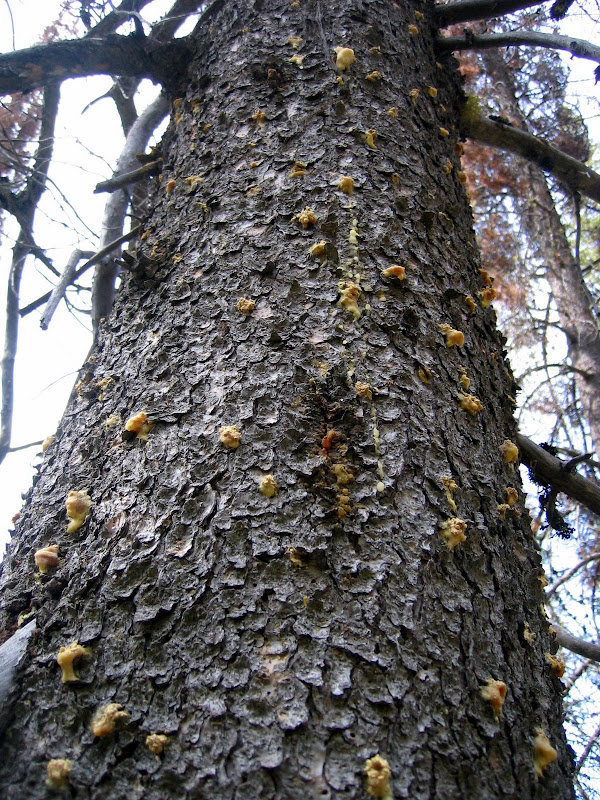
Now, how to identify a Lodgepole? Obviously, a forest of lodgepoles is utterly characteristic, as the serried ranks of pencil-thin trees announces that they can be no tree other than a lodgepole. But when a lodgepole is growing in a mixed forest, along with Ponderosa and Pinyon pines in the south, and Jack pines in the north, as well as with spruces and firs and other conifers throughout its range, identification can be more tricky. So, here we go. Now, your first hint is going to be the tree's proportions; as has doubtlessly been beaten into your brain by this point, the Lodgepole pine is a thin and straight tree. Its needles are reasonably light in color, yellow-green or bright green, and are long, 1.5 to 3 inches in length. They come in bundles of two, bounded together by a small, papery, blue-gray fascicle. This arrangement of needles into bunches is (as far as I know!) universal among the true Pines, the Pinus genus, and one can tell a good deal about a Pine's genealogy based on the number of needles it has per fascicle. But more on that in a later entry. Its male cones (pollen cones) are bright yellow or orange and sit at the very tips of its branches, and its immature female cones, with their bruised reddish-purple color, stay in the upper crown, difficult for earthbound humans to peer at. Once matured, though, these cones are, as I've said before, 1 to 2 inches in length and equipped with hard prickles (heh! he said it again!) at the end of each scale. They can be somewhat assymetric and "lumpy" at their base. Finally, the bark of the tree is very thin (as mentioned earlier, in the discussion of why the tree is so vulnerable to fire) and is a light grey in shade, and features many small, close scales. Sometimes, though rarely, the bark is much darker, and othertimes it is scarred from the attacks of the dreaded Pine Bark Beetle, one of the tree's deadliest foes.
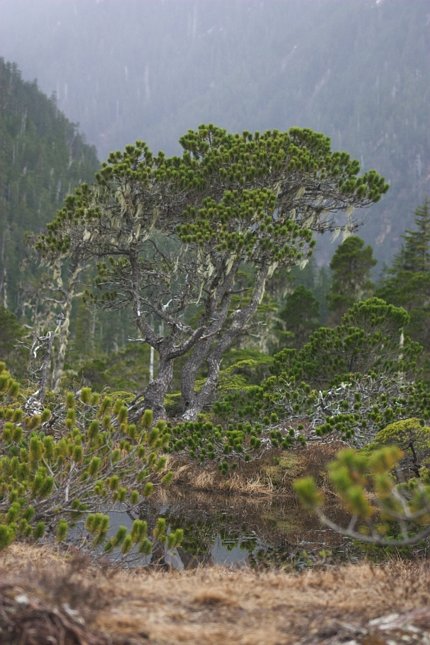
Of course, while most of this description will hold true for all Lodgepoles, there are certain exceptions I must make to the first part of it, describing its form. See, in a true forest, yes, the Lodgepole will grow eminently straight and tall. But up above the timber line, up near the very top of those mighty peaks that the Earth has thrusted up towards the sky through the exertion of forces, of purely mechanical forces, containing energies greater than those of the much-vaunted Hydrogen Bomb, even the Lodgepole pine fails to grow straight. Instead, it takes stunted, blasted and often even completely fantastical forms, clinging madly to the rock with muscular roots, and curving this way and that with all the drama and elegance of a bansai tree. But, remember, in the details, it is identical to your less dramatic, straight-as-an-arrow lodgepole.
I am wrapping up soon, I swear, but first I must say a word about the tree's taxonomy. As a pine species, it is obviously in the Pinaceae, which I have eulogized so bravely in a previous entry. Of more pressing interest is its several sister subspecies. And these are true subspecies, a clear case of it. There are clear genetic, physiological, and (most importantly) geographical distinctions between the various races of P. contorta, making them more than mere varieties, but they still intermingle freely with one another, and along the edges of their respective ranges one finds a variety of intermediate forms who are simply P. contorta, no real definable subspecies. Now, most accounts I have seen list three subspecies of P. contorta: P. contorta subsp. contorta, the Coast pine of the Pacific Northwest, a stunted, scrubby, but gorgeous tree; P. contorta subsp. latifolia, the Lodgepole pine of the interior of the continent, about which you now are experts on, doubtlessly; and P. contorta subsp. murrayana, the Sierra Lodgepole Pine, a tree of the Sierra Nevada ranges of California, which is a taller and thicker tree than the Lodgepole, but which shares a propensity for somewhat bizarre growth habits with subsp. contorta. Some experts further subdivide the genus by cutting off from subsp. contorta another subspecies, subsp. bolanderi, which grows further south than most of the other members of subsp. murrayana, down on the coast of Mendocino County in California. I have no idea whether to accept or deny this claim; the USDA does, though, so if you're susceptible to the ol' "Argument from Authority", well, there's a damn good authority for ya. Anyway, here's a nice map from Wikipedia showing the distributions of the three universally accepted subspecies. It should be noted that, as genetically distinct populations living with some geographical seperation from each other, these various different seperate types of P. contorta make an excellent example of how species are formed; if we wait another 10,000 years or so (and leave things reasonably close to how they are, which I doubt is possible; even in my most ecologically obsessed moments, I have no doubt that even the most ecologically obsessed of human societies will cause vast, vast, vast, VAST [but very very interesting, and potentially very very cool, it should be pointed out! not all change is bad!] changes in the Earth's ecosystem over the course of ten more bloomin' millenia) we will perhaps see this various subspecies achieve full (or at least partial) reproductive isolation from each other, and become true species.
So go put that in your pipe and smoke it, ye goddamn Young Earth Creationists!
Putting that in his pipe and smoking it since 1986,
--mark






No comments:
Post a Comment