Late again, is Mark. He attributes this to the two following unfortunate facts: first, that he's been having a rough couple of weeks; and secondly, that the people whose interne Jane & I have been "borrowing" at our apartment has been either on the fritz, or has been told not to let us "borrow" it anymore. But, anyway, we're in double digits now! Cool, n'est-ce-pas?
Our tree this week is not a plant one oftentimes thinks of as a "tree". Although it is common enough in Urban landscapes, and is indeed a great favorite of the horticultural profession, when we city-slickers see it, it is as likely as not in the form of a mere shrub, forming an elegant hedge wall or framing the walk of some stately home or office-bearing massif.
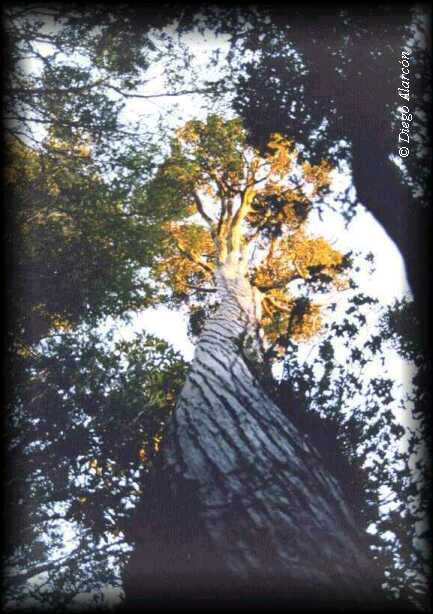
But it in the wilderness, Thuja occidentalis (Thuja is pronounced "Thew-ya", NOT "Thew-ja"), the Eastern Arborvitae, can reach sizes that are more than respectable. The tallest currently known specimen, growing on South Manitou Island in the middle of Lake Michigan, is some 115 feet in height and nearly six feet in diameter. I should add here, for the sake of my own rememberance if nothing else, that next summer, when I take my epic month-long bikeride 'round that great Lake, I am going to have to take the ferry over to South Manitou Island for a "day-trip" to visit the ancient Arborvitae grove where that tree lies.
And when I say "ancient", I do mean it. The oldest living Arborvitae has seen some thousand cyclings of the earth 'round the sun, and stumps of dead arborvitaes have been found that dendochronoligists have calculated as being a millenium and a half in age at their death. I would like to regale you with stories of all the seemingly long lives of Men that can pass in that time, all the epic deeds and great sea-changes of fortune and destiny that humans can witness in such vast stretch of History; but instead of such an anthropocentric fancy, let us instead take a more dendrocentric approach. Consider, not what human deeds can pass in 1500 years, but rather the epic struggles that that tree has had to endure. Imagine the thousands of lightning storms its endured, with those bolts of Zeus far hotter than the surface of the Sun arcing down from the sky towards this tree. Imagine those fifteen hundred winters it saw, enduring cold, bitter cold, without the aid of either shelter or fire, and with neither warm blood in its veins to keep its innrt flame going, nor the blissful hibernation of toads and deciduous trees which bringeth nepenthe and rest. Imagine the numberless droughts it endured, lasting far longer without any water to soothe its thirst than any fragile human could hope to! Imagine its timeless battles with its pestilent predators, the millions of birds, insects, and tearing, biting deer who have feasted on its green succulence for those ages of its life, but all of whom it has out-lived, and laughed at, though it is but an immobile plant and cannot evade their hunger. And imagine its constant exertion, its constant upward and downward growth, building a spire in defiance of all gravity and wind, and cracking the solid, immemorial rocks themselves with its roots as they twine deeper and deeper in their quest food. What could have killed such a thing? Was it humans, whose axes and saws fell it and then mutilated its corpse to serve as the roofing for their dwellings? Was it some lightning bolt which the tree could not evade or survive? Or was it simply old age, simply the slow decay of vitality and life which could now no longer be avoided?
I have no idea, I'm afraid, and, what's more, I fear I am getting quite ahead of myself. I've allowed myself to tell a tale of high drama and storybook legend without first giving any hint of the main character's personality! And though I flatter myself that my friends are intelligent people, capable of deducing much from minimal information, still it would take someone with powers greater than those of Mr. Holmes or M. Dupin to extract much information about Thuja occidentalis from the above rhapsodies.
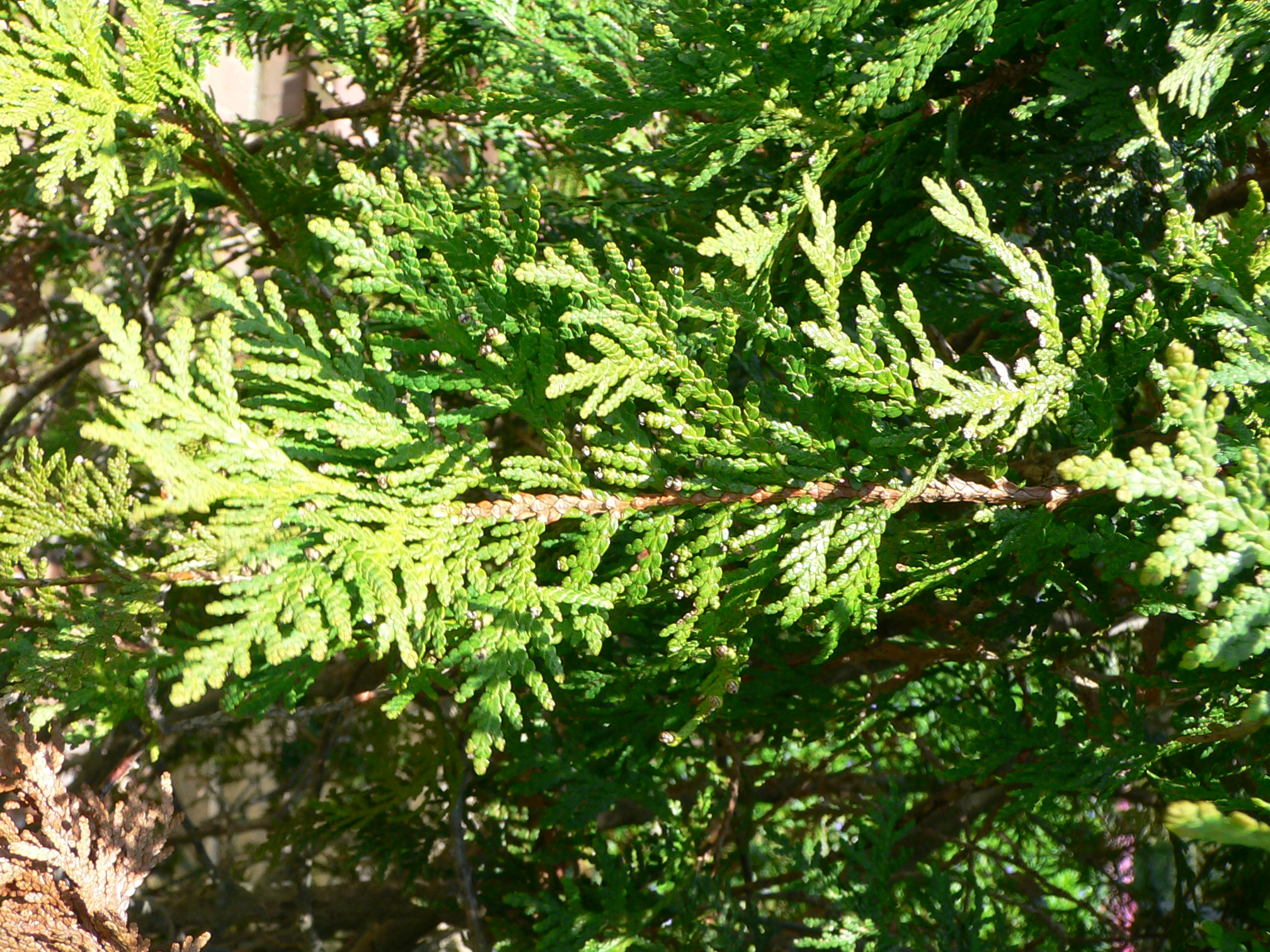
Worldwide, there are five species within the genus Thuja. There is, of course, T. occidentalis, the species under question, which is native to the Northeastern region of our continent. There is another species, T. plicata, native to the West coast. The other three species are found in the far Orient, in China, Korea, and Japan. As a group, these trees are remarkably easy to distinguish from all other trees. Principally, this is because of their branches, which look as if they've been pressed flat by an iron. These branches are enveloped by the small, scale-like leaves that stick out of them. Arborvitae scales are soft, too, quite unlike the jagged needles produced by various junipers. All that being said, distinguishing between one species of Thuja and another can be a real bitch, as can be distinguishing between Thuja species and those of the related genera Platycladus and Thujopsis, also commonly known as "arborvitaes". Now, in general, in urban areas, the arborvitaes you will be seeing are either going to be Thuja occidentalis, or Platycladus orientalis (formerly known as T. orientalis, but now transferred over to the other genus), one of the Chinese species of arborvitaes. You can tell the difference by a close inspection of the leaves. The scales on T. occidentalis are darker and more tightly attached to their branch than those of P. orientalis, whose leaves are a lighter color and have a greater tendency to 'flare' off from their branches. Furthermore, the leaves of true members of the genus Thuja, unlike those of the related Platycladus, will emit a pleasing odor if crushed. Also, if you will look closely at the pictures I linked to above, you will notice that, on the scales of T. occidentalis, you will note that they have on them a tiny "dot". This dot is a gland of some sort (I confess that I know not what its function is) and is unique to T. occidentalis, allowing it to be distinguished from all other arborvitaes.
Being a coniferous plant, the eastern arborvitae reproduces via its cones, slender, elliptical things just a centimeter or two in length. At this time of year, they are brown, ripe, and mature; earlier in the season, before their final ripening, they wore a bright yellow hue. Though the species be long-lived, they are also precocious, and begin producing sexually mature cones at the age of six years or so. But it is not until they enter their adolescence, at their 75th-odd birthday, that they really start to crank out the seeds.
Now, I know that in my lengthy introduction I may have stated that T. occidentalis can be a mighty tree, streaking up over a hundred feet into the air. Technically, this is true. There do exist such mighty specimens of the species. But that tree is an extreme outlier. In general, this arborvitae is a much more humble plant, growing to maybe forty feet in height. It is a slow-growing tree, as well, oftentimes adding significantly less than a foot to its height over the course of an entire year. It is reasonably shade tolerant, and so can often function as an understory tree; but its slow growth and small height makes it rather thoroughly unable to actually compete in the forest canopy. So, instead of trying to compete against foes it knows it can't beat, T. occidentalis opts instead to play a different game. The arborvitae can be found in all sorts of extreme environments where more traditional trees find themselves completely at a loss. On the edges of swamps and bogs, where the soil oxygen content is low, and water regularly washes away both nutrients and the stabilizing soil, the eastern arborvitae will, if not quite thrive, then certainly at the least survive. And many of the very oldest individuals can be found on the sides of cliffs, as simultaneously tiny, stunted, and ancient as Yoda himself. There, they thrust their roots into rocks, cracking the solid mineral apart in their quest for whatever little food they can find in this demanding habitat. Whipped by fierce, biting winds for which they have no protection, they are lucky to hit the two meter mark. But, though stunted, they endure, and without any competition, and isolated from the depradations of their mortal nemesis, the white-tailed deer, Odocoileus virginianus, they have little to fear from Father Time, and can count themselves un-lucky if they do not live to celebrate their 500th birthday. Making it even more difficult to kill, To. occidentalis can grow back from a stump, and can even send out shoots that grow into new trees, allowing it to reproduce asexually; rare feats for a conifer.
Still, despite its ability to survive in such harsh climes, the favored place of growth of the Eastern Arborvitae is in the rich, cool, and moist but well-drained soils at the southern edge of the great Boreal forests of the North. In that habitat, though, it suffers dearly from its inability to compete with the taller, faster-growing firs, spruces, birches, and maples, and also from its vulnerability to the many ravenous stomachs of the white-tailed deer. During the winter, when the broadleaves have lost their foliage, the soft, feathery fronds (which are great for tickling people with, by the way) of T. occidentalis become immensely appealing to these deer, who strip them from the tree with gusto. Given the skyrocketing deer populations that our nation's often misguided wilderness management policies have fostered, in many areas our Eastern Arborvitae is becoming rarer. Not that it is endangered; as a species, it still does flourish and is at no more risk of becoming extinct than Humanity itself. But just as certain populations of humans may come to risk by the local disasters such as floods, droughts, wars, plague, and famine, so are these Arborvitae clans having to face the Plague of Deer, which is for them a disaster most terrible.
Speaking of Humanity, our two species, Homo sapiens and Thuja occidentalis, have a long history of interaction. When the first explorers ventured onto this continent from their native Kamchatka some 12,000 years ago, they discovered that this plant had a bevy of uses. Its leaves had certain medicinal properties that proved efficacious against some ailments, and its bark and wood, though in many respects weak and flimsy, was found to be easy to work with, lightweight, resistant to rot, and very "tough", and so they used it for structural components in their well crafted birchbark canoes. When the next great wave of colonists came to our shores in the 1500 and 1600s, and brought with them that greatest of all human inventions, Literacy, they recorded their encounters with the tree. It was during the voyages of Jacques Cartier that news of the tree first entered into History. For during the winter of 1835-36, M. Cartier and men of his fellow adventurers grew ill with the Scurvy. They were bleeding from their pores; their gums were sloughing off; they were covered in sores; wounds and fractures they had once thought long-healed would re-open. They were miserable. But, being made of that sturdy stuff which anyone, from any age, who decides to become an Adventurer must be made of, if he wants not to die, they kept on. One of their guides, a man named Domagaya, the son of a chief whose people had lived in that area since time immemorial (immemorial to them, perhaps, although doubtlessly the Arborvitae elders would have a different story to tell) had gotten so sick with the scurvy that they had to leave him behind. They couldn't afford to take him with them any further. Continuing on, they were surprised when, in a few days, they encountered their friend Domagaya, looking as hale and hearty as a Grecian athlete! After first ascertaining that he was, indeed, alive, and not some shade from beyond the grave, they asked him how he came to be healed of his scurvy. He told them that he simply made a tea from the leaves of a certain tree, which his people called "annedda", and drank some of it every day, and the officinal virtue contained therein healed his malady. M. Cartier and his comrades, of course, begged Domagaya to show them this wonderous plant, that they too might be relieved of their agonies through its aid. Domagaya then nonchalantly took them to a stand of Thuja occidentalis, and told them that 'twas from this tree that he obtained the leaves. And by following his advice were Jacques Cartier and his band of Frenchmen healed; for the leaves of this arborvitae are rich in Vitamin C, and therefore are indeed capable of curing the scurvy. It was in honor of this life-saving power that the tree was given the name of 'Arborvitae', meaning "Tree of Life", by European horticulturalists. Should any of my readers decide to try to make their own arborvitae tea, in lieu, perhaps, of a glass of OJ in the morning. I would caution you, though it should be obvious, not to brew it from any arborvitae you find growing in a city, for it doubtlessly has, by accident, incorporated into its vital matter some of the toxins that are commonly found in the urban air and earth.
The story of the intermingling of our two species continues, for the Eastern Arborvitae was among the very first trees from the Westlands that European explorers brought back to their home countries for cultivation. It is known for a fact that the gardens of the burgeoning civilizations of that continent were graced by T. occidentalis' prescence as early as the 1560s. The tree is still loved by gardeners, for its unique lacy foliage, its handsome reddish bark and its neat, slender conical form. Its long life and durability help make it popular, too, for if one plant in a gardener's demesne is easy to take care of, then the gardener will have more time to look after his or her more fragile plants. That same slenderness of form and longevity have also made it perfect for the formation of tall hedges, living screens and walls, and other such formal features which many gardeners (for reasons unbeknownst to this one) so enjoy to play with.
Now that you've been formally introduced to T. occidentalis, you can perhaps better appreciate my earlier anecdotes. And, being well-bred individuals all, you probably are now wondering about the lineage from which T. occidentalis has sprung. Allow me to assure you that it comes from a truly noble family; indeed, there are many who would rank its family as the noblest in all the Plant kingdom. That family is the Cupressaceae, the Cypress family. While I said several weeks ago, in my report on Pseudotsuga menziesii, the Douglas-Fir, that the Pinaceae is the coniferous family which has best survived during the past 90 million years of flowering plants, the Cupressaceae must be a close second. And indeed, though the Pinaceae might contain more species, it is purely Northern in its habitat, whereas the Cupressaceae, as befitting such a distinguished lineage, is more cosmopolitan, and can be found growing natively on all continents, save Antarctica. It can count among its members not only the arborvitae, but also such plants as the Junipers, the Cypresses, the Japanese Sugi tree, the massive (and long-living!) Fitzroya of South America, and the strangely beautiful Chamaecyparis.
But, though these are all excellent trees, it is not they who confer on the Cupressaceae their high status. Indeed, it was not until recent times, and the advent of molecular and genetic taxonomy, that it was understood just how exalted a group the Cupressaceae was. For those studies proved that the Taxodiaceae, the Bald-Cypress family, could not be considered as a true monophyletic group, seperate from the Cupressaceae; and that any reasonable evolutionary definition of the Cupressaceae would have to include the Taxodiaceae, as this handy diagram from Wikipedia clearly shows. And the Taxodiaceae, in addition to the magnificent Bald-Cypress, also includes such blue-blooded royals as Sequoia sempervirens, the Coastal Redwood, and Sequoiadendron giganteum, the Giant Sequoia. Now folded in to the new Cupressaceae, they add into an already aristocratic family the blood...er, the sap, anyway...of Emperors.
Containing the sap of emperors since 1986,
--mark






No comments:
Post a Comment