For too long already have I dilly-dallied and procrastinated in posting this entry, but no more! Friends, though you may or may not actually care about the contents of these Tree-of-the-Week entries, you ought to love them for the beneficent effects that they have on me, Mark, your host, and so ought to be glad that I am at last getting down to work and posting one of them. Of course, you ought to be glad for their existence simply for their own sake, as well, for Flora provides to the watchful eye (yum-yum!) and mind delights aplenty, and I would cast a disapproving eye (yum-yum!) on any who would refuse to accept Her gifts.
Here in Chicagoland (and, I strongly suspect, in those other climes that other readers of mine inhabit), fall is fast approaching, and so I must be in something of a phrenzied rush to tell you all of those various deciduous species which shall soon loose their foliage and become horrifyingly difficult to identify, let alone to truly appreciate. So, in that spirit, I have this week chosen a plant whose leaves are among the first to change colors and fall from their boughs. Indeed, as long as a month ago, in the middle of August, when the sun beat down at is fiercest and all thoughts of January's snows seemed as distant as Epsilon Eridani, many individuals of this species were already begunning to turn themselves from green to orange, as I saw with my own eyes while making the rounds through the Northern Illinois collection at the Arboretum. The species is, as you already know from this entry's title, Aesculus glabra, commonly known as the Ohio Buckeye.
Members of the genus Aesculus are easily distinguished from other trees by virtue of a number of eccentricities they possess. They have large palmately compound leaves that (in the case of A. glabra) have 5-7 leaflets attached. Furthermore, they have similarly large capsular nuts, and extremely showy flowers.
Distinguishing between the various seperate species of the genus is more difficult, but A. glabra can be rather readily distinguished by several features:
1. It is a tree. This is as opposed to, say, the bottlebrush buckeye (A. parviflora) which is a shrub, though a rather showy and attractive one.
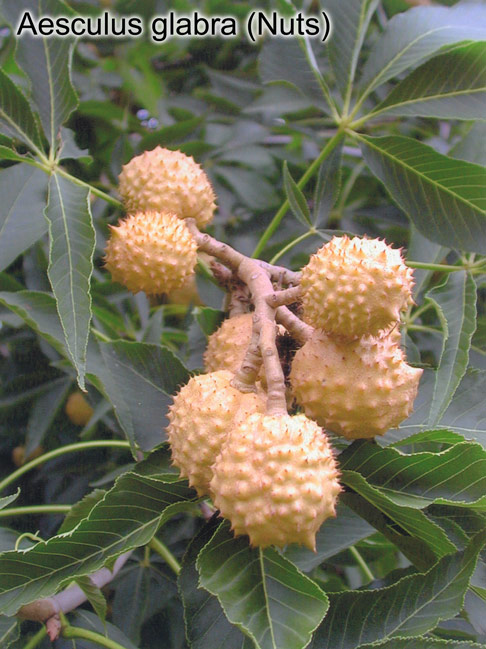
2. Its fruits, as shown in the earlier picture, have a prickly husk surrounding them, unlike certain other members of the genus whose fruits have smoother husks. Though be warned - A. glabra is not the only member of the genus whose fruit has a prickly husk, so that feature is only a clew, and not a clear diagnostic.
3. It typically has many more leaves with five leaflets than it does leaves with seven leaflets, a feature useful in distinguishing between it and the European Horse-Chestnut, A. hippocastanum, which even in these United States of ours so far from its native lands (Greece, in this case) is frequently planted as an ornamental, and whose leaves are far more typically equipped with seven leaflets than with five.
4. Most uniquely distinctive, the leaves of the Ohio Buckeye will, when crushed, release a foetid odor, as will the twigs when scratched. I am afraid that I have never actually tried this experiment myself, but all of the sources that I have consulted in doing my research for this post agree about it, and I plan to check for myself on the next Buckeye I find. I'll post the results later.
It is from this last fact that the tree derives one of its older common names, the Stinking Buckeye. So remember that next time you are in Ohio, and be forewarned by it! For any state which chooses as its mascot so unneighborly a plant is, in all likelihood, not to be trusted.
In fact, its foetid sap is not the only thing unneighborly about the Ohio Buckeye. Like many plants, it is unwilling to share the results of its hard work, the fruits of its labor if you will (ha-ha-ha!), with wandering animal passers-by, and it has gone so far as to protect its nuts with a bitter toxin which is poisonous to most animals, including humans, although there are some species of squirrel that are immune to the venom and so eagerly gobble up the hefty seeds. Whatever toxin it is that its large nuts contain (and I'm afraid that I know not the specific chemical responsible), it acts on the gastrointestinal system and, according to the Canadian government, is actively capable of murdering a human in its self-defense. It is from this poisonousness of all members of the genus that they get their oldest English name, that of "Horse-Chestnut", for their nuts are vaguely reminiscent of chestnuts (tho' in truth the two species be not nearly related), at least in size, and they are as puissant as a horse.
Which provides me with a convenient excuse to launch into a diatribe on taxonomy, for the family of these trees is given the name of the Hippocastanaceae, which is a literal translation of "horse (Hippo-) chestnut (-castanum)" into the Latin. It is a small clan, containing only the genuses Aesculus, Billia, and Handeliodendron, which probably originated (and let me mention that the following is merely an inference of this author's and not necessarily a full initiate of the Dogma of Forestry) in relatively recent geological eras in either North America or China, where there are by far the greatest numbers of species from this family. The rest of the world is graced with but few members of the clan, and in fact to the best of my knowledge the Balkan A. hippocastanum is the only species naturally present outside of those two regions. This family is believed to be a good one, a true clade all of whose members are more closely related to each other than to any other species on the globe.
However...
This small clan has recently been shown to be in truth but an offshoot of an immensely prodigious family, who doubtlessly shall take their poor relatives under the wing! You see, in recent decades the whole science of taxonomy has been revolutionized by the power of genetics, which have revealed that species once thought to be closely related have been shown to be but distant cousins, and species who had previously been only the remotest of acquaintances have proven to be birthed from the same womb. In response to this, a large collection of plant taxonomists have come together to interpret the results of all these new studies and reclassify the flowering plants. Among many other conclusions they reached, was that in order for the vast, sprawling Soapberry family (the Sapindaceae, containing over a thousand species of mostly tropical shrubs) to remain monophyletic (that is, to ensure that all members of it share a unique last common ancestor shared by no other group), it must absorb both the Hippocastanaceae and the mighty Aceraceae, the extraordinarily successful world-straddling family of the Maples. So, it was decreed that it should be so (for the other alternative was to dice up the Sapindaceae into a myriad tiny families, and the botanical world already contains an over-abundance of tiny families whose names are impossible to remember) and lo! it did come to pass that the Hippocastanaceae is no more, and Aesculus glabra is now a member of the even vaster Sapindaceae.
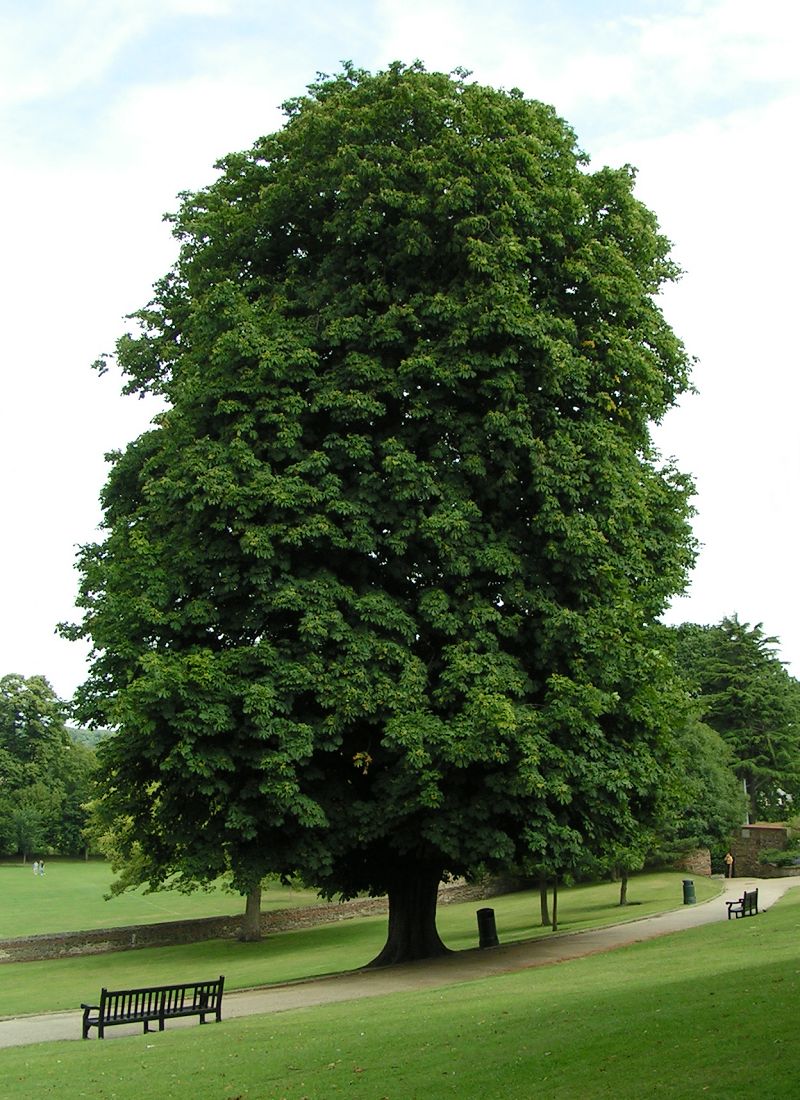
Now, for those of ye who find the science of taxonomy less intrinsically thrillling than do I, we'll return to the subject of the tree itself. It's a handsome tree, which grows reasonably tall (up to seventy feet in height) and can, like its close cousins the maples, produce a prodigious amount of shade. But it does not dish out anything that it can't, in turn, take, for it is itself rather tolerant of shady areas. It is also very tolerant of acidic soils, and indeed prefers soils whose pH is well below neutral, making it a natural companion for pines whose needle-litter is acidic and imparts that quality onto the soil as it rots. It's a reasonably thirsty tree, too, prefering moist soils to dry ones, though it cannot survive much standing water and is seldom seen in boggy sites. In cities, it is most often seen as a park tree, luxuriating in the space and attention lavished on it by urban foresters as it grows tall over the turf beneath. It is seldom planted as a street tree, tho', with the primary reason being the mess and hazard caused by its large nuts on the sidewalk.
I opened this entry by mentioning that A. glabra begins shedding its leaves early in the season, and so let me close it be returning to that theme. Even as soon as early August, the Ohio Buckeye's leaves begin to change color, either to a shining yellow or a brilliant, fire-like orange that lights up the late summer greenery and presages things to come. Soon, all of its leaves are fallen, and the tree is left barren to wait out "December's foggy freeze". But, just as this Stinking Buckeye is the first tree to lose its leaves in the fall, so is it the first to put them out again in the Spring, splitting open its well-prepared buds long before the deciduous trees around it. And soon after that, if the weather remains good, it mimics the showy May flowers at its feet with its own bountiful display of curiously arranged flowers, looking for all the world like a Fourth-of-July fireworks display come several months too early. So keep your eyes peeled for this gift of Flora's right now, before all its leaves are dropped, as it celebrates in the early Autumn air, and then again in the spring be ready to look to the heavens and see the magnificent show which Aesculus glabra has in store. And, if you are the sort of person who (like me!) feels that everything is made more fun when a level of prurient interest is added to it, you may care to remember that those showy displays that the ol' Stinky Buckeye will throw erect into the air are in fact its sex organs, its many thousands of botanical penises and vaginas, and that each buckeye plant is in fact a hermaphrodite, both male and female, and once you have remembered this you will feel like a Stinking Pervert for thus gasping at the beauty of the Stinking Buckeye's flowers, and will then be much pleased with yourself.
Feeling like a Stinking Pervert since 1986,
--mark
edited 9/21/07 at 4:10 PM.




Subscribe to:
Post Comments (Atom)
No comments:
Post a Comment